

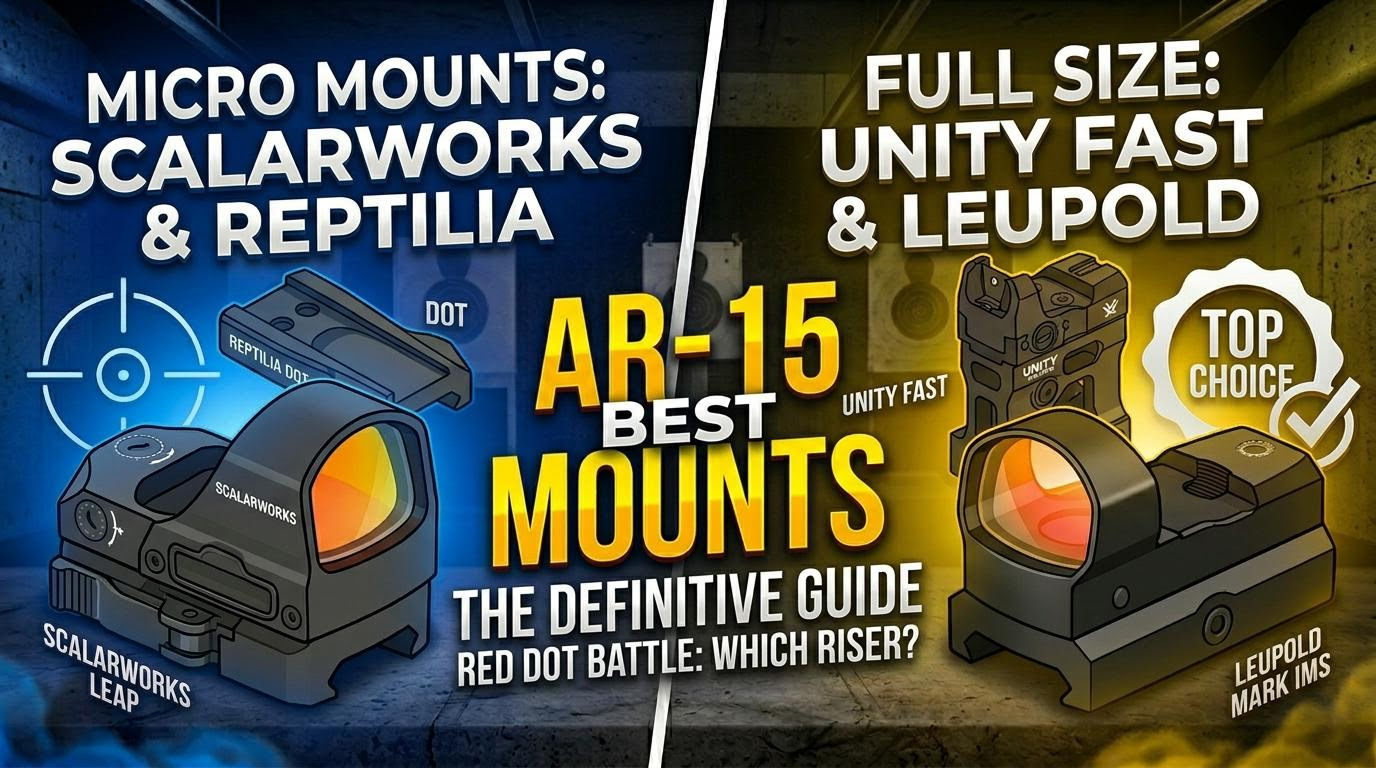
Why Your Red Dot Mount Makes or Breaks Accuracy
Most shooters spend serious money on a quality red dot but treat the mount as an afterthought. That’s a mistake that shows up fast on the range – a loose or poorly designed mount will let your zero wander, create co-witness problems, and in some cases fail completely under recoil. The mount is the mechanical link between your optic and your rifle, and any weakness in that link directly affects your ability to hit what you’re aiming at.
A good mount does three things consistently: it holds zero through sustained fire, it returns to zero after removal, and it positions the optic at the correct height for your shooting style. Whether you’re running a home defense AR, a competition gun, or a hunting carbine, those three requirements don’t change. What changes is how much you need to spend to get there, and that’s exactly what this guide breaks down.
Top 7 Red Dot Mounts Tested on Live AR-15 Builds
We ran these mounts on actual AR-15 builds chambered in 5.56 NATO and .300 Blackout over multiple range sessions. Each mount was torqued to spec, zeroed, then put through round counts ranging from 200 to 800 rounds before re-checking zero. The optics mounted included the Trijicon MRO, Aimpoint Micro T-2, Holosun 510C, and Sig Sauer Romeo5 – all common choices in the North American market.
Here are the seven mounts that made the final cut based on performance, build quality, and value:
- Geissele Automatics Super Precision Mount – 30mm and 34mm versions, absolute co-witness height
- American Defense Manufacturing (ADM) Recon – quick-detach lever, 1.93″ centerline height
- LaRue Tactical LT-751 – lever-lock QD, machined 7075 aluminum
- Scalarworks LEAP/01 – ultra-low profile, titanium hardware, 1.42″ or 1.93″ options
- Aero Precision Ultralight Mount – budget-friendly, solid performer for the price
- Unity Tactical FAST Mount – 2.26″ height for LPVO or large red dots, riser-style
- Primary Arms SLx Mount – entry-level QD option with consistent torque specs
Head-to-Head Performance Data From Real Range Days
Zero Retention After Removal and Remount
The ADM Recon and LaRue LT-751 both returned to zero within one MOA after multiple removal and remount cycles – that’s the standard you want if you’re pulling your optic off for storage or transport. The Geissele Super Precision held zero through 800 rounds without any measurable shift, which is why it’s a favorite in the duty and competition communities. The Primary Arms SLx showed minor zero drift after 400 rounds, roughly 1.5 MOA, which is acceptable at its price point but worth knowing.
The Scalarworks LEAP surprised us with rock-solid zero retention despite its lightweight profile. It uses a proprietary clamping system that distributes force evenly across the rail, and it showed zero measurable shift through our entire test cycle. The Unity Tactical FAST is designed more for height-over-bore correction than for QD cycling, and it performed exactly as advertised – no movement, no drama, just a stable platform at an elevated height that works well with a cheek weld on a standard stock.
Recoil Performance Under Sustained Fire
| Mount | Material | Height | QD | Weight | Price Tier |
|---|---|---|---|---|---|
| Geissele Super Precision | 7075 Aluminum | 1.93″ | No | 2.8 oz | Premium |
| ADM Recon | 7075 Aluminum | 1.93″ | Yes | 2.4 oz | Mid-High |
| LaRue LT-751 | 7075 Aluminum | 1.93″ | Yes | 2.6 oz | Mid-High |
| Scalarworks LEAP/01 | 6061 Aluminum | 1.42″/1.93″ | No | 1.4 oz | Premium |
| Aero Precision Ultralight | 6061 Aluminum | 1.93″ | No | 1.9 oz | Entry |
Build Quality Checks – Fit, Finish, and Zero Retention
Machining Tolerances and Anodizing
Fit and finish tell you a lot about how a mount was made before you ever put it on a rifle. The Geissele Super Precision has some of the tightest machining tolerances we’ve seen – the cap seats perfectly flush, the cross-bolt torques evenly, and the anodizing is consistent across the entire surface. The ADM Recon is similarly well-built, with a lever mechanism that snaps positively into place and doesn’t rattle when locked. Both of these mounts feel like tools, not accessories.
On the more affordable end, the Aero Precision Ultralight has decent machining but the anodizing shows minor inconsistencies on the interior surfaces. That doesn’t affect function, but it does indicate slightly looser quality control. The Primary Arms SLx is serviceable for a range or home defense gun that won’t see hard use, but the lever tension on the QD mechanism can feel inconsistent between units. If you’re buying budget, just inspect yours carefully before trusting it on a duty or hunting rifle.
Quick Checklist – Evaluating a Red Dot Mount Before You Buy
- Check the rail interface – does it fit your Picatinny or M-LOK rail without slop?
- Confirm the height matches your co-witness preference (absolute vs. lower 1/3)
- Verify torque specs are published and achievable with standard tools
- Look for 7075 aluminum as the minimum material standard for hard-use applications
- Test the QD lever tension if applicable – it should be firm and consistent
- Confirm the optic footprint matches the mount (30mm, 1-inch, or proprietary)
- Check weight – every ounce matters on a patrol or hunting rifle
- Look up zero retention data from independent testers, not just marketing copy
- Inspect anodizing quality – bubbling or thin spots indicate lower quality control
- Verify the mount is made in the USA if that matters to your purchase criteria
Best Mounts by Budget – Entry Level to Duty Grade
Entry Level: Under $60
The Aero Precision Ultralight sits in this range and is a solid choice for a range gun or a first AR build where budget is a real constraint. It holds zero adequately for most recreational shooting and fits standard Picatinny rails without issues. The Primary Arms SLx is another option here, offering a QD lever at a price that most shooters can absorb without hesitation.
Neither of these mounts is what you’d call duty-grade, and that’s fine – they’re not marketed as such. If your AR is a weekend plinker or a home defense rifle that won’t see extreme round counts or rough handling, either of these will serve you well. Just don’t expect them to perform like a Geissele when things get demanding.
Mid-Range to Duty Grade: $80 to $200+
The ADM Recon and LaRue LT-751 live in the $100-$160 range and represent a significant jump in quality over entry-level options. Both offer QD capability with genuine zero return, and both are built from proper 7075 aluminum with tight tolerances. The Geissele Super Precision runs closer to $150-$200 depending on configuration and is the standard that others in this category are measured against.
The Scalarworks LEAP is priced at the upper end of this range and earns it with a dramatically lower weight profile and a clamping system that genuinely distributes force better than most competitors. If you’re building a lightweight patrol rifle or a competition gun where every ounce matters, the Scalarworks is worth the premium. For a general-purpose duty or hunting carbine, the ADM or LaRue will get you there at a slightly lower cost.
Common Mistakes When Mounting a Red Dot on AR-15s
One of the most common errors is skipping the torque wrench. Most mount manufacturers publish specific torque values for a reason – over-tightening can strip threads or deform the mount body, while under-tightening leads to zero shift under recoil. A basic inch-pound torque wrench costs less than $30 and eliminates this problem entirely. There’s no excuse for skipping this step on a rifle you’re trusting for defense or hunting.
Another frequent mistake is buying a mount that puts the optic at the wrong height for your shooting setup. Absolute co-witness (1.93″ centerline) aligns your red dot with your iron sights directly through the optic window. Lower 1/3 co-witness (typically 1.41″-1.45″) puts the irons in the lower third of the optic view, which many shooters find less cluttered. Neither is wrong, but choosing the wrong height for your stock and cheek weld will force you into an awkward head position that hurts both accuracy and speed. Figure out your preferred height before buying, not after.
Quick Takeaways – Best Picks by Shooter Type
Who Should Buy What
- Duty or law enforcement use – Geissele Super Precision or ADM Recon; zero retention and build quality justify the cost
- Competition shooters – Scalarworks LEAP for weight savings, or LaRue LT-751 for QD between stages
- Hunting carbine builders – ADM Recon or LaRue LT-751 offer QD flexibility for transport and storage
- Home defense AR – Aero Precision Ultralight is adequate; spend the savings on training
- Budget-conscious first builds – Primary Arms SLx gets you running without a major investment
- Lightweight build priority – Scalarworks LEAP is the clear choice at under 1.5 oz
- Shooters who remove optics frequently – any QD mount with documented zero return data, ADM or LaRue preferred
FAQ – Red Dot Mounts for AR-15 Platforms Answered
Q: Does mount quality actually affect zero retention, or is that marketing?
Yes, it genuinely matters. Cheaper mounts use softer aluminum alloys and looser machining tolerances that allow micro-movement under recoil. Over hundreds of rounds, that adds up to measurable zero shift. Higher-quality mounts use tighter tolerances and better materials that resist this movement.
Q: What’s the difference between absolute co-witness and lower 1/3 co-witness?
Absolute co-witness puts your iron sights centered in the optic window, directly behind the dot. Lower 1/3 co-witness drops the irons to the bottom portion of the view, keeping the sight picture cleaner during normal shooting. Most experienced AR shooters prefer lower 1/3, but it depends on your stock height and cheek weld.
Q: Can I use a red dot mount designed for a different optic brand?
It depends on the footprint. Most red dots use a standard 30mm tube or a proprietary footprint. Mounts built for 30mm rings will fit any 30mm optic. Mounts designed for a specific optic’s footprint – like Aimpoint Micro or Trijicon MRO – are not interchangeable. Always confirm compatibility before ordering.
Q: How often should I check my mount’s torque?
After the first 50-100 rounds, re-check torque on all fasteners – new mounts can settle slightly. After that, check every 500 rounds or any time the rifle takes hard impact. This is a two-minute task that prevents a lot of frustration downrange.
Q: Are QD mounts reliable enough for duty use?
Quality QD mounts from ADM, LaRue, and similar manufacturers are used by military and law enforcement units. The key is buying a mount with documented zero return performance and maintaining the lever mechanism. Cheap QD mounts are a different story – the lever tension can degrade over time and the return-to-zero capability is often inconsistent.
Q: Is a cantilever mount necessary on an AR-15?
Not always. A cantilever moves the optic forward on the rail, which can improve eye relief and balance on certain builds. For most standard AR-15 configurations with a flat-top upper, a standard mount positions the optic correctly. Cantilevers are more relevant for shotguns with short rail sections or specific AR builds with non-standard handguards.
Expert Conclusion – Our Final Mount Recommendations
After running these mounts through real range sessions on live AR builds, a few clear patterns emerge. The Geissele Super Precision remains the benchmark for non-QD mounts – its zero retention and build quality are difficult to argue with, and it works with virtually every common red dot on the market. The ADM Recon is the most practical all-around choice for shooters who need QD capability without sacrificing performance. Both are worth the investment if your rifle sees serious use.
For shooters working with tighter budgets, the Aero Precision Ultralight is a reasonable starting point, and the Primary Arms SLx adds QD at a low cost of entry. Neither will perform like a Geissele or ADM under hard use, but both will serve recreational and home defense applications without major issues. The most important takeaway from all of this testing is simple: buy the best mount your budget allows, torque it properly, and verify zero before you need it. The mount is not the place to cut corners on a rifle you’re counting on.