

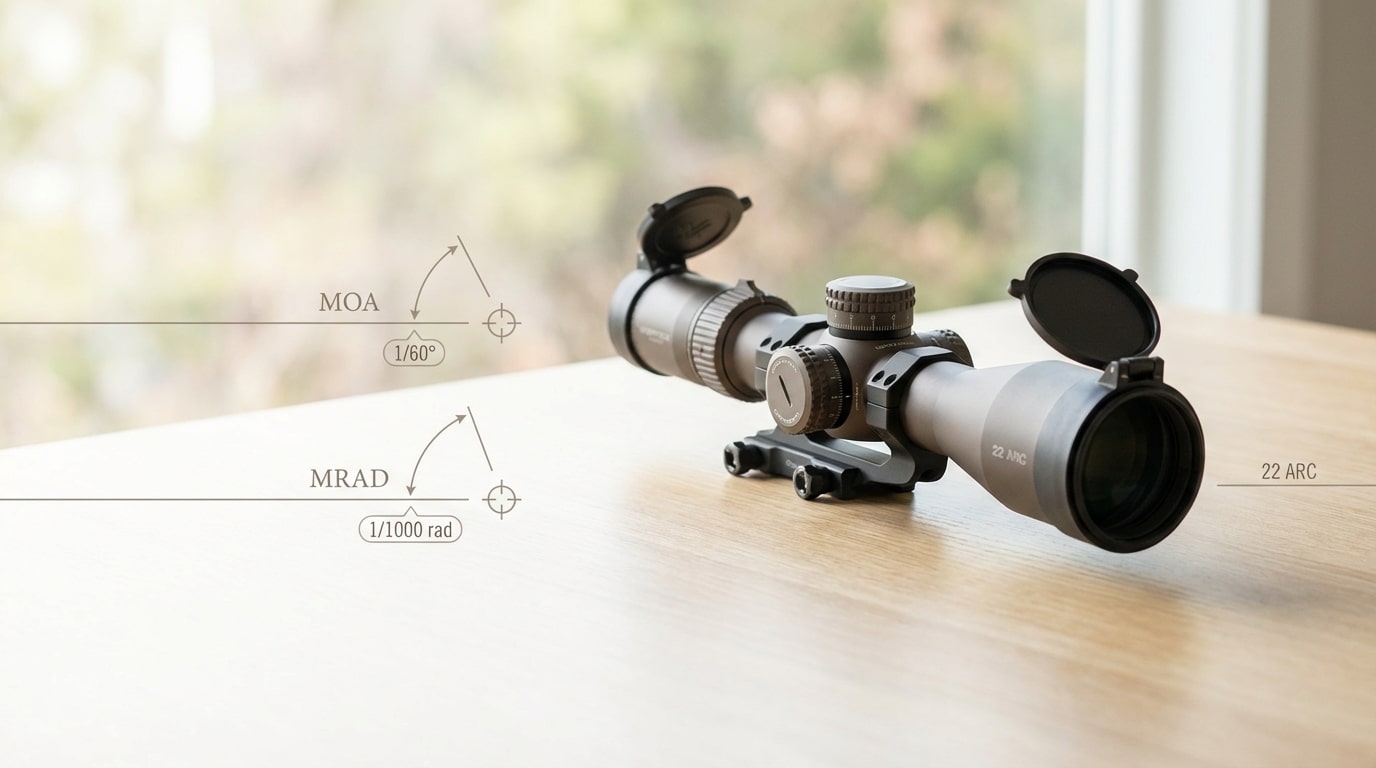
If you’re setting up a scope for long-range work with the 22 ARC, one decision will follow you to every range session and every field trip: MOA or MRAD? It sounds like a technical detail, but it touches every part of how you use your optic – from how you dial elevation at the range to how you communicate holds with a spotter and how you build your data cards.
Neither system is objectively better. They’re different measurement languages, and picking one is mostly about which math you find more intuitive and which community you’re shooting with. What matters is that you understand both systems, commit to one, and use it consistently.
This guide walks through both systems, shows you how the numbers actually work with 22 ARC ballistics, and gives you a practical drop table so you can see what you’ll be dialing in the real world.
The Basics: What MOA and MRAD Actually Measure
Both MOA and MRAD are angular measurements – they describe an angle at the shooter’s position, which translates to a physical distance at the target.
MOA (Minute of Angle): One MOA equals approximately 1.047 inches at 100 yards. Most shooters round this to 1 inch at 100 yards for field math. At 500 yards, 1 MOA = ~5.2 inches. At 1,000 yards, 1 MOA = ~10.5 inches. Most MOA scopes have turrets that click in 1/4 MOA increments (0.25 MOA per click).
MRAD (Milliradian): One MRAD equals 3.6 inches at 100 yards, or 36 inches (approximately 1 yard) at 1,000 yards. MRAD scopes typically click in 0.1 MRAD increments. One MRAD at 100 yards is 10cm – which is why MRAD is sometimes called “metric-friendly.”
Here’s the quick conversion: 1 MRAD = 3.438 MOA. Or roughly: 1 mil ≈ 3.5 MOA.
The Math in the Field
Here’s where most shooters form a preference. Let’s use a real 22 ARC scenario: you’re shooting an 80-grain ELD-X from a bolt-action rifle at 3,100 fps, zeroed at 100 yards.
Approximate Drop Chart: 22 ARC Bolt (80gr ELD-X, 3,100 fps, 100-yard zero)
| Distance | Bullet Drop (inches) | Drop in MOA | Drop in MRAD |
|---|---|---|---|
| 200 yards | -1.5″ | 0.75 MOA | 0.2 MRAD |
| 300 yards | -5.5″ | 1.75 MOA | 0.5 MRAD |
| 400 yards | -14″ | 3.4 MOA | 1.0 MRAD |
| 500 yards | -28″ | 5.4 MOA | 1.6 MRAD |
| 600 yards | -48″ | 7.7 MOA | 2.2 MRAD |
| 700 yards | -77″ | 10.6 MOA | 3.1 MRAD |
| 800 yards | -116″ | 14.0 MOA | 4.1 MRAD |
| 1,000 yards | -234″ | 22.3 MOA | 6.5 MRAD |
Note: These are approximate values. Always run your specific load through a ballistic calculator (Applied Ballistics, Hornady 4DOF, or Kestrel) with your actual G7 BC, altitude, and temperature for precise DOPE.
Now look at the MRAD column from 400 to 800 yards. The progression – 1.0, 1.6, 2.2, 3.1, 4.1 – is easy to work with in your head. At 1,000 yards you’re at 6.5 MRAD, which means 65 clicks on a 0.1 MRAD per click turret.
The MOA numbers – 3.4, 5.4, 7.7, 10.6, 14.0 – are also workable, but the 1/4 MOA click math gets slightly more tedious. At 600 yards you need 7.75 MOA, which is 31 clicks. At 1,000 yards you need 22.25 MOA, which is 89 clicks. Not complicated, but MRAD clicks are typically faster to count.
MOA: The American Standard
MOA is the traditional American system and still dominates the domestic hunting scope market. The 1-inch-per-100-yards approximation is deeply intuitive for American shooters who think in yards and inches.
MOA makes sense if:
- You’re a hunter who learned to think in terms of “1 inch groups at 100 yards”
- You’re shooting alone or with hunting partners rather than in a formal precision rifle competition environment
- Your maximum range is in the 400–600 yard zone where the click-count differences between systems are minimal
- You’re using a scope from a brand that offers better MOA turret options in your budget (Leupold’s CDS system, for example, is MOA-based and excellent)
- Your ballistic data cards and apps are already set up in MOA
The MOA tradeoff: At 1,000 yards, you’re working with larger click counts (89 clicks to get to 2225 MOA). More clicks means more time dialing. For most hunting, this is a non-issue. For a precision rifle match where you’re frequently resetting from max to zero, it’s a real-world slowdown.
MRAD: The Precision Rifle Standard
MRAD has become the near-universal standard in the Precision Rifle Series (PRS) community, military precision units, and among serious long-range shooters. The reasons are practical.
MRAD makes sense if:
- You shoot with a spotter or communicate in terms of “come up 0.3” or “come left 0.2”
- You participate in PRS, NRL, or other precision rifle competition formats
- You shoot beyond 600 yards regularly and want to minimize dialing time
- You work in meters or appreciate metric-system math
- You want reticle-based holdover to integrate cleanly with your turret adjustments (since both use the same unit)
- You’re buying one scope to share between different rifles and want a universal system
The MRAD tradeoff: If you’re a lifelong hunter who thinks in MOA, converting to MRAD feels like learning a second language. There’s no reason to switch unless the advantages above apply to your actual shooting.
The Mixed System Trap: Avoid It
The single most important thing to get right is internal consistency. Your scope turrets, your reticle subtensions, your data card, and your ballistic calculator all need to use the same system.
A common mistake: buying an MRAD-turret scope with an MOA reticle, or vice versa. Some budget scopes are sold this way. Avoid them. Every time you try to hold off using your reticle and then dial a correction on your turret, you’re converting between systems under pressure. Eventually you’ll make a mistake – and at 700 yards, it matters.
When evaluating any scope for 22 ARC, confirm:
- Turret adjustment unit (MOA or MRAD)
- Reticle subtension unit (MOA or MRAD)
- Both are the same
If those don’t match, keep shopping.
What About Dialing vs. Holding?
The MOA/MRAD choice intersects with another technique question: do you dial your corrections with the turret (dialing) or hold off using reticle subtensions (holding)?
For 22 ARC at long range, a mixed approach typically works best:
- Dial elevation for known distances (your DOPE-confirmed yardage to target). This is precise and eliminates error from misreading reticle subtensions under field conditions.
- Hold for wind using reticle subtensions, because you’re making real-time wind calls that change between the time you dial and when the bullet arrives. Holding wind with the reticle is faster and more flexible than dialing.
This dial-elevation/hold-wind approach is exactly why FFP reticles matter (see our FFP vs SFP article) and exactly why consistent MOA or MRAD across your whole system is non-negotiable.
How Much Adjustment Does 22 ARC Actually Need?
A common practical question: how much total elevation travel do you need in a scope for 22 ARC?
Using the drop table above (bolt-run, 80gr ELD-X, 3,100 fps, zeroed at 100 yards):
- To reach 600 yards: need ~7.7 MOA / 2.2 MRAD above your zero
- To reach 800 yards: need ~14 MOA / 4.1 MRAD above your zero
- To reach 1,000 yards: need ~22.3 MOA / 6.5 MRAD above your zero
With a 100-yard zero, most scopes that offer 60+ MOA (17+ MRAD) of usable elevation adjustment (not total range, but usable from your zero position) will comfortably reach 1,000 yards with the bolt-run ARC. The critical spec to check is how much adjustment is available above zero – not total travel.
For factory ARC in an AR-15 with a 450-yard effective ceiling, the demands drop significantly. A scope with 40–50 MOA / 11–14 MRAD of usable upward adjustment handles it easily.
Quick Reference: MOA vs MRAD for 22 ARC
| Factor | MOA | MRAD |
|---|---|---|
| Click size (typical) | 1/4 MOA per click | 0.1 MRAD per click |
| Clicks to 1,000 yards (bolt ARC) | ~89 clicks | ~65 clicks |
| Intuitive for yards/inches? | Yes | Less so |
| Standard in precision competition? | Less common | Yes |
| Good for hunting to 450 yards? | Yes | Yes |
| Good for hunting to 600–650 yards? | Yes | Yes |
| Good for 1,000-yard precision work? | Yes (slightly more clicks) | Yes (slightly fewer clicks) |
| Best for solo hunting use | ✓ | ✓ |
| Best for competition / spotter comms | – | ✓ |
The Bottom Line
For 22 ARC specifically, there’s no ballistics-driven reason to choose one system over the other. Both will get you on target at 1,000 yards. The choice comes down to your shooting context:
Choose MOA if you’re a hunter, you think in inches and yards, and you’re not shooting in organized precision competition.
Choose MRAD if you’re pursuing precision rifle matches, you work with a spotter, or you want your scope system to align with the current standard in the long-range community.
Pick one. Stay consistent throughout your entire system. And build your DOPE card before you go to the field – because at 800 yards with a 12 mph crosswind, you won’t have time to do the math from scratch.
Related Articles
- 22 ARC vs 22 Creedmoor: Which Needs More Scope?
- FFP vs SFP Scopes for 22 ARC: Which Reticle Works Better at Long Range?
- How to Zero Your 22 ARC Scope for 500 Yards: Step-by-Step
- Best Scopes for 22 ARC: Top Picks for Long-Range Shooting