

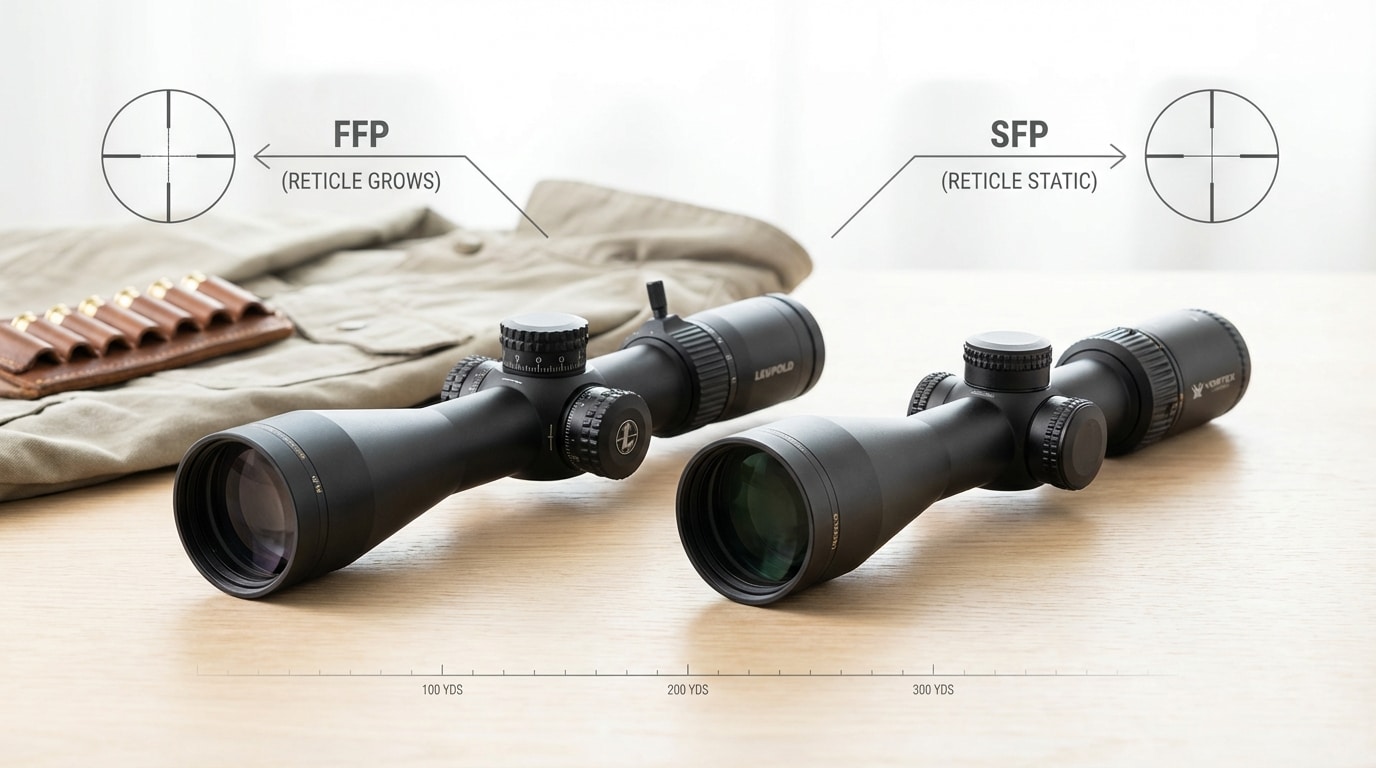
One of the most common questions new 22 ARC owners ask when shopping for a scope is whether they need a First Focal Plane (FFP) optic or if a Second Focal Plane (SFP) setup will work just as well. It’s a fair question – FFP scopes cost more, and the marketing copy on both sides gets murky fast.
Here’s the straight answer: for most 22 ARC applications at 600–1,000 yards, FFP is the right choice. But there are legitimate scenarios where SFP works fine and saves you real money. Understanding which category you’re in takes about five minutes.
What FFP and SFP Actually Mean
Before getting into ARC-specific recommendations, let’s make sure the terminology is clear.
First Focal Plane (FFP): The reticle sits in front of the magnification erector inside the scope tube. As you increase magnification, the reticle appears to grow along with the image. This means your MOA or MRAD subtension marks are accurate at every magnification setting. If your reticle says 1 mil between those hash marks at 10x, it still says 1 mil at 20x and 5x.
Second Focal Plane (SFP): The reticle sits behind the magnification erector. The reticle stays the same visual size regardless of magnification. The subtension marks are only accurate at one specific magnification – usually maximum. At any other power setting, holds using the reticle will be off by a proportional amount.
This distinction matters a lot more on variable-power scopes. On a fixed-power optic, there’s no difference at all.
Why It Matters for 22 ARC Specifically
The 22 ARC is unusual because it operates effectively across a fairly wide range of engagement distances – from varminting at 200 yards to precision work at 600–800+ yards in bolt-gun form. That versatility is precisely why reticle choice matters.
Here’s the scenario where SFP bites you: you’re dialed to a mid-power setting (say, 10x out of a 5–25x scope) for a wider field of view while glassing, then you spot a target and quickly engage. If you’re holding for wind using your reticle subtensions, your hold is wrong by a factor proportional to the power difference. At 10x on a scope calibrated at 25x, you’re off by 60%. At 500+ yards, that’s a miss.
With FFP, you dial, hold, or do both – at any magnification. The math always works.
The Case for FFP: When You Need It
FFP is the right choice for 22 ARC if:
You shoot in a precision rifle or long-range context (500–1,000+ yards). At these distances, you’re constantly making fine adjustments – dialing elevation for distance, holding for wind, splitting the difference between the two. FFP lets you do this accurately at whatever magnification gives you the best sight picture. On a difficult shot at 800 yards with heat mirage distorting the air, you may need to back down to 12–14x for a cleaner image. With FFP, your wind hold is still valid. With SFP, you’d have to mentally correct – and under pressure, that error creeps in.
You engage targets at varied distances without re-zeroing or running the turrets to zero each time. Hunters walking up terrain often engage at unpredictable ranges. FFP lets you use a DOPE (Data on Previous Engagements) card and hold off using the reticle directly.
You’re running a bolt-action 22 ARC with handloads at 60,000+ PSI. At that level of performance, your effective range extends to 600 yards for hunting and beyond for target work. FFP isn’t optional at those distances – it’s the tool that makes accurate holds possible.
You value simplicity under stress. In a hunting context where time pressure is real and your hands aren’t perfectly steady, having one fewer mental step (you don’t have to confirm you’re at max power before trusting your holds) is valuable.
The Case for SFP: When It’s Fine
SFP isn’t inherently inferior – it’s a different tool with legitimate advantages in specific contexts.
For 22 ARC in an AR-15 with factory loads, a practical range ceiling of 400–450 yards, and hunting use: At these ranges and with this platform, most of your shooting is at or near maximum magnification anyway. You’re engaging a deer at 300 yards, not dialing for a 900-yard target. SFP works perfectly here, and you’ll save $150–300 compared to equivalent FFP options.
If you always shoot at maximum magnification. Some precision target shooters lock in max power and leave it there. For them, SFP’s “accurate at max power only” limitation is no limitation at all. If this is your workflow, SFP is a legitimate choice and often offers better image brightness at max magnification (because the reticle doesn’t optically thicken at lower powers as with FFP).
Budget builds where FFP isn’t available at the price point. At the $300–400 price point, FFP options exist but are limited. A quality SFP scope at that price will outperform a mediocre FFP optic – better glass, cleaner tracking, tighter tolerances. Don’t buy a bad FFP just to check the FFP box.
For dedicated varmint shooting inside 300 yards. Calling in coyotes or shooting prairie dogs at sub-300-yard distances doesn’t require the full utility of FFP. The shots are fast, the range is consistent, and the holds are simple.
The FFP Fine Print: What to Watch For
FFP isn’t without tradeoffs, and understanding them helps you make a smarter purchase.
Reticle thickness at low power: At the minimum magnification on a high-power FFP scope (say, 5x on a 5–25x), the reticle is visually very thin. In low light or against a busy background, it can be hard to see. This is a genuine limitation for hunting at dawn or dusk. Some manufacturers address it with illuminated reticles.
Cost: FFP scopes cost more at every price tier. The gap has narrowed in recent years as manufacturing has improved, but a quality FFP scope in a mid-tier brand still runs $150–300 more than an equivalent SFP model.
Not all FFP reticles are equal: An FFP scope is only as useful as the quality and design of its reticle. A simple crosshair in FFP gives you no more holding utility than the same crosshair in SFP. Look for FFP scopes with a well-designed Christmas-tree or grid reticle (MOA or MRAD hashmarks below center for wind and drop holds) to actually use what FFP offers.
FFP Scope Recommendations for 22 ARC by Budget
Under $600
- Vortex Diamondback Tactical 4–16×44 FFP (EBR-2C MRAD) – $400–450. Outstanding value, solid tracking, EBR-2C reticle has practical wind and drop holds. Glass quality punches above its price. A legitimate 600-yard optic in bolt-gun ARC applications.
- Primary Arms PLx 4–14×44 FFP (ACSS Athena BPR) – $475–550. Primary Arms’ ACSS reticles are thoughtfully designed for real-world holdover use. Excellent option for AR-15 ARC with 450-yard ceiling.
$600–$1,200
- Vortex Viper PST Gen II 5–25×50 FFP (EBR-2C) – $750–900. This is the workhorse recommendation for bolt-action 22 ARC. Excellent optical quality, reliable tracking, zero-stop, large objective for edge-to-edge clarity. Hard to beat in this range.
- Burris XTR III 3.3–18×50 FFP – $900–1,000. Outstanding glass for the price, very compact for a 50mm objective. Strong choice if you want a slightly lighter build.
$1,200+
- Nightforce NX8 4–32×50 FFP (MOAR-T) – $1,450–1,600. If you’re running a serious bolt-action 22 ARC for 1,000-yard precision work, this scope handles it cleanly. The 4–32x range covers everything from hunting distances to full precision work without changing optics.
- March Compact 4–40×52 FFP (FML-1) – $2,200+. Overkill for most, but if 22 Creedmoor and 22 ARC are your serious long-range cartridges and you want a single optic that excels at everything, March’s glass clarity is in a different league.
SFP Recommendations for 22 ARC (AR-15 / Close-Mid Range)
- Vortex Crossfire II 4–12×44 AO – $250–300. Budget-friendly, reliable, serviceable to 400 yards for factory ARC in an AR-15.
- Leupold VX-3HD 4.5–14×40 CDS-ZL – $700–800. If you’re a hunter who shoots 22 ARC in an AR-15 at ranges under 450 yards and prefers the tried-and-true SFP Leupold ergonomics, this is a clean choice.
The Bottom Line
For 22 ARC in a bolt gun – especially with handloads reaching 3,100+ fps and engagement ranges from 400–1,000 yards – FFP is the correct choice. The reticle accuracy across all magnifications isn’t a luxury at those distances; it’s a practical necessity.
For 22 ARC in an AR-15 with factory loads and a practical ceiling around 450 yards, SFP is a reasonable, cost-effective option – particularly at lower price points where SFP glass quality outpaces FFP equivalents.
When in doubt: buy FFP. The versatility will serve you as your skills and ambitions grow.
Related Articles
- 22 ARC vs 22 Creedmoor: Which Needs More Scope?
- MOA vs MRAD for 22 ARC: Dialing Long-Range Drops
- Best Scopes for 22 ARC: Top Picks for Long-Range Shooting
- What Magnification Do You Need for 22 ARC at 1,000 Yards?