

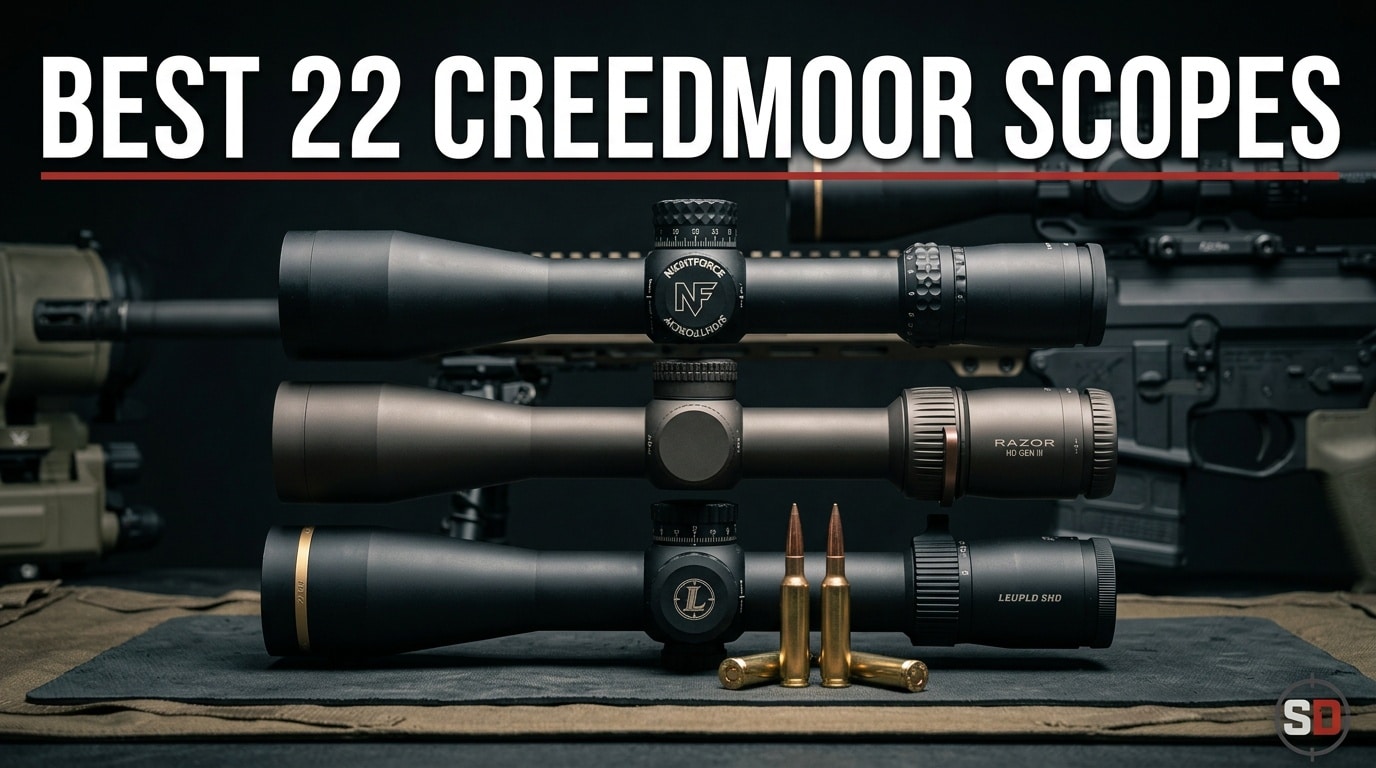
The 22 Creedmoor is a purpose-built long-range cartridge. Based on the 6.5 Creedmoor case necked down to 224, it drives 80–88 grain bullets at 3,150–3,180 fps, keeping them above the 2,000 fps expansion threshold for hunting past 625 yards and supersonic beyond 1,000 yards. It lives in standard short-action bolt guns with 473″ bolt faces – the same platform as the 6.5 Creedmoor – which means a huge ecosystem of rifles, stocks, and chassis already fit it without modification.
All of that capability requires an optic that can actually use it. A scope on a 22 Creedmoor build needs genuine long-range credentials: enough elevation adjustment to reach 1,000 yards, glass quality that holds up at 20–25x, and tracking consistency that doesn’t add error to an already demanding ballistic solution.
This guide covers the best scopes for 22 Creedmoor at every price tier, with specific attention to why this cartridge’s velocity profile and long-range demands shape the optic selection differently than other high-performance 22s.
What 22 Creedmoor Specifically Needs from a Scope
Before the recommendations, it’s worth understanding what makes 22 Creedmoor’s optical requirements specific.
Higher velocity means more elevation travel needed. This sounds counterintuitive – a faster bullet drops less, right? True within the 400-yard range. But at 1,000 yards, you’re still dialing a significant amount of elevation from a 100-yard zero, and the Creedmoor’s higher muzzle velocity actually means a slightly steeper relative drop in the transonic zone (800–1,000 yards) compared to slower, more stable configurations. Plan on needing 65–80 MOA (18–22 MRAD) of usable elevation above your zero for full 1,000-yard capability.
Twist rate matters for stability, which scopes can’t compensate for. Many 22 Creedmoor barrels are cut at 1:8 twist rather than the 1:7 found standard on 22 ARC. At 1,000 yards, a 1:8 barrel with 88gr ELD-M can show signs of gyroscopic instability – vertical stringing, inconsistent groups. If you’re seeing this, the fix is the barrel, not the scope. This context matters because some shooters troubleshoot optic tracking when the actual problem is bullet stability. Confirm your barrel spec before investing in optic upgrades.
Factory loads run hot. The 22 Creedmoor’s larger case capacity and the need for slow-burning powders (H4350, StaBALL 6.5, H1000) creates significant heat at the barrel. More heat means barrel life in the 1,300–1,900 round range – roughly half of what a 22 ARC delivers. This isn’t directly an optic consideration, but it affects the build philosophy: 22 Creedmoor is typically a dedicated precision hunting and competition rifle, not a high-volume training cartridge. The scope budget should reflect that.
It’s always a bolt gun. Unlike 22 ARC, which can legitimately live in an AR-15, 22 Creedmoor is bolt-only. There’s no entry-level, factory-ammo-limited platform version. Every 22 Creedmoor build is a precision rifle, which means every scope should be a precision scope.
The Non-Negotiables for Any 22 Creedmoor Scope
Given the above, here’s what every scope on this list must offer:
- 5–25x or 4–32x magnification range – the minimum for 800–1,000 yard target work
- First Focal Plane (FFP) reticle with practical wind/drop hash marks
- 65+ MOA or 18+ MRAD of usable elevation travel above zero
- Zero stop – for fast return after dialing corrections in match or field conditions
- Reliable tracking – a non-negotiable verified with a box test before field use
- 50mm or larger objective – low-light performance at high magnification requires it
The following recommendations all meet these criteria. Differences between them are in glass quality, weight, warranty, and ergonomics.
Top Scopes for 22 Creedmoor by Tier
Mid Tier: $700–1,200
Vortex Viper PST Gen II 5–25×50 FFP – Best Value in Class
Price: ~$800–950
Tube: 30mm | Objective: 50mm
Reticle: EBR-2C MRAD or EBR-7C MOA (FFP)
Adjustment: 0.1 MRAD or 025 MOA / click
Elevation travel: 25 MRAD / 75 MOA
Weight: 33.6 oz
For shooters who want a legitimate 1,000-yard scope for their 22 Creedmoor without spending over $1,000, the PST Gen II 5–25x is the clearest recommendation available. Vortex’s tracking consistency in this line is well-established through thousands of field hours and documented competition use. The 75 MOA of total elevation travel (which translates to approximately 65+ MOA usable above a 100-yard zero with most rail setups) covers the Creedmoor’s needs out to 1,000 yards.
The EBR-2C MRAD reticle is practical: a Christmas-tree layout with wind and drop hash marks spaced for 0.5 mil increments. It enables fast field holds and precise dialing, depending on the situation.
At $800–950, it’s accessible. The competition at this price point is thinner than most buyers expect – very few scopes do what the PST Gen II does at this price.
The honest limitation: the glass quality is good, not great. At 25x in excellent light, the edge-to-edge clarity is slightly soft compared to $1,200+ competition. In hunting-grade light, it’s not a meaningful issue. In a precision rifle match at 9 AM with a mirage-free target, you’ll notice it.
Best for: Primary workhorse scope for any 22 Creedmoor build; precision hunting and entry-level competition.
Burris XTR III 3.3–18×50 FFP – Best Compact Option
Price: ~$950–1,050
Tube: 34mm | Objective: 50mm
Reticle: SCR Mil (FFP)
Adjustment: 0.1 MRAD / click
Elevation travel: 30 MRAD
Weight: 29 oz
The XTR III delivers notably better glass quality than the PST Gen II at a similar or slightly higher price point. Burris’s optical manufacturing in this line is impressive – contrast and clarity are a meaningful step above the Vortex mid-tier glass.
The tradeoff is magnification range. At 18x maximum, the XTR III shows its limits on a 22 Creedmoor at 1,000 yards on days when conditions are good enough to use more power. For most hunters, 18x is sufficient. For precision target shooters who want to see bullet trace and call shots at distance, 18x is limiting.
The 30 MRAD of elevation travel through a 34mm tube is generous – more than enough for any 22 Creedmoor application. The larger tube also adds rigidity under recoil, though 22 Creedmoor’s recoil is mild enough that this isn’t a practical concern.
Best for: 22 Creedmoor hunters; precision builds where glass quality matters more than maximum magnification.
Premium Tier: $1,200–2,000
Leupold Mark 5HD 5–25×56 FFP – Best Hunting Premium
Price: ~$1,200–1,400
Tube: 35mm | Objective: 56mm
Reticle: PR-1 MOA or Tremor3 (FFP)
Adjustment: 025 MOA / click
Elevation travel: 100 MOA
Weight: 30.8 oz
The Mark 5HD represents Leupold’s entry into the serious long-range precision market, and it earns its place. The optical quality is a genuine step above mid-tier – crisper glass, better low-light transmission through the large 56mm objective, and a contrast that makes high-magnification shooting more comfortable over longer sessions.
The 100 MOA of total elevation travel is the most generous of any scope in this guide and ensures you’ll never run out of adjustment headroom with a 22 Creedmoor even in challenging environments (high altitude, cold weather, unusual load combinations). The Tremor3 reticle is sophisticated – highly regarded by experienced precision shooters, though it has a steeper learning curve than simpler Christmas-tree designs.
One note: the 35mm tube requires specifically sized rings, which adds slight cost and limits some mounting options.
Best for: Premium 22 Creedmoor hunting builds; shooters who prioritize glass quality and low-light performance.
Nightforce NX8 4–32×50 FFP – Best All-Around Premium
Price: ~$1,450–1,600
Tube: 34mm | Objective: 50mm
Reticle: MOAR-T, PTR2, or MIL-XT (FFP)
Adjustment: 0.1 MRAD or 025 MOA / click
Elevation travel: 120 MOA / 34 MRAD
Weight: 30 oz
The NX8 is the most practical premium scope recommendation for 22 Creedmoor for one reason above all others: the 4–32x magnification range covers every distance the cartridge is capable of in a single optic. The 4x floor is genuinely useful for field scanning and close-range target acquisition. The 32x ceiling is enough for calling precise shots at 1,000 yards.
Nightforce’s reputation for precision tracking is well-established in competition circles. The MOAR-T reticle’s MOA-based holdover system is particularly well-suited to hunters who work in yard/inch measurements. The 34 MRAD (120 MOA) of elevation travel means you’ll never run out of range.
The optical quality sits between mid-tier and the Leupold Mark 5HD – very good, honest, not exceptional. Nightforce’s value proposition is in the engineering reliability and the warranty support, not in having the most impressive glass in any light condition.
Best for: The complete package for serious 22 Creedmoor precision shooting – matches, hunting, and extended training sessions.
Elite Tier: $2,000+
March Compact 4–40×52 FFP – Best Glass, Period
Price: ~$2,200–2,400
Tube: 30mm | Objective: 52mm
Reticle: FML-1, FMA-1, or FLR-1 (FFP)
Adjustment: 0.1 MRAD / click
Elevation travel: 14 MRAD
Weight: 24.7 oz
For dedicated 22 Creedmoor precision competition, the March Compact delivers a level of optical performance that changes what long-range shooting feels like. At 25–40x in good air, the image quality is genuinely in a different class from any American-made option – Japanese optical manufacturing at its finest.
The 30mm tube and 24.7 oz weight are remarkable for a 4–40x scope. This is the optic to choose if your 22 Creedmoor rifle is built for precision competition and weight-to-capability ratio matters.
The critical limitation: 14 MRAD of elevation travel is tight for 22 Creedmoor at 1,000 yards from a 100-yard zero without a canted rail. Plan your build to include a 20 or 30 MOA rail, or use a 200-yard zero, to ensure you have enough upward adjustment for full-distance work.
Best for: Dedicated precision competition; shooters who have used every other option and want the optical ceiling.
Nightforce ATACR 5–25×56 FFP – Benchrest-Grade Tracking
Price: ~$2,800–3,000
Tube: 34mm | Objective: 56mm
Reticle: MOAR, Mil-XT, or TReMoR3 (FFP)
Adjustment: 0.1 MRAD or 025 MOA / click
Elevation travel: 120 MOA / 34 MRAD
Weight: 32 oz
When tracking precision is the absolute priority – competition where your elevation dial needs to put the bullet exactly where the calculation says – the ATACR is Nightforce’s answer. The manufacturing tolerances are tighter than the NX8, the glass quality is a step above, and the 56mm objective matches the Mark 5HD’s low-light transmission.
The ATACR is difficult to justify against the NX8 for most 22 Creedmoor applications unless you’re shooting at a level where the NX8’s tracking is the limiting factor. At $3,000, you’re paying for the last 5% of mechanical precision.
Best for: Precision rifle competition at the highest level; shooters whose skills have genuinely outpaced NX8-class tracking.
Scope Recommendations by Scenario
| Scenario | Recommended Scope | Price |
|---|---|---|
| First 22 Creedmoor build, all-around | Vortex Viper PST Gen II 5–25×50 | ~$900 |
| Premium hunting to 650 yards | Leupold Mark 5HD 5–25×56 | ~$1,300 |
| Hunting + target, single optic | Nightforce NX8 4–32×50 | ~$1,500 |
| PRS competition, glass priority | March Compact 4–40×52 | ~$2,300 |
| PRS competition, tracking priority | Nightforce ATACR 5–25×56 | ~$2,900 |
| Best glass on a tighter budget | Burris XTR III 3.3–18×50 | ~$1,000 |
Building Around Your Scope: Practical Considerations
Rail cant: With a 22 Creedmoor zeroed at 100 yards and shooting to 1,000 yards, you need approximately 65–70 MOA of elevation above zero. Most scopes offer 100+ MOA of total travel, but that travel is split above and below zero. A 20 MOA canted Picatinny rail shifts the split so most of your available travel sits above zero. Highly recommended for any serious long-range build.
Ring height and tube diameter: The 30mm tube is still common, but premium options are increasingly 34mm or 35mm. Ring cost and availability varies – 30mm rings are cheapest and most available, 34mm is standard at precision rifle shops, 35mm requires specific brands. Plan your rings and rail simultaneously with your scope purchase.
Scope caps and protection: At $1,000–3,000, your scope is worth protecting. Quality Butler Creek or Vortex flip caps cost $20–30 and prevent lens damage during transport and field use.
The Bottom Line
For a 22 Creedmoor build, there’s no version of this rifle that benefits from a budget scope. This is a bolt-action precision cartridge with a barrel life of 1,300–1,900 rounds. Every component in the build – including the glass – should be selected for precision performance.
The Vortex Viper PST Gen II 5–25×50 FFP is the right scope for most 22 Creedmoor shooters: proven tracking, practical reticle, adequate glass, and a price that leaves room in the budget for quality rings and a canted rail.
If glass quality is your priority, the Leupold Mark 5HD is worth the additional investment. If you want a single optic that excels from close range to 1,000 yards, the Nightforce NX8 is the right answer.
Build it right the first time. A 22 Creedmoor deserves an optic that can use its capability.
Related Articles
- Best Scopes for 22 ARC: Top Picks for Long-Range Shooting
- 22 ARC vs 22 Creedmoor: Which Needs More Scope?
- MOA vs MRAD for 22 ARC: Dialing Long-Range Drops
- FFP vs SFP Scopes for 22 ARC: Which Reticle Works Better at Long Range?
- How to Zero Your 22 ARC Scope for 500 Yards: Step-by-Step