
Long-Range Precision Without the Premium Price Tag
The Vortex Viper PST Gen II 5-25×50 sits in that sweet spot where serious capability meets attainable pricing. After logging extensive range time and field use with this optic, I can say it punches well above its weight class – though it’s not without compromises. Here’s what you need to know before mounting one on your precision rifle.
First Impressions & Build Quality
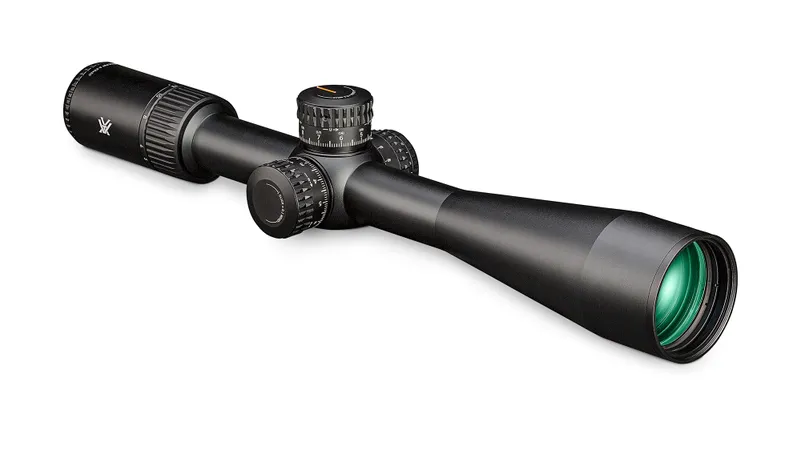
Right out of the box, the Viper PST Gen II feels substantial. At 31 ounces, it’s not featherweight, but the heft translates to a reassuring solidity that inspires confidence. The tube is a true 30mm, giving you plenty of mounting options and internal adjustment range.
The anodizing is well-executed with a matte finish that resists glare effectively. I’ve had mine mounted for over a year now, and despite regular transport in a soft case and exposure to typical field conditions, the finish shows minimal wear. The turrets are covered by removable caps that thread on securely – no accidental bumps throwing your zero.
The magnification ring requires deliberate effort to turn, which some shooters love and others find stiff. I’m in the former camp – it stays exactly where you set it, even during position changes or when bumped in the truck. The parallax adjustment on the left side of the turret housing turns smoothly with clear, legible markings from 25 yards to infinity.
Glass and Coatings
Vortex applied their XR fully multi-coated lens system and XD extra-low dispersion glass to this scope. The objective bell houses a 50mm lens that gathers considerable light, and the eyepiece features an integrated fast-focus diopter that locks firmly once adjusted.
Optical Performance
This is where the Viper PST Gen II legitimately competes with scopes costing several hundred dollars more. The image clarity at mid-magnification ranges (8-18x) is excellent, with sharp edge-to-edge resolution and minimal chromatic aberration. Colors render naturally without the slightly warm or cool casts you sometimes see in this price bracket.
Low-Light Clarity
During multiple dawn and dusk hunting sessions, the 50mm objective delivered usable images well into shooting light’s final minutes. I could clearly resolve a whitetail buck’s rack at 300 yards approximately 25 minutes after sunset – not quite matching my buddy’s Kahles K525i, but close enough that the $1,500 price difference became hard to justify for pure hunting applications.
The twilight factor is genuinely impressive here. Where this scope falls slightly behind true alpha glass is in contrast and color saturation during those marginal light conditions. Details are visible, but they don’t quite pop the way they do through premium German or Japanese glass.
High Magnification Performance
At 25x, you’ll notice some image degradation that’s typical for scopes in this class. There’s slight edge softness in the outer 15-20% of the field of view, and mirage becomes more pronounced on hot days. For practical shooting purposes, I rarely push past 20x anyway – the sweet spot for this optic sits between 12-18x for most long-range work.
The field of view measures 19.8 feet at 100 yards on 5x, narrowing to 4.4 feet at 25x. That’s competitive with similar designs, though you’ll notice the tunnel effect more than with scopes featuring larger objectives or shorter magnification ranges.
Turrets, Reticle & Tracking
The exposed tactical turrets are where the PST Gen II really shines for the money. Each click delivers a positive, tactile bump with an audible click that’s easy to count even with gloves on. The turrets are calibrated in 0.1 MRAD increments (the version I tested – MOA versions are also available), with 10 MRADs of adjustment per revolution.
Zero Stop and Revolution Indicator
The zero-stop mechanism requires initial setup but works flawlessly once configured. You get 17.4 MRADs of total elevation adjustment, which is sufficient for reaching 1,000+ yards with most 6.5 Creedmoor or .308 Winchester loads. The revolution indicator – a small window showing which rotation you’re on – prevents getting lost during extensive dialing.
I’ve tracked this scope’s adjustments across multiple range sessions, and it’s proven reliably repeatable. Box tests consistently returned to zero, and tall target tests showed accurate tracking throughout the elevation range. There’s no noticeable slop or backlash in the turret mechanism.
Reticle Options
I tested the EBR-2C MRAD reticle, which features a fine center crosshair with hash marks for wind holds and ranging. The Christmas tree design in the lower half provides holds out to 5 MRADs, making rapid follow-up shots practical without dialing. The reticle is etched on the first focal plane, so subtensions remain accurate at any magnification.
The illumination offers 11 brightness settings, with the off positions between each setting – a thoughtful touch that lets you quickly kill the illumination. Settings 1-3 are genuinely NVG-compatible, while 8-11 are bright enough for daylight use against shadowed backgrounds. The illumination dial sits on the left side, easily accessible without breaking your shooting position.
At 5x magnification, the reticle is usable but requires good eyes or close attention to pick up the finer details. By 8x, everything becomes clear and practical. This is a precision shooting reticle, not a hunting reticle – if you’re primarily hunting, you might find it cluttered at lower magnifications.
Real-World Use: Hunting & Shooting
I’ve used this scope primarily for precision rifle practice out to 800 yards and for western mule deer and antelope hunting. In both roles, it’s performed admirably with some caveats worth noting.
On the Range
For PRS-style shooting and long-range practice, the Viper PST Gen II delivers everything most shooters need. The reticle allows fast wind calls, the turrets track reliably for dialing solutions, and the glass is clear enough to spot your own impacts on steel at reasonable distances. I’ve successfully spotted .264 bullet splashes on white steel at 600 yards in good light conditions.
The weight becomes noticeable during stages requiring extensive rifle manipulation, but it’s manageable. Mounting it on a 10-pound rifle creates a fairly substantial system – consider this if you’re building a lightweight hunting rig.
In the Field
During hunting season, I kept the magnification between 5-12x for most situations, which provided adequate field of view while maintaining the resolution needed for shot placement verification. The scope’s weight didn’t bother me on spot-and-stalk hunts, though I was glad to have it mounted on a carbon-fiber stocked rifle.
Eye relief measures 3.9 inches and remains fairly consistent across the magnification range – a significant advantage over some competitors. I could maintain a proper cheek weld and find the sight picture quickly when shooting from awkward field positions.
The parallax adjustment requires attention beyond 300 yards. I developed a habit of checking it before each shot, which became second nature but is an extra step compared to scopes with more forgiving parallax ranges.
How It Compares
| Model | Magnification | Objective Lens | Reticle Type | Key Strength | Notable Trade-off | Price Tier |
|---|---|---|---|---|---|---|
| Vortex Viper PST Gen II | 5-25x | 50mm | EBR-2C FFP MRAD | Turret quality and tracking reliability | Glass clarity at max magnification | $900-1000 |
| Athlon Ares ETR | 4.5-30x | 56mm | APLR5 FFP MRAD | Higher magnification range, larger objective | Heavier at 39 oz, less refined turrets | $1100-1200 |
| Bushnell Match Pro | 5-30x | 56mm | Deploy MOA FFP | Excellent glass for price, Locking turrets | Bulkier design, limited availability | $1000-1100 |
| Leupold Mark 5HD | 5-25x | 56mm | TMR FFP | Superior glass quality, lighter weight | $1000+ more expensive | $2000-2200 |
The Viper PST Gen II distinguishes itself primarily through turret quality and Vortex’s unconditional warranty. While competitors like the Athlon Ares ETR offer more magnification and slightly better glass, the Vortex feels more refined in daily use. The Bushnell Match Pro provides comparable performance with excellent glass, but the Vortex edges ahead in turret feel and brand support network.
Against the Leupold Mark 5HD, the Viper PST Gen II obviously gives up some optical quality and weight savings. However, for shooters who don’t need absolute top-tier glass, the Vortex delivers 85% of the performance at 45% of the cost.
Who It’s For (And Who Should Skip It)
Ideal Users
This scope is perfect for precision rifle shooters operating on a realistic budget who refuse to compromise on tracking reliability. If you’re building a dedicated long-range rifle for practice and competition, or you need a hunting scope that can genuinely reach out past 500 yards, the Viper PST Gen II deserves serious consideration.
Western hunters pursuing mule deer, antelope, or elk in open country will appreciate the magnification range and turret precision. The scope handles variable distances well, and the FFP reticle provides rangefinding capabilities if your rangefinder fails.
Competition shooters in local and regional matches will find this scope entirely competitive. You won’t feel undergunned against competitors using scopes costing twice as much – at least not until you’re shooting at a level where hundredths of a minute matter.
Who Should Look Elsewhere
If you’re primarily a timber hunter taking shots inside 200 yards, this scope is overkill. The reticle is busy at low magnifications, and the weight adds unnecessary bulk for close-range work. A simpler 3-15x scope would serve you better.
Serious competitive shooters competing at national-level matches might find the glass quality limiting for spotting trace and impacts at extended distances. If you’re regularly shooting past 800 yards and need to spot your own hits, budget for something in the $1,500-2,000 range.
Weight-conscious mountain hunters should also reconsider. At 31 ounces, this isn’t a backpack-friendly optic for sheep or mountain goat hunts where every ounce matters. Look at lighter options with lower magnification ranges.
Final Verdict
The Vortex Viper PST Gen II 5-25×50 represents one of the best values in precision rifle optics today. It doesn’t pretend to compete with $3,000 scopes in optical quality, but it delivers reliable tracking, good glass, and excellent turrets at a price point that makes long-range shooting accessible to more shooters.
The strengths are clear: repeatable turrets, useful FFP reticle, solid construction, and Vortex’s unbeatable warranty. The compromises – slight optical degradation at maximum magnification, weight, and glass that’s very good rather than exceptional – are reasonable given the price.
For the shooter who needs a scope that works rather than a scope that impresses, the Viper PST Gen II is an easy recommendation. It’s proven itself reliable across hundreds of rounds and diverse conditions in my testing. While it won’t make you a better shooter by itself, it also won’t hold you back – and that’s exactly what a tool should do.
If you’re in the $900-1,000 budget range and need a scope for serious long-range work, this should be on your short list. Just make sure your rifle and shooting skills are ready to take advantage of what this optic offers.