 Maksym Kovaliov
Six Months in the Field
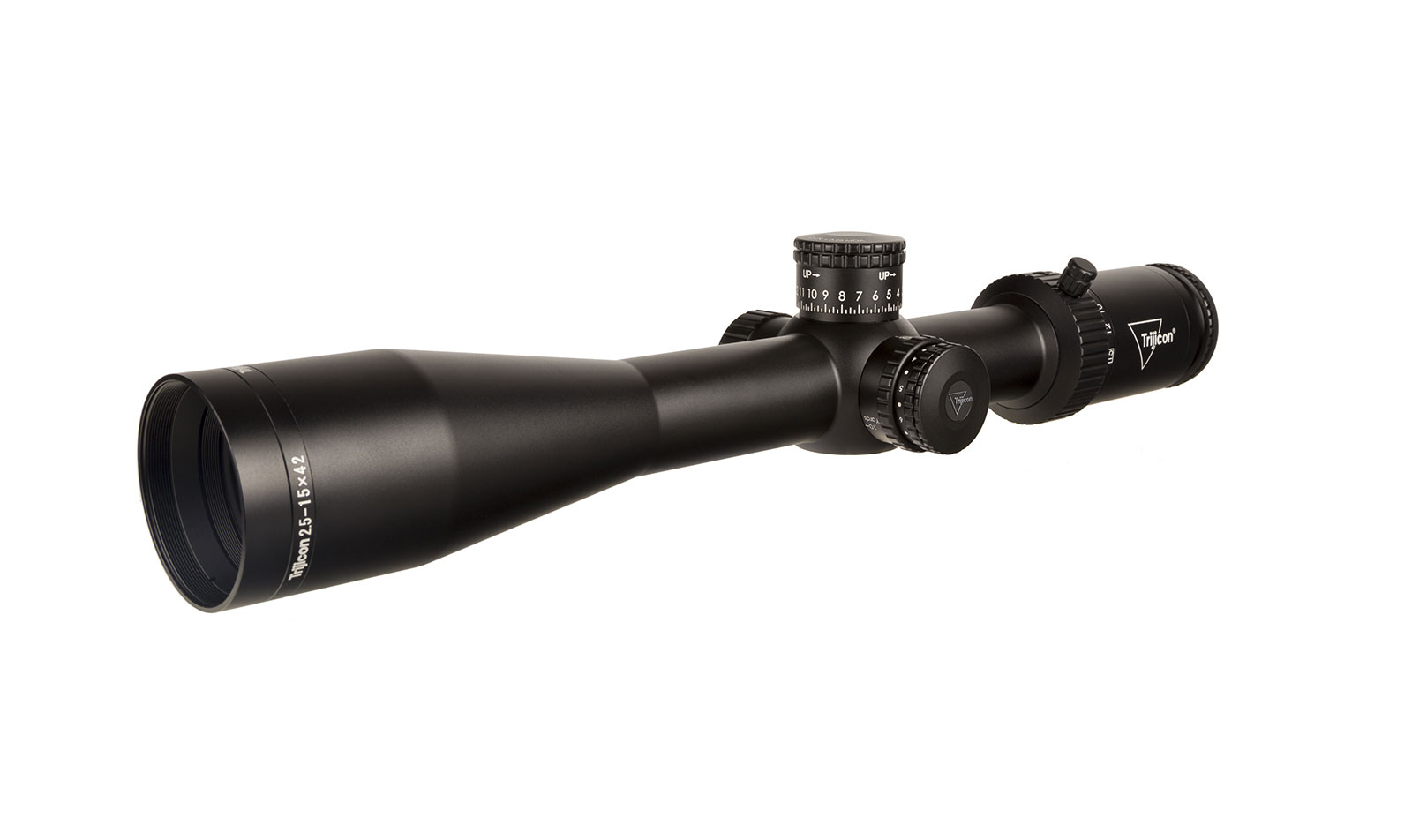
Trijicon doesn’t need much of an introduction. The ACOG has been on American military rifles since the ’80s, and that reputation follows the brand into everything they make – including a $900 hunting scope. The Credo HX 2.5-15×42 sits in one of the most crowded price brackets in the optics market. Leupold, Nightforce, Vortex, and half a dozen others all want your money right around that $800–$1000 mark. So the real question isn’t whether this is a good scope – it is – it’s whether it’s the right scope for you, and where it actually falls short.
I ran the Credo HX on a bolt-action 308 Win for about six months: whitetail hunting in November, prairie dog work in the spring, and regular range sessions pushing distances out past 400 yards. Somewhere around 400 rounds total, rain, snow, heat, cold. Here’s the honest rundown.
Build Quality and First Impressions
Pick it up and you already know where your money went. At 24.2 ounces, this isn’t a mountain hunter’s dream, but the weight is purposeful – the 30mm tube is machined from a single billet of 7075-T6 aluminum, the same alloy used in aircraft structural components. Turret caps thread on with the kind of resistance that tells you tolerances were actually held. The matte anodized finish doesn’t glare and doesn’t feel like it’ll peel off after a season in the brush.
This scope is built in Japan to Trijicon’s specs, and you can feel the difference from cheaper overseas manufacturing the moment you handle it. The ocular ring rotates smoothly and locks with authority. Diopter adjustment holds without tools. The included throw lever fits without play. None of this feels like it was designed to hit a price point – it feels like it was designed to work.
Weatherproofing is nitrogen-purged with O-ring seals, and it’s not just a marketing claim. I ran this scope through a sustained November downpour, late-season blowing snow, and temperature swings from 15°F to 85°F. Zero internal fogging. Zero issues.
Optical Performance
Let’s set expectations right off the bat: the Credo HX is not going to touch Swarovski Z8i or Zeiss Victory V8 glass. Those are different leagues at different prices. But in the $800–$1000 bracket, this scope holds its ground.
At lower magnifications – 2.5× to around 6× – the image is clean edge to edge. Crank it up to 15× and you’ll see some softening in the outer 10–15% of the field of view. It’s noticeable if you’re specifically looking for it, but in hunting situations where your target is center frame, it genuinely doesn’t matter. Color rendition is neutral – none of the warm cast you get from some Japanese glass, none of the cold blue tint from budget options. Just an honest picture. Chromatic aberration is well controlled; you’ll see minor purple fringing on hard contrast edges like dark timber against bright sky, but it’s not something you’ll notice on animals.
Resolution is strong enough to count tine points at 350–400 yards in decent light. That’s a practical field measurement, not a lab spec.
Low light is where the Credo HX separates itself from most of its competition. The 42mm objective paired with Trijicon’s fully multi-coated glass pulls in light well into the shooting hours most people call “too dark.” I’ve picked out targets at 250 yards close to 30 minutes past legal shooting light – that’s territory where a lot of scopes in this price range are just giving you gray mush. It’s not Swarovski-level transmission, but for a hunting scope under a grand, the twilight performance is legitimately impressive. Practical tip: when the light gets really thin, dial back from 15× to 6–8×. You’ll add another 10–15 minutes of usable visibility.
Turrets
The elevation turret runs 0.25 MOA per click with 15 MOA per revolution. Clicks are audible and tactile without being obnoxiously loud – you can feel and count each one with gloves on, but you’re not going to spook deer with your adjustments. After 200+ rounds of deliberate tracking tests – dialing up, dialing down, coming back to zero – the scope returns to zero consistently. That’s not something you can assume in this price range; some scopes in the $700–$900 bracket have tracking problems on large adjustments. This one doesn’t.
The main real-world downside: no zero stop. You can dial below zero and the scope won’t tell you. For a hunter who rarely adjusts turrets in the field, that’s a minor inconvenience. For someone who regularly dials corrections at distance, you need to stay aware of how many revolutions you’ve moved. It’s not a dealbreaker, but it’s a legitimate omission at this price.
The windage turret is capped, designed for occasional corrections rather than constant adjustment – that’s the hunting philosophy here, not a tactical build.
Reticle and Illumination
I tested the MOA version with Trijicon’s BDC Hunter reticle in the second focal plane. The reticle itself is well-proportioned – fine center crosshair with holdover marks for typical hunting cartridges and windage dots on the horizontal wire. At 15×, it threads the needle between too heavy (covering small targets) and too thin (disappearing in dark timber).
The most important thing to understand about this reticle: the holdover marks are only accurate at maximum magnification. This is standard SFP behavior, but it catches shooters who are used to FFP scopes. At 8×, the marks are still visually present but their angular subtensions have changed – using them for holdovers will put your shots low. Either use the marks at 15× or dial your turrets at other magnifications. There’s nothing broken here, it’s just how SFP works, but it’s worth building the habit before you’re in the field.
Illumination runs 10 brightness levels with off positions between each setting – meaning you can switch it off without cycling through all the levels, which is a genuinely useful detail. Single CR2032 battery. Top brightness levels cut through a bright open field; low settings don’t wash out a dark-adapted eye. After six months of intermittent use, I haven’t changed the battery.
Real-World Hunting Use
The 2.5× bottom end provides fast, genuine close-range target acquisition. I took shots inside 75 yards in thick cover without feeling like the scope was working against me. Not every scope marketed as a hunting optic can actually do that – some 3-15× scopes feel tunnel-like even at minimum power. This one doesn’t.
The 15× top end handles every realistic hunting distance with room to spare. For dedicated shooting beyond 500 yards you’d want more magnification, but for hunting, 15× is plenty.
Power changes are smooth, and the throw lever makes quick adjustments without breaking your cheek weld. The eye box is forgiving at lower powers and tightens up predictably above 12× – that’s normal. Eye relief stays consistent at 3.7 inches across the full magnification range, which matters more than people realize.
Recoil testing across 308 Win and 30-06 produced zero shift in point of impact and no mechanical issues. The scope sits well on medium-length actions. For mountain hunting, 24.2 ounces is a real weight consideration. For vehicle-based hunting or any situation where durability outweighs weight savings, it’s a non-issue.
How It Stacks Up Against the Competition
Leupold VX-5HD 3-15×44 (~$949) is the most direct comparison. Leupold is about 7 ounces lighter, which is significant if you’re putting in miles on foot. The turret feel is slightly more refined, and edge-to-edge clarity is marginally better. The Credo HX counters with better low-light performance and more robust weatherproofing. If weight and turret feel are priorities, Leupold. If you’re hunting in rough weather and shooting in low light, Trijicon.
Nightforce SHV 3-10×42 (~$749) costs less and has an outstanding reputation for tracking reliability. The limitation is the 10× ceiling, which becomes a real constraint on western hunts with longer shots. The Credo HX’s additional magnification range makes it more versatile.
Athlon Midas TAC 5-25×56 (~$849) offers more magnification and a bigger objective for similar money, but it’s nearly 10 ounces heavier and the glass quality doesn’t match Trijicon’s. It’s a better pick for dedicated long-range shooting; the Credo HX is the better all-around hunting tool.
| Scope | Weight | Glass | Turrets | Low Light | Price |
|---|---|---|---|---|---|
| Trijicon Credo HX 2.5-15×42 | 24.2 oz | Very Good | Very Good | Excellent | ~$899 |
| Leupold VX-5HD 3-15×44 | 17.2 oz | Very Good | Excellent | Very Good | ~$949 |
| Nightforce SHV 3-10×42 | 20.8 oz | Good | Excellent | Good | ~$749 |
| Athlon Midas TAC 5-25×56 | 33.5 oz | Good | Good | Very Good | ~$849 |
Common Mistakes
Using the BDC holdovers below 15×. Already covered this, but it’s worth repeating because it’s the most common reason people think the scope is lying to them. It isn’t. SFP.
Over-torquing the rings. The hefty tube tempts people into cranking down hard. Correct torque is 18–25 inch-pounds. I’ve seen shooters go 65+ inch-pounds on this scope – that can distort the tube over time and mess up tracking. Don’t do it.
Mounting too far forward. 3.7 inches of eye relief is already generous. You don’t need to stretch it further. Mount it where you get a full sight picture at your natural cheek weld, not where you think you want it.
Leaving the throw lever on by default. Test the power ring bare first. If it turns easily enough for you, the lever just adds a snag point in brush. Some shooters love it, some find it gets in the way – don’t assume you need it just because it came in the box.
FAQ
Is the Credo HX 2.5-15×42 good for long-range shooting past 800 yards?
Optically it can resolve targets at that distance. The practical limitation is the turret setup – 15 MOA per revolution and no zero stop make managing large adjustments less convenient than a dedicated long-range scope with a zero stop and 10+ MOA per click options. For the occasional long shot, it’ll handle it. For regular shooting past 600 yards, you’d be better served by something with a FFP reticle and a zero stop, like the Nightforce ATACR or Vortex Razor HD Gen III.
What’s the actual difference between the Credo HX and the standard Credo?
The HX gets improved glass quality, better coatings, and some refinements to the turret system. The optical difference is real and most noticeable in low light – it’s not just a marketing tier name. If you’re hunting primarily in daylight under 300 yards, the standard Credo is serviceable. If low light matters, the HX is worth the extra money.
Can I run this scope on an AR-15?
Mechanically it’ll hold up fine. Practically, 2.5× is too much for most AR applications at close range, and 24.2 ounces is heavy for a semi-auto carbine setup. If you’re running an AR for varmints or precision work at distance, it could work. For any kind of dynamic or close-range use, you’re better off with a 1-6× or 1-8× LPVO.
What rings do I need for the Credo HX 2.5-15×42?
30mm tube, 42mm objective. Medium-height rings (roughly 1 inch) work on most standard rifle profiles with a Picatinny rail. If you have a low comb stock or a rail that sits close to the bore, you may want high rings to clear the objective. Warne Maxima and Leupold PRW2 are solid, reliable choices that won’t eat half your scope budget.
Is there a FFP version of this scope?
Yes, Trijicon offers the Credo HX with a first focal plane reticle at a slight price premium – usually $100–$150 more depending on the retailer. FFP means the holdover marks stay accurate at every magnification setting. For hunting it rarely matters since most hunters are shooting at fixed power anyway. For long-range precision work or tactical use, FFP is more practical.
What’s the warranty situation?
Trijicon covers the Credo HX with a lifetime limited warranty against defects in materials and workmanship. In my experience dealing with their customer service, they’re responsive and don’t give you the runaround. That kind of support matters when you’re spending close to $900 on a piece of glass.
Is the Credo HX worth the extra money over a budget scope like a Vortex Crossfire II or a Primary Arms SLx?
Yes, but only if the specific advantages matter to you. The gap in low-light performance, build quality, and long-term tracking reliability is real and significant. If you’re hunting dawn and dusk, dealing with wet weather, and want a scope that holds zero reliably for years of hard use – the Credo HX delivers things that budget optics genuinely can’t match. If you’re a casual plinker or a fair-weather range shooter, that gap is harder to justify.
Bottom Line
The Trijicon Credo HX 2.5-15×42 earns its price. It’s not the lightest option, it doesn’t have a zero stop, and the SFP reticle has the usual limitations. Those are real trade-offs worth knowing before you buy. But in the things that matter on an actual hunt – low-light performance, weatherproofing, reliable tracking, and a magnification range that handles everything from close brush shots to 400-yard field crossings – this scope delivers. It’s one of the better all-around hunting optics under $1000 on the market right now.