
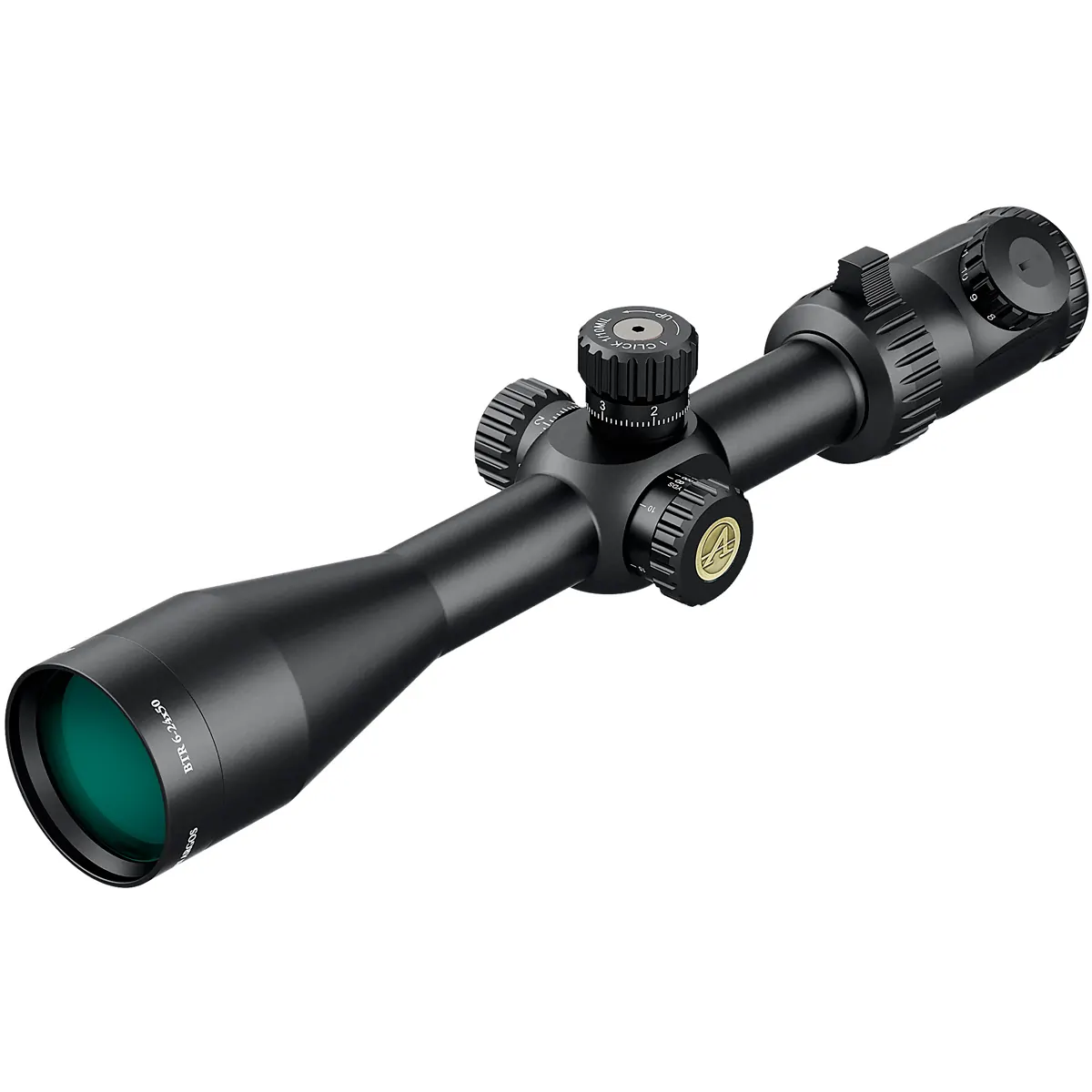
The Athlon Argos BTR Gen 2 6-24×50 sits in a crowded segment where budget-conscious shooters expect genuine performance, not just acceptable compromises. Priced around $400-$450, this scope promises first focal plane functionality, a Christmas tree reticle, and exposed tactical turrets – features that once belonged exclusively to optics costing twice as much. After several months testing this scope across prairie dog towns, steel ranges out to 800 yards, and whitetail stands in marginal light, I’ve developed a clear picture of where it excels and where its price point shows through.
This isn’t a scope trying to compete with alpha-tier glass, and it doesn’t pretend to be. Instead, Athlon aimed to deliver functional precision tools to shooters who need reliable tracking and usable reticle features without financing their optic. The question isn’t whether it matches a Nightforce – it’s whether it delivers enough performance to justify choosing it over saving longer or spending slightly more. That answer depends heavily on your specific application and expectations.
First Impressions & Build Quality Overview
Out of the box, the Argos BTR Gen 2 feels substantial without crossing into punishing territory. At 24.7 ounces, it’s noticeably lighter than some 34mm tube competitors, making it reasonable for hunting rifles that might see miles of carry. The 30mm tube is constructed from single-piece aluminum with a matte anodized finish that resists glare adequately, though the coating shows handling marks more readily than higher-end scopes with better surface treatments. The scope comes with a throw lever, lens covers, and a sunshade – a complete package that eliminates immediate accessory purchases.
Build quality presents a mixed picture that’s honest for this price bracket. The turrets feel solid with distinct clicks, but there’s slight rotational play in the magnification ring that doesn’t affect function but betrays the manufacturing tolerances. The eyepiece threads smoothly for diopter adjustment and locks firmly, while the parallax knob turns with consistent resistance throughout its range. Sealing appears adequate – I’ve used it through several rainstorms and temperature swings from 20°F to 95°F without fogging issues, though I haven’t subjected it to true abuse testing. This isn’t a scope I’d trust after a hard fall onto rocks, but for normal field use with reasonable care, the construction seems sufficient.
Optical Performance in Field Conditions
The optical performance is where budget scopes either justify themselves or reveal their limitations, and the Argos BTR Gen 2 lands firmly in “good enough for most tasks” territory. At 6x magnification in good light, the glass delivers sharp center resolution with acceptable edge clarity – certainly adequate for hunting applications where you’re focused on the center reticle anyway. Color rendition leans slightly cool but remains neutral enough not to distort target identification. Chromatic aberration is noticeable when examining high-contrast edges (like tree branches against bright sky) but doesn’t intrude during actual shooting scenarios where your focus narrows to the target.
Low-light performance is this scope’s most significant optical limitation. During the last 20 minutes of legal shooting light – critical time for whitetail hunters – the image noticeably dims compared to scopes with better glass and coatings. The 50mm objective helps, but the ED glass quality simply can’t gather and transmit light like Japanese or German optics in higher price brackets. At 24x magnification, the image gets dim enough in marginal conditions that I found myself dialing back to 12-16x to maintain a usable picture. For western hunting in open country where shots happen in good light, this isn’t problematic. For timber hunters or those frequently shooting in dawn/dusk conditions, the optical limitations become more relevant to your decision.
Turrets & Reticle Functionality Testing
The exposed tactical turrets are a primary reason shooters choose this scope, and they perform reliably within realistic expectations. Each click delivers a distinct tactile and audible feedback representing 0.1 mil adjustments. I’ve tracked these turrets through approximately 400 rounds of precision shooting, including multiple box tests and tall target evaluations. Tracking proved consistent and accurate – dialing 6 mils up repeatedly returned to zero within 0.1 mil, which is perfectly acceptable for field shooting. The turrets aren’t as crisp as Nightforce or even Vortex’s higher-tier offerings, with slightly mushy feedback, but they’re predictable and functional.
The APMR FFP (first focal plane) reticle uses a Christmas tree design with 0.2 mil hash marks and wind holds throughout. Being first focal plane, the reticle scales with magnification, remaining proportionally accurate at any power setting – essential for ranging or holding wind at variable distances. The reticle thickness works well from 12x upward but becomes almost too fine at 6x for quick acquisition, especially against dark backgrounds. For precision rifle applications where you’re typically at higher magnification, this isn’t problematic. Hunters who need rapid target acquisition at lower powers might find the fine reticle frustrating in thick cover or low light. The illumination offers 11 brightness levels with several usable in daylight, though the battery cap occasionally requires firm tightening to maintain consistent contact.
Real-World Use: Range to Hunting Applications
On the precision rifle range, the Argos BTR Gen 2 performs its intended role competently. I’ve used it for steel shooting from 300 to 800 yards, where the reticle’s wind holds and reliable tracking allowed first-round hits on IPSC-sized targets after confirming dope. The glass clarity at range distances is sufficient for spotting impacts on steel and reading mirage, though not for detailed bullet hole identification on paper beyond 300 yards. For shooters developing long-range skills or competing in budget-friendly divisions, this scope delivers the functional tools needed without embarrassing itself optically. The magnification range hits a sweet spot for this application – 6x provides enough field of view for stage setup, while 24x offers adequate resolution for distance work.
Hunting applications reveal both strengths and limitations based on your specific scenario. I mounted this scope on a .308 Winchester used for whitetail and coyotes, where it proved adequate but not ideal. The weight and turret profile make the rifle feel purposeful rather than nimble – fine for stand hunting or deliberate western stalks, less appealing for fast-moving situations. The optical performance in good light allowed confident shot placement out to 400 yards on deer-sized vitals. However, the dimmer image in twilight conditions cost me one shot opportunity when a buck appeared 15 minutes before dark – I could see him clearly enough but couldn’t confidently resolve the crosshair placement through brush shadows. For mountain hunters shooting in clear conditions or prairie shooters engaging coyotes in daylight, this scope works well. For thick-cover whitetail hunters where shooting light is often marginal, the optical limitations matter more than the feature set.
Competitive Comparison
| Feature | Athlon Argos BTR Gen 2 6-24×50 | Vortex Viper PST Gen II 5-25×50 | Bushnell Match Pro 6-24×50 | Arken EP5 5-25×56 |
|---|---|---|---|---|
| Street Price | ~$425 | ~$650 | ~$500 | ~$450 |
| Weight | 24.7 oz | 27.5 oz | 26.3 oz | 32.8 oz |
| Tube Diameter | 30mm | 30mm | 30mm | 34mm |
| Turret Type | Exposed tactical, 0.1 mil | Exposed tactical, 0.1 mil | Exposed tactical, 0.1 mil | Exposed tactical, 0.1 mil |
| Reticle | APMR FFP | EBR-2D FFP | Deploy MOA FFP | VPR Mil FFP |
| Low-Light Performance | Adequate | Good | Adequate | Adequate |
| Tracking Reliability | Consistent | Excellent | Very Good | Good |
| Best Use Case | Budget precision/daylight hunting | Serious precision/competition | PRS on a budget | Long-range practice |
The Vortex Viper PST Gen II costs 50% more but delivers noticeably better glass, superior low-light performance, and the confidence of Vortex’s transferable warranty. If you can stretch the budget, it’s a meaningful upgrade. The Bushnell Match Pro sits $75 higher with slightly better optical quality and more refined turrets – worth considering if your primary use is precision rifle competition. The Arken EP5 offers similar pricing with a larger objective and 34mm tube, but adds significant weight that makes it less suitable for hunting applications. The Athlon distinguishes itself by offering the lightest package with complete features at the lowest price, making it ideal for shooters who prioritize functionality over optical refinement.
Who Should Choose This Scope – And Who Shouldn’t
This scope makes sense for specific shooter profiles. Budget-conscious precision rifle shooters developing long-range skills will appreciate the functional reticle and reliable tracking at a price that leaves money for ammunition and training. Hunters who primarily shoot in good light conditions at moderate distances (200-400 yards) gain tactical turret adjustability and ranging capability without paying for optical quality they won’t fully utilize. Shooters building a practice rifle or backup hunting rifle get legitimate FFP functionality without premium investment. The Argos BTR Gen 2 delivers what it promises: working tools at an accessible price.
This scope isn’t right for everyone, and recognizing that saves disappointment. Serious low-light hunters – especially whitetail hunters in timber or evening stand sitters – should prioritize better glass even if it means fewer features or saving longer. Competitive precision rifle shooters who need confidence reading wind at distance or spotting trace will find the optical limitations frustrating compared to scopes just $200-300 more. Hunters who are hard on equipment or hunt in genuinely harsh conditions should invest in more robust construction with better warranty support. If your shooting demands maximize optical performance or durability, this scope’s compromises will matter more than its price advantage.
The Athlon Argos BTR Gen 2 6-24×50 succeeds at its intended mission: delivering first focal plane functionality, tactical features, and adequate optical performance at a price point accessible to budget-conscious shooters. It’s not trying to be a premium optic, and judging it against that standard misses the point. The tracking works, the reticle is functional, and the glass is clear enough for most practical shooting applications in good conditions. For shooters who understand and accept the optical limitations – particularly in low light – this scope provides genuine value and capability. The question isn’t whether it’s the “best” scope, but whether it’s the right scope for your specific needs, budget, and shooting environment. For many shooters developing skills, hunting in daylight, or building working rifles without premium budgets, the answer is yes. For those whose shooting consistently demands maximum optical performance or takes place in challenging light conditions, spending more or choosing a simpler second focal plane scope with better glass makes more sense. Know what you’re getting, use it within its capabilities, and the Argos BTR Gen 2 will serve you well without apology for what it costs.