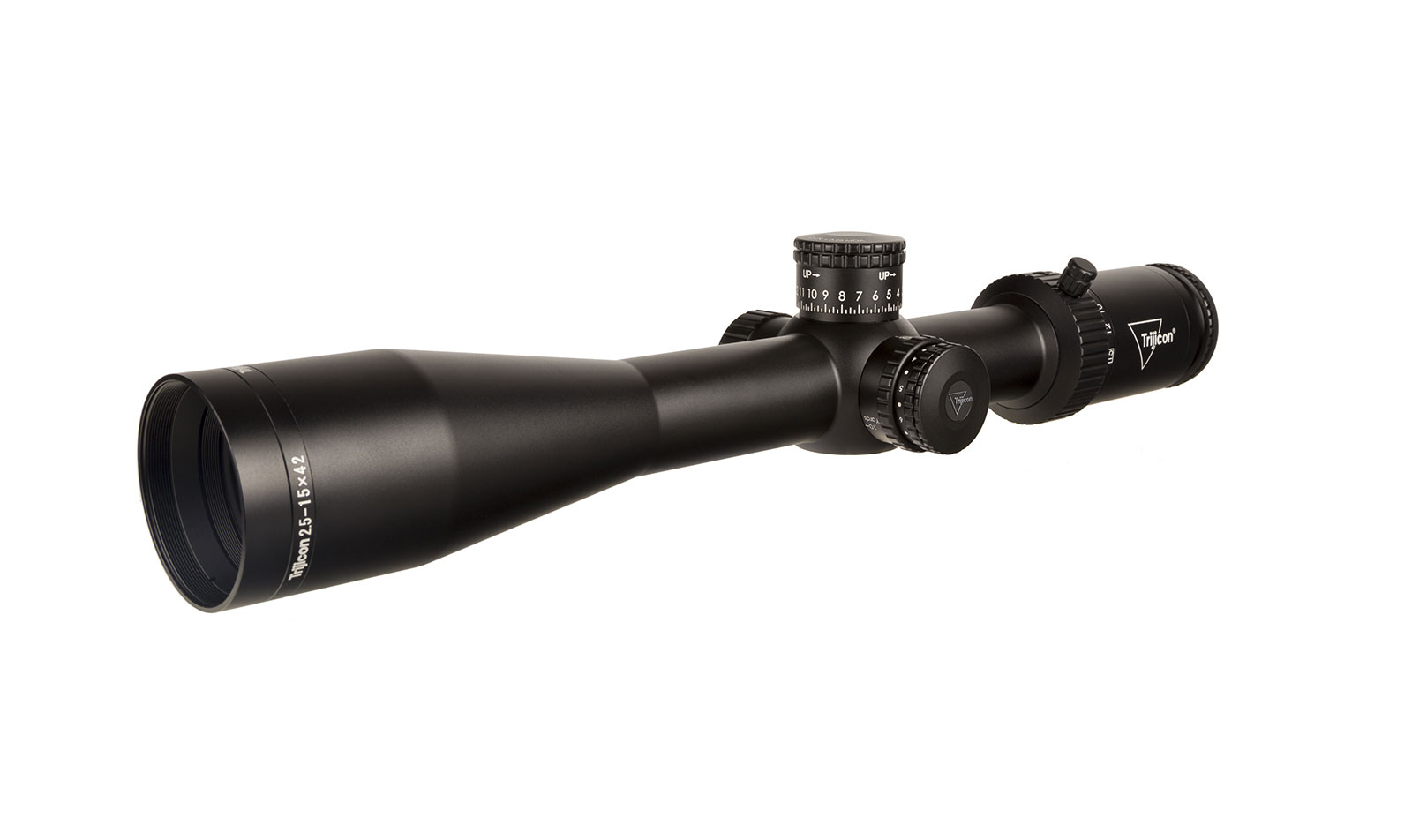

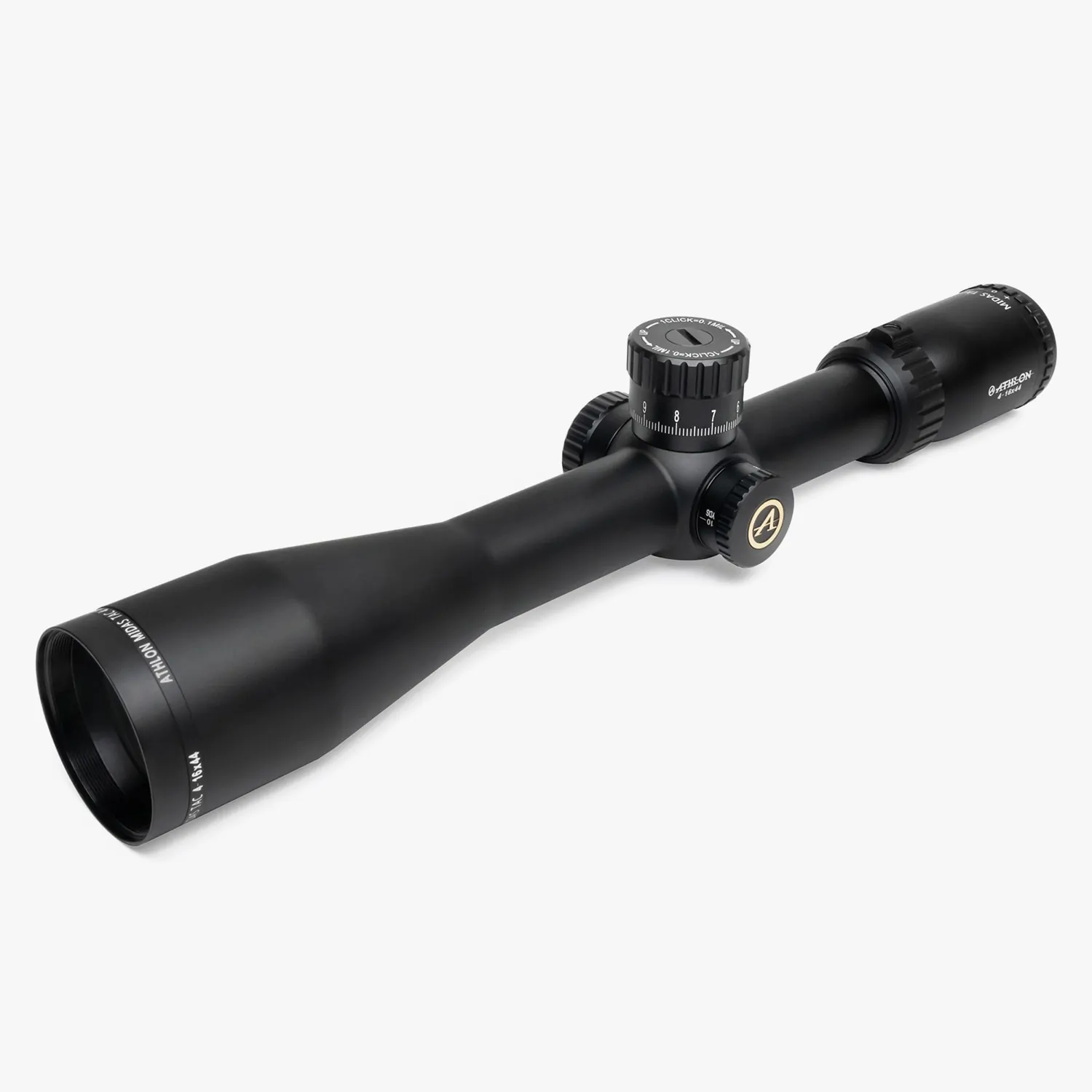
The Athlon Midas TAC 4-16×44 lands in your hands with a reassuring heft that suggests substance without crossing into burdensome territory. At 24.9 ounces, it occupies a middle ground that works for both precision rifle setups and hunting applications where weight matters but durability can’t be compromised. The machining is clean, with a matte black anodized finish that resists glare and shows attention to detail in the transition between the turret housing and main tube. The 30mm main tube provides adequate internal adjustment range, and the fast-focus eyepiece locks firmly without the slop you sometimes find in budget-oriented optics.
Build quality reflects Athlon’s positioning as a value-driven brand that doesn’t cut corners where it counts. The scope arrives with flip-up lens covers, a sunshade, and throw lever – accessories that would be extra-cost items from some manufacturers. Seals appear robust, and the nitrogen purging has held up through temperature swings and humidity without internal fogging in my testing. The turrets are capped, which signals Athlon’s understanding that this scope serves dual purposes: tactical training and hunting applications where you need protection from accidental adjustments. That said, the overall aesthetic leans more utilitarian than refined – this isn’t trying to compete with European elegance, and that’s perfectly fine for its intended market.
Optical performance in varied conditions
Glass quality in the Athlon Midas TAC 4-16×44 delivers performance that punches slightly above its price point but won’t be mistaken for alpha-tier optics. In full daylight with good contrast, the image is sharp across most of the field of view, with only modest edge softness that becomes noticeable past 12x magnification. Color rendition trends neutral without the warm cast some Japanese glass produces, making it easier to judge distance in natural terrain. Chromatic aberration is controlled adequately – you’ll see some purple fringing when glassing backlit branches against bright sky, but it doesn’t intrude during normal shooting scenarios.
Low-light performance reveals the scope’s practical limitations. At dawn and dusk, the 44mm objective provides workable brightness for the first and last 20 minutes of legal shooting light, but it falls behind larger objectives and premium glass coatings when conditions get truly marginal. The fully multi-coated lenses do their job competently, though side-by-side comparison with scopes using higher-grade coatings shows a noticeable difference in contrast and color saturation as light fades. For most hunting situations and daylight precision work, the optical package is entirely adequate. For serious low-light hunting or competitive shooting where target resolution at distance matters most, you’ll want to look at scopes with better glass pedigree.
Turrets & reticle functionality
The capped turrets on the Athlon Midas TAC 4-16×44 offer tactile clicks that are both audible and distinct under finger pressure. Each click represents 0.25 MOA of adjustment, and tracking tests across multiple range sessions have shown reliable return-to-zero performance. The turrets aren’t as crisp as those found on scopes costing twice as much – there’s a slight mushiness at the bottom of each click – but they’re consistent and predictable. The zero-stop feature works as advertised, though the setup process requires removing the turret cap and following the manual carefully. Elevation adjustment range is adequate for most applications out to 600-700 yards with common cartridges.
The APMR3 FFP reticle (first focal plane) is where this scope shows real utility for precision shooting. The reticle design balances holdover capability with a clean center aiming point, and being first focal plane means your holds remain accurate at any magnification. The Christmas tree-style wind holds are intuitive once you spend time with them, though the reticle can feel cluttered at lower magnifications for hunters accustomed to simple duplex designs. Illumination offers multiple brightness levels with off positions between settings, and the daylight-bright settings genuinely work in full sun. The parallax adjustment side-focus wheel turns smoothly and is marked clearly enough for ranging, though it’s not precise enough to replace a quality rangefinder.
Real-world use across shooting disciplines
In precision rifle applications, the Athlon Midas TAC 4-16×44 performs reliably for training and recreational shooting. I’ve run this scope through multiple range sessions from 100 to 600 yards, dialing for elevation and using the reticle for wind holds. The tracking has been consistent, and the 16x top-end magnification provides sufficient resolution for reading impacts on steel and paper at distance. The scope handles recoil from both .308 Winchester and 6.5 Creedmoor platforms without issue, maintaining zero through hundreds of rounds. For shooters building their first precision rifle setup or those wanting an affordable scope for practice, this delivers functional performance without breaking the bank.
Hunting applications reveal both strengths and compromises. The 4x bottom-end magnification is versatile enough for shots inside 100 yards, and the weight distribution works fine on both bolt-action and semi-automatic rifles. I’ve used this scope for whitetail hunting in mixed timber and agricultural settings where shots ranged from 75 to 350 yards. The reticle’s busy design takes some mental adjustment if you’re coming from traditional hunting scopes, but the first focal plane capability means you can dial down to 6x or 8x for closer shots and still have accurate holdovers available. The scope’s limitations show most clearly in thick cover during low light – the 44mm objective and glass quality simply don’t gather enough light to compete with larger, higher-quality hunting optics when conditions get tough.
How it compares to direct competitors
| Feature | Athlon Midas TAC 4-16×44 | Vortex Viper PST Gen II 3-15×44 | Bushnell Match Pro 3-15×44 |
|---|---|---|---|
| Street Price | ~$430 | ~$600 | ~$480 |
| Weight | 24.9 oz | 27.3 oz | 25.5 oz |
| Glass Quality | Good | Better | Good |
| Turret Feel | Adequate | Excellent | Very Good |
| Reticle Plane | FFP | FFP | FFP |
| Low-Light | Acceptable | Good | Acceptable |
| Warranty | Lifetime | Lifetime | Lifetime |
Against the Vortex Viper PST Gen II 3-15×44, the Athlon offers similar capability at a lower price point but gives up some optical quality and notably superior turret feel. The Vortex delivers crisper clicks and better glass, which matters if you’re shooting competitively or need every edge in marginal light. The Bushnell Match Pro 3-15×44 sits between them in price and performance – its turrets are better than the Athlon’s, though not quite matching Vortex, and glass quality is comparable. The Athlon’s advantage lies in its included accessories and slightly lower entry cost, making it attractive for budget-conscious shooters.
Where the Athlon Midas TAC 4-16×44 truly competes is against shooters’ temptation to buy cheaper optics that compromise on fundamentals. Compared to sub-$300 scopes, this delivers meaningfully better tracking reliability and glass quality. It’s not trying to compete with $1000+ optics from Nightforce or Kahles – that’s a different performance tier entirely. This scope exists for shooters who understand they need first focal plane reticles and reliable adjustments but can’t justify or don’t need top-shelf pricing. If you’re choosing between this and significantly cheaper options, the Athlon is worth the extra investment. If you’re comparing it to premium mid-range scopes and can afford the step up, scopes like the Vortex Viper PST Gen II offer noticeable improvements.
Common mistakes when setting up this scope
The most frequent error with the Athlon Midas TAC 4-16×44 involves improper scope height selection, particularly on AR-platform rifles. The 44mm objective requires adequate clearance, and many shooters underestimate the needed ring height, ending up with the objective bell contacting the barrel or handguard. For AR-15 platforms, you’ll typically need rings that provide at least 1.5 inches of height from the rail to the scope’s center line. On bolt-action rifles with lower mounting surfaces, medium-height rings usually suffice, but always verify clearance before permanently mounting and lapping.
The second common mistake involves misunderstanding the zero-stop setup procedure. Unlike some scopes where the zero-stop is pre-set from the factory, this requires manual configuration after zeroing your rifle. Shooters who skip this step or rush through it often find their zero-stop isn’t actually at zero, leading to confusion during shooting sessions. Take the time to follow the manual’s instructions precisely – zero your rifle at your chosen distance, then remove the turret cap and set the zero-stop mechanism before replacing the cap. Additionally, many hunters transitioning from second focal plane scopes forget that the FFP reticle appears smaller at low magnification. This isn’t a defect – it’s inherent to FFP design. If you need a bold aiming point at 4x for close shots, consider adding a small piece of bright tape to your parallax knob as a reminder to bump magnification to 6x or 8x, where the reticle becomes more visible while maintaining its subtension accuracy.