
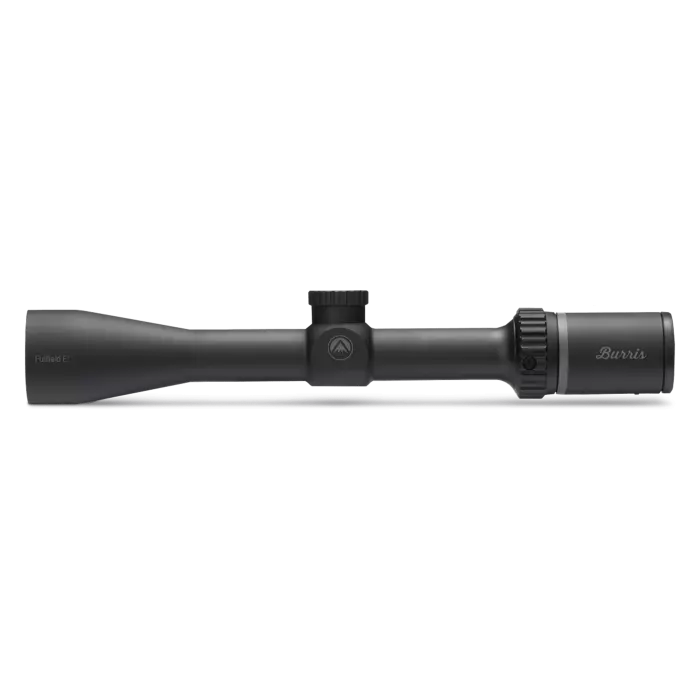
The Burris Fullfield E1 3-9×40 arrives with a straightforward, no-nonsense presentation that immediately signals its purpose – this is a working hunter’s scope, not a showpiece. The matte black finish is uniform and functional, and the 40mm objective keeps the profile trim enough for quick-handling rifles. At 12.6 ounces, the Burris Fullfield E1 3-9×40 sits comfortably in that sweet spot where you notice the quality but don’t feel burdened on long stalks through rough country. The tube is one-piece construction, and while the turret caps are simple plastic affairs, they snap on securely and don’t rattle.
Build quality reflects the price point honestly – this isn’t trying to be something it’s not. The magnification ring turns smoothly with positive detents, though it requires more effort than premium European glass. The eyepiece adjusts easily for diopter correction, and the fast-focus feature works as advertised. Burris includes their Forever Warranty, which adds real value when you’re spending under $200. The scope mounts easily in standard one-inch rings, and there’s no play or flex in the tube when properly torqued. It feels like a tool built to do a job rather than impress at the range.
Optical Performance in the Field
Glass clarity in the Burris Fullfield E1 3-9×40 delivers exactly what you’d expect from this price bracket – perfectly adequate for hunting inside 300 yards with some compromises. Center sharpness from 3x through 7x is genuinely good, with enough resolution to distinguish antler points and identify shot placement zones on deer-sized game. Edge clarity softens noticeably, particularly above 7x magnification, but this matters far less in hunting applications than shooters often assume. Color rendition leans slightly warm, which actually helps game stand out against foliage in typical woodland conditions.
Low-light performance is the real test for budget hunting glass, and here the Fullfield E1 performs adequately but not impressively. In the critical half-hour before dark when deer movement peaks, you’ll notice the image dims faster than scopes costing two or three times as much. Chromatic aberration appears as purple fringing around dark branches against bright sky, though it’s manageable and rarely interferes with shot placement. The parallax is factory-set at 100 yards, which works well enough for typical hunting ranges but shows noticeable shift when glassing beyond 200 yards. For morning and evening hunts in heavy timber or field edges at reasonable distances, the optical package does the job without apology.
Turrets & Reticle Functionality
The Burris Fullfield E1 3-9×40 comes with a Ballistic Plex reticle in the second focal plane, which keeps the crosshair size constant regardless of magnification – exactly what most hunters want. The reticle is simple and effective: a duplex design with thick outer posts that taper to fine crosshairs at center, plus hash marks below the horizontal wire for holdover at extended range. The hash marks correspond to specific bullet drops if you match them to your load and zero distance, though this requires some homework with Burris’s online calculator. In practice, most hunters will use the main crosshair for shots inside 250 yards and ignore the rest, which is perfectly reasonable for this scope’s intended application.
Turrets are capped, finger-adjustable models with 1/4 MOA clicks that you can hear and feel – barely. The tactile feedback is mushy compared to anything in the tactical scope world, but they’re not designed for dialing corrections in the field. The adjustments track reasonably well for initial zeroing, though I wouldn’t trust them for repeated adjustments and returns to zero. Elevation and windage offer 40 MOA of total adjustment, which provides adequate range for most hunting rifles. The turrets are meant to be set and forgotten under those caps, and that’s how you should use them. If you need to dial for long-range shots, this isn’t your scope – but that’s not what it’s built for.
Real-World Use: Hunting Performance
I’ve used the Burris Fullfield E1 3-9×40 on a 308 Winchester for two whitetail seasons and one western mule deer hunt, and it’s proven itself a capable tool within its limitations. On my local whitetails in mixed hardwood forest, shots typically come between 75 and 180 yards, and the scope has never been the limiting factor. The 3x low end provides enough field of view for quick target acquisition when a deer appears in thick cover, and 9x delivers plenty of detail for precise shot placement on broadside or quartering animals. The scope held zero through transport in a soft case, ATV rides on rough trails, and the inevitable bumps that come with hunting from ladder stands and ground blinds.
The mule deer hunt in Colorado tested the scope’s limits more thoroughly. At 8,000 feet in open sage and juniper country, shots stretched to 280 yards, and the optical compromises became more apparent. Glassing for bedded deer at 9x revealed the edge softness and chromatic aberration I’d noticed before, though once I identified an animal and confirmed it was legal, the shot itself was straightforward. The scope’s lighter weight was genuinely appreciated during long climbs and ridge walks. Recoil handling has been solid – no shift in zero, no loose components, no failures of any kind. For the hunter who needs a reliable scope for typical hunting ranges and doesn’t require premium glass or tactical features, this scope delivers honest performance without pretense.
How It Compares to Competitors
The budget 3-9×40 hunting scope market is crowded with options, and the Burris Fullfield E1 sits in the middle of the pack with some specific advantages. Against the Vortex Diamondback 3-9×40, the Burris offers slightly better edge clarity and a more hunting-focused reticle, while Vortex provides a better warranty experience and marginally brighter image in low light. The Leupold VX-Freedom 3-9×40 costs about $50-75 more but delivers noticeably better glass quality and superior low-light performance – if your budget stretches that far, the Leupold is worth the extra money. The Nikon Prostaff (now discontinued but still available used) matched the Burris closely in optical quality but had a slight edge in turret feel.
| Feature | Burris Fullfield E1 3-9×40 | Vortex Diamondback 3-9×40 | Leupold VX-Freedom 3-9×40 |
|---|---|---|---|
| Street Price | $180-200 | $180-210 | $250-280 |
| Weight | 12.6 oz | 13.1 oz | 12.6 oz |
| Low Light Performance | Adequate | Good | Very Good |
| Turret Quality | Basic, mushy clicks | Better feedback | Excellent, crisp clicks |
| Glass Clarity | Good center, soft edges | Good overall | Excellent throughout |
| Warranty | Forever Warranty | VIP Lifetime | Lifetime |
The Burris makes sense if you’re maximizing value on a strict budget and hunting at reasonable ranges. If you hunt primarily in low-light conditions or need better glass quality, save for the Leupold. The Vortex splits the difference and offers exceptional customer service. None of these scopes will impress long-range shooters or serve well for precision applications, but that’s not their purpose.
Common Mistakes When Using This Scope
The most frequent error I see with the Burris Fullfield E1 3-9×40 is hunters trying to use it beyond its designed capability. This is a 250-yard scope for hunting applications, maybe 300 in perfect conditions with solid fundamentals. Attempting to dial turrets for long-range shots or trusting the Ballistic Plex holdovers without proper verification leads to wounded game and frustration. The holdover hash marks require specific velocity and zero combinations to work correctly – don’t assume they’ll match your load without testing. If you need to shoot beyond 300 yards regularly, buy a different scope with better glass, reliable turrets, and first focal plane reticles designed for that work.
Another common mistake is mounting this scope on hard-recoiling magnums or lightweight mountain rifles where the cumulative punishment exceeds what the scope is built to handle. While the Fullfield E1 handles standard cartridges like .308, .30-06, and even .300 Winchester Magnum in properly-weighted rifles, pairing it with a 6.5-pound .300 WSM or putting it through hundreds of rounds of load development will likely reveal its limitations. The scope also suffers when hunters fail to properly torque rings and bases – at this price point, the scope won’t compensate for sloppy mounting. Use quality rings, apply proper torque specs, and treat it like the working tool it is. Clean the lenses carefully, protect it during transport, and don’t expect it to perform like scopes costing three times as much. Realistic expectations matched to appropriate applications will serve you far better than hoping budget glass can do everything.