
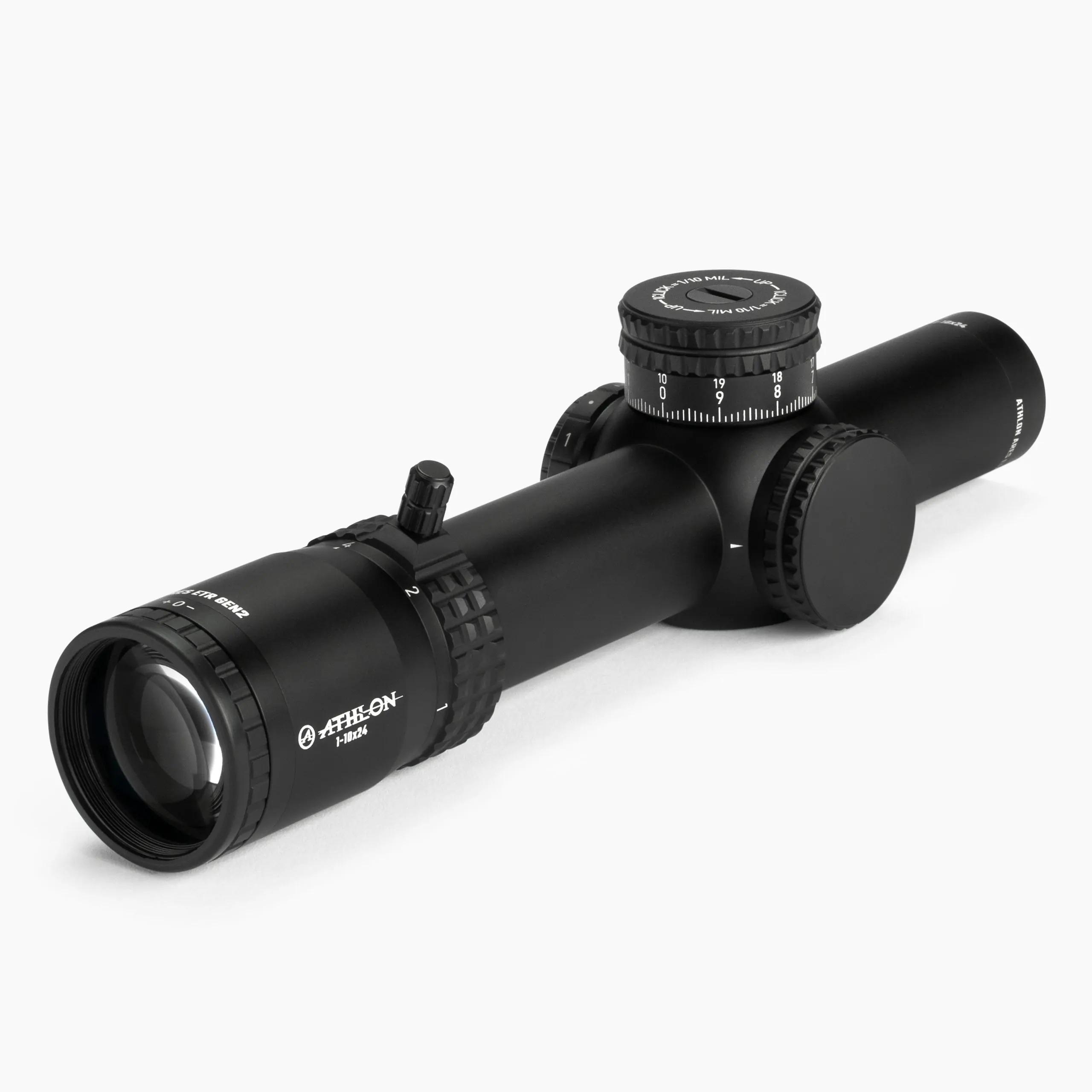
The Athlon Ares BTR Gen2 1-10×24 arrives with a purposeful, no-nonsense appearance that immediately communicates its tactical-hunting crossover intent. At 25.6 ounces and 10.24 inches long, the Athlon Ares BTR Gen2 1-10×24 sits in a comfortable middle ground – light enough for quick-handling rifles but substantial enough to feel like a serious piece of equipment. The 34mm main tube is a welcome feature at this price point, providing generous internal adjustment range (80 MOA elevation, 50 MOA windage) and positioning this optic closer to premium-tier construction than budget alternatives. The finish is matte black with well-executed machining, though not quite as refined as what you’d see on European glass.
The turrets are capped and low-profile, which makes sense for a variable power optic designed for dynamic shooting rather than dialing. The throw lever is included and easily removable, though the magnification ring turns smoothly enough that you may not always need it. Eye relief is advertised at 3.74-3.94 inches across the magnification range, and in practice, it’s forgiving – critical for a 1-10x scope that needs to work at true 1x for close encounters. The scope comes with lens covers and a sunshade, rounding out a package that feels complete out of the box without requiring immediate accessory purchases.
Optical performance in the field
Glass clarity on the Athlon Ares BTR Gen2 1-10×24 is where this optic earns its place in the mid-tier market. The Japanese ED glass delivers good color fidelity and resolution across the magnification range, with sharpness holding up well into the outer third of the image before you notice any degradation. At 1x, the sight picture is genuinely usable for both-eyes-open shooting, though there’s a slight tunnel effect compared to true red dots – acceptable for a variable scope but worth noting if you’re transitioning from dedicated close-range optics. Edge distortion is minimal until you push past 8x, where some chromatic aberration becomes visible in high-contrast scenarios like dark timber edges against bright sky.
Low-light performance is solid but not exceptional. During last-light hunts in heavy cover, the 24mm objective limits light transmission compared to larger objectives in this magnification class. The scope remains functional in legal shooting light, but you’ll notice the image dimming faster than premium German or Japanese alpha glass. The illuminated reticle helps considerably here – the APMR3 FFP reticle offers 11 brightness settings with off positions between each level, allowing precise adjustment for varying light conditions. At maximum magnification in good light, the glass resolves detail well enough for precise shot placement out to 600-700 yards on game-sized targets, making this a legitimate hunting tool for most practical applications.
Turrets & reticle functionality
The capped turrets on the Athlon Ares BTR Gen2 1-10×24 are designed for set-and-forget zero work rather than frequent dialing, and they execute that role competently. Clicks are tactile and audible at 0.1 mil per click, with consistent resistance throughout the rotation. I’ve run this scope through multiple range sessions and two hunting seasons without experiencing any zero shift, which is the fundamental requirement for any optic. The turrets reset to zero easily after removing the caps – a three-screw system that’s straightforward but requires an Allen key. Turret caps are tethered, which prevents loss in the field but can occasionally catch on gear in tight spaces.
The APMR3 first focal plane reticle is the real functional highlight of this scope. The reticle scales appropriately across the magnification range, remaining usable at 1x for quick shooting while providing enough subtension detail at 10x for holdover work. The Christmas tree lower half gives you multiple aiming points without cluttering the center, and the 0.2 mil hash marks are spaced well for wind calls. Reticle illumination is daylight-bright at the upper settings – genuinely usable in full sun – and dims low enough for night vision compatibility at the bottom end. The illumination knob is positioned at 11 o’clock, accessible but not prone to accidental adjustment. If you’re planning to dial rather than hold, this isn’t the ideal platform – but for a hold-based shooting system, the reticle gives you everything needed for quick ranging and compensation.
Real-world use across hunting scenarios
I’ve deployed the Athlon Ares BTR Gen2 1-10×24 on a 16-inch .308 bolt gun and a 5.56 semi-auto, and it’s proven most effective in mixed-terrain hunting where engagement distances vary widely. On driven boar hunts where shots ranged from 30 to 250 yards, the magnification range covered everything without requiring scope changes or compromise. The true 1x capability meant quick shots on moving game were instinctive, while cranking to 10x provided enough detail for precise placement on standing shots across valleys. The scope’s weight didn’t penalize the rifle’s handling, and the eyebox was forgiving enough that I never lost the sight picture during rushed mounting.
For mountain hunting in the Rockies, the Athlon Ares BTR Gen2 1-10×24 handled elevation changes and temperature swings without issue. I verified zero at both 2,000 and 9,500 feet with no point-of-impact shift. The scope maintained zero through pack carry, rifle drops onto talus, and typical field abuse. Where it showed limitations was in thick timber at dawn and dusk – the 24mm objective simply doesn’t gather enough light to extend your effective shooting window compared to larger scopes. If most of your hunting happens in the first and last 20 minutes of legal light, you’ll want more objective diameter. For midday hunts, overcast conditions, or open country work, the glass performs admirably. The scope also excels on predator rifles where weight matters and shots typically happen in better light.
How it compares to direct competitors
| Optic | Weight | Price Range | Glass Origin | Key Advantage |
|---|---|---|---|---|
| Athlon Ares BTR Gen2 1-10×24 | 25.6 oz | $650-750 | Japan (ED) | Best value FFP with 34mm tube |
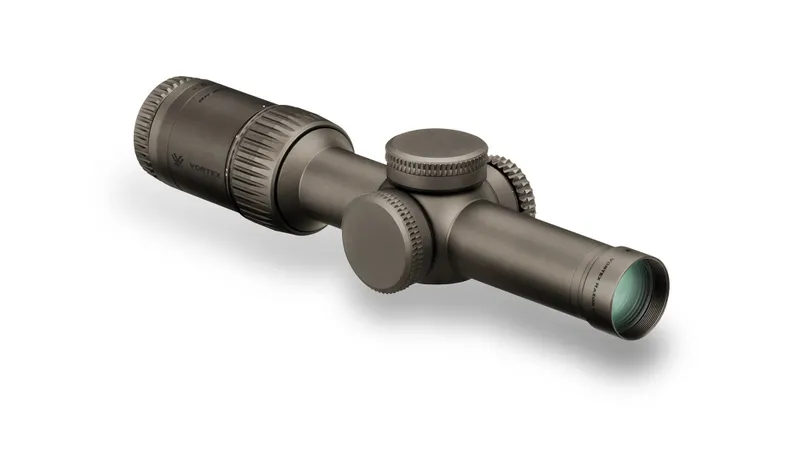
| Vortex Razor HD Gen II-E 1-6×24 | 21.6 oz | $1,100-1,300 | Japan | Superior glass, lighter weight |
| Primary Arms PLx 1-8×24 | 21.7 oz | $800-900 | Japan | Similar performance, less mag range |
| Burris XTR II 1-8×24 | 20.5 oz | $650-800 | Philippines | Lighter, but less robust turrets |
Against the Vortex Razor HD Gen II-E 1-6×24, the Athlon offers more magnification range and a 34mm tube at roughly half the price, but the Vortex delivers noticeably better glass clarity and low-light performance. The Razor’s image is brighter and sharper edge-to-edge, and the build quality feels more refined. If your budget allows and you can live with 6x maximum magnification, the Vortex is the better optic. However, the Athlon provides 80-85% of the performance at 50-60% of the cost, making it a rational choice for shooters who need to balance capability with budget.
The Primary Arms PLx 1-8×24 sits between the Athlon and Vortex in both price and performance. It’s lighter than the Athlon and offers comparable glass quality, but you sacrifice 2x magnification on the top end. For pure close-to-medium range work, the Primary Arms is excellent – but the Athlon’s 10x maximum extends its utility for longer shots. The Burris XTR II 1-8×24 competes directly on price but uses Philippine glass that doesn’t quite match the Athlon’s clarity, and I’ve experienced more frequent tracking issues with Burris turrets. The Athlon edges ahead in this matchup based on optical quality and mechanical reliability.
Common mistakes when using this optic
The most frequent error I see with the Athlon Ares BTR Gen2 1-10×24 is mounting it incorrectly for the intended use. This scope needs proper eye relief setup – if you mount it too far forward trying to maximize eye relief at 10x, you’ll compromise the 1x performance and lose the both-eyes-open capability that makes low magnification useful. Take time to find the sweet spot where you get a full sight picture at 1x with your natural head position, even if that means slightly shorter eye relief at maximum magnification. A quality cantilever mount helps here, as it positions the scope forward enough for AR-platform rifles while maintaining proper eye relief.
Another common mistake is expecting this scope to perform beyond its design parameters. The 24mm objective and FFP reticle mean the reticle gets small at low magnification and the image dims faster than larger scopes in poor light. Hunters who need last-light performance should consider a 2-12×42 or similar configuration instead. Similarly, shooters who want to dial elevation for long-range precision work will find the capped turrets and 1-10x magnification limiting – this scope is optimized for hold-based shooting inside 700 yards. Understanding and accepting these design trade-offs prevents disappointment and allows you to use the scope for what it does well rather than forcing it into roles better suited to different optics.
Quick takeaways – is it worth your money?
The Athlon Ares BTR Gen2 1-10×24 delivers legitimate mid-tier performance at a price point that undercuts most direct competitors. It’s ideal for hunters who need magnification versatility across varied terrain, shooters running do-everything rifles that might see both close-range and extended shots, and anyone wanting first focal plane capability without spending four figures. The 34mm tube, Japanese ED glass, and robust construction make this a scope you can trust in the field. It won’t embarrass you optically, and it’ll hold zero through normal hunting use.
This optic isn’t the right choice if you prioritize low-light performance above all else – the 24mm objective is a real limitation in dim conditions. It’s also not ideal for dedicated long-range precision shooters who need exposed turrets and higher magnification for dialing solutions. If your hunting happens primarily at dawn and dusk in heavy cover, look at scopes with larger objectives. If you’re building a specialized long-range rig, you need different tools. But for the hunter or tactical shooter who values versatility, needs a scope that works from 25 to 500 yards without compromise, and wants solid quality without premium pricing, the Athlon Ares BTR Gen2 1-10×24 represents genuine value. It’s a workhorse scope that does most things well rather than one thing perfectly – and for many shooters, that’s exactly what’s needed.