
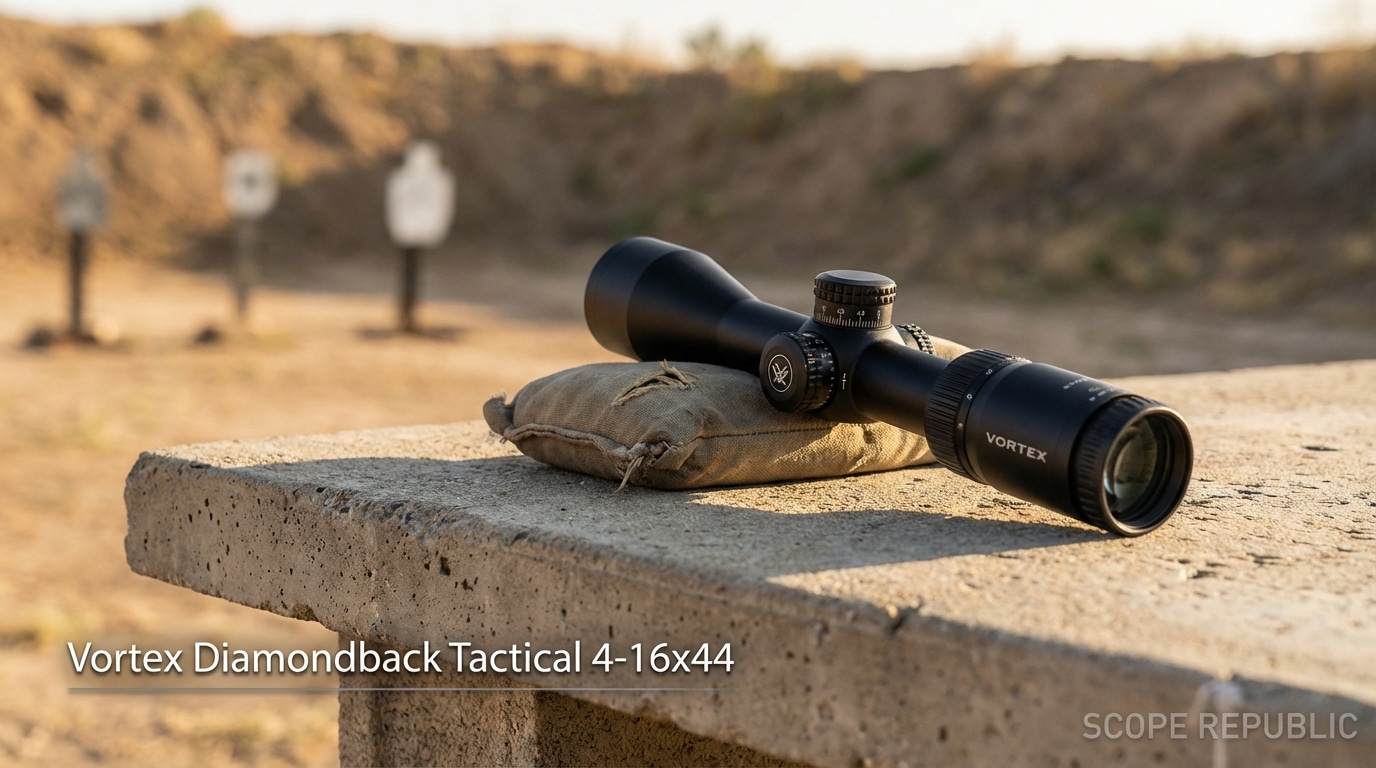
The Vortex Diamondback Tactical 4-16×44 sits in an interesting position within the budget-to-midrange tactical scope market. Priced comfortably under $400, it promises first focal plane performance, exposed tactical turrets, and enough magnification range for precision shooting out to moderate distances. I’ve run this optic through multiple range sessions and field conditions over several months, mounting it on both a .308 bolt gun and a precision AR-15 platform. What follows is an honest assessment of where this scope delivers on its promises – and where its price point shows through.
First Impressions & Build Quality
The Diamondback Tactical arrives with a solid feel that immediately separates it from bottom-tier optics. The 30mm main tube is constructed from aircraft-grade aluminum with a matte black anodized finish that resists glare reasonably well. At 21 ounces, it’s not featherweight, but the heft feels purposeful rather than excessive. The turret caps thread on smoothly, the magnification ring turns with appropriate resistance, and the side parallax adjustment operates without slop. Nothing about the construction screams “premium,” but neither does anything feel like it’ll fail under normal use.
Where Vortex made smart compromises becomes apparent upon closer inspection. The turrets are capped rather than zero-stop equipped, which keeps costs down but means you’ll need to track your rotations mentally or with tape markers. The diopter adjustment at the eyepiece is fast-focus style rather than a locking collar – functional, but it can shift if you’re rough with the scope. The flip-up lens covers are basic butler creek-style caps that work but don’t inspire confidence for hard field use. For a scope at this price point, these are acceptable trade-offs, but users coming from higher-end glass will notice the difference immediately.
Optical Performance in Field Conditions
The optical clarity of the Diamondback Tactical is where expectations need calibration. In good lighting conditions – bright overcast or full sun – the glass performs admirably for its price class. Edge-to-edge sharpness is decent at mid-magnifications (8-12x), with noticeable but not disqualifying softening near the periphery at 16x. Color rendition leans slightly cool but remains natural enough for target identification. Chromatic aberration is present when viewing high-contrast edges (think bare branches against bright sky), showing purple fringing that’s typical of scopes in this tier. It’s not obtrusive during most shooting scenarios, but it’s there.
Low-light performance reveals the scope’s limitations more clearly. The 44mm objective gathers adequate light for shooting through late afternoon, but as dusk approaches, the image dims noticeably faster than scopes with higher-quality coatings or larger objectives. I’ve used this scope during early morning deer observation, and while it’s functional in the first hour after sunrise, it doesn’t extend your shooting window the way premium glass does. The fully multi-coated lenses help, but you’re getting entry-level coatings here – functional, not exceptional. For range work and most hunting scenarios in reasonable light, it’s entirely adequate. For alpine hunting in variable weather or serious low-light work, you’ll want better glass.
Turrets, Tracking & Reticle Functionality
The exposed tactical turrets are among the most important features on this scope, and they perform better than the price suggests – with caveats. Each click delivers 0.25 MOA adjustment with tactile and audible feedback that’s clear enough to count without looking. I ran a tall target tracking test at 100 yards, dialing 15 MOA up and back down multiple times. The turrets tracked within 0.5 MOA of advertised values across the range, which is respectable. There’s no mushiness or backlash in the adjustments, and return-to-zero has been reliable over multiple sessions. However, the clicks aren’t as crisp as what you’d find on a Bushnell LRHS or Athlon Midas TAC – there’s a slight sponginess that experienced shooters will notice.
The first focal plane reticle (I tested the EBR-2C MOA version) scales appropriately throughout the magnification range and remains usable from 4x through 16x. At 4x, the reticle is visible but fine; at 16x, it’s bold enough for precise holdovers without obscuring small targets. The hash marks are logically spaced for wind holds and ranging, though the reticle is busy enough that it can clutter the sight picture when scanning terrain at lower magnifications. Illumination is provided via a side-mounted dial with multiple brightness settings. The illumination is daylight-visible at higher settings but drains the battery (CR2032) relatively quickly if left on. For most tactical and precision rifle applications, the reticle design works well. For hunting in thick cover where speed matters, the reticle complexity might be more than necessary.
Real-World Use: Range to Field Testing
On the range, the Diamondback Tactical proves itself as a capable trainer and competition optic for shooters working within its limitations. I’ve used it for PRS-style practice out to 600 yards, and the combination of magnification range, reticle design, and turret performance makes it entirely functional for learning fundamentals and practicing positional shooting. The eyebox is forgiving enough at 4-10x but tightens up noticeably at full magnification – you’ll need consistent cheek weld and head position at 16x, or you’ll see scope shadow and vignetting. Eye relief sits around 3.5 inches, which is adequate for most rifles but can feel cramped on hard-recoiling magnums.
In the field, I’ve mounted this scope on a .308 bolt gun for prairie dog shooting and steel target practice in variable weather. It handles temperature swings without issue – no fogging internally, and the turrets continued functioning smoothly in 20°F conditions. The scope has taken bumps in a truck bed and been knocked around on shooting bags without losing zero. For a working rifle that sees regular use but not abuse, it’s proven durable. Where it falls short is in the optical performance during marginal conditions: late evening shots, heavily overcast days, or trying to resolve detail in shadowed timber. The glass simply doesn’t transmit enough light or provide enough contrast to compete with scopes even one tier up in price. If your shooting happens primarily in controlled conditions or good light, that’s a non-issue. If you’re hunting in the mountains or shooting in varied environments, the optical limitations will frustrate you.
Competitive Landscape
| Scope | Price | Weight | Glass Quality | Turret Performance | Best For |
|---|---|---|---|---|---|
| Vortex Diamondback Tactical 4-16×44 | ~$380 | 21 oz | Adequate; CA present | Good tracking, mushy clicks | Budget precision shooting, training |
| Athlon Midas TAC 5-25×56 | ~$450 | 30 oz | Slightly better; larger objective | Excellent; crisper clicks | Long-range practice, more magnification needed |
| Bushnell Match Pro 6-24×50 | ~$420 | 26 oz | Comparable; better coatings | Very good; zero stop included | Serious competition on a budget |
| SWFA SS 3-15×42 | ~$700 | 23 oz | Noticeably superior | Exceptional; bomb-proof | Hunters/shooters wanting upgrade glass |
The Diamondback Tactical competes directly with scopes like the Athlon Midas TAC and Bushnell Match Pro. The Athlon offers more magnification and a larger objective for slightly more money, making it better suited for long-range work where every bit of detail matters. The Bushnell Match Pro includes features like a zero stop and slightly better glass coatings, making it a stronger choice for competitive shooters who can stretch the budget. The SWFA SS costs nearly double but delivers meaningfully better optical performance – it’s the scope you buy when you’re tired of compromising on glass quality but still want tactical features.
Who This Scope Is For – And Who Should Look Elsewhere
The Vortex Diamondback Tactical 4-16×44 is ideal for shooters who need tactical features and FFP performance without spending $800+. It’s a solid choice for new precision rifle shooters building their first dedicated long-range setup, for trainers who need reliable turrets and reticle functionality for practicing fundamentals, or for budget-conscious competitors shooting club-level matches. It’s also reasonable for varmint hunting and steel shooting where lighting conditions are generally favorable. Vortex’s VIP warranty adds value here – if something breaks, they’ll fix or replace it, no questions asked.
This scope is not the right choice if low-light performance is critical to your shooting. Mountain hunters, those pursuing game during dawn/dusk hours, or shooters who regularly work in poor weather should invest in better glass. Similarly, if you’re mounting this on a hard-recoiling magnum or plan to subject it to genuine tactical/duty use, the turrets and construction, while adequate, aren’t as bomb-proof as scopes from Nightforce or higher-end Vortex lines. Competitive shooters serious about winning should also look at the Bushnell Match Pro or save for an Athlon Ares BTR – the features and performance justify the extra cost. The Diamondback Tactical is a working optic that punches above its weight in some areas while showing its price point in others. Know what you’re getting, and it won’t disappoint.
After months of use, the Vortex Diamondback Tactical 4-16×44 has earned its place as a legitimate budget tactical optic that doesn’t embarrass itself on the range or in the field. It’s not going to wow you with optical brilliance or turret refinement, but it tracks reliably, holds zero, and provides the features needed for precision shooting at a price that won’t require a second mortgage. If you understand its limitations – particularly in glass quality and low-light performance – and your shooting fits within those boundaries, this scope delivers honest value. For shooters who need better glass or plan to push their equipment harder, save the extra money and step up. But for those building a capable rifle on a budget or learning long-range fundamentals, the Diamondback Tactical is a sensible choice that gets the job done without pretense.