
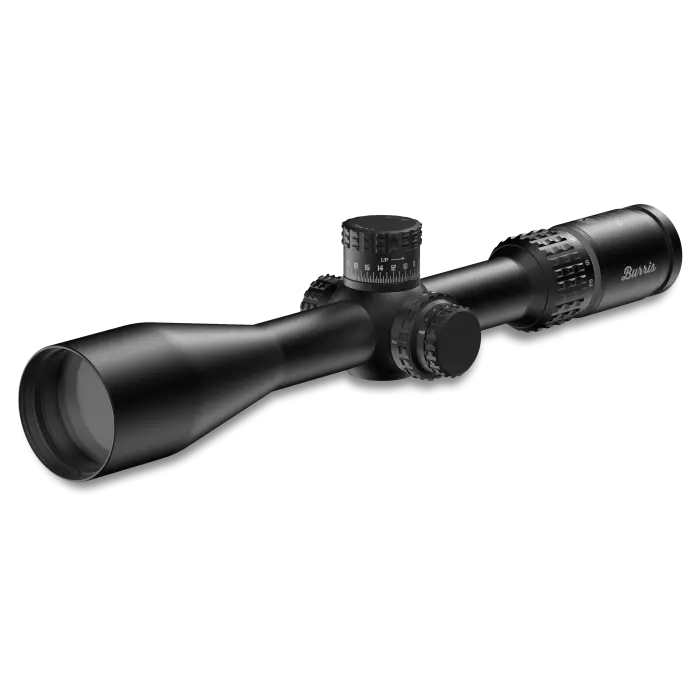
The Burris Veracity 4-20×50 arrives with a purposeful, workmanlike appearance that signals its intended role without unnecessary flash. The 30mm main tube feels substantial in hand, and the matte finish resists glare effectively while showing fingerprints less than glossier alternatives. At 27 ounces, the Burris Veracity 4-20×50 sits in a reasonable weight class for a 50mm objective scope, though it’s noticeably heavier than some European counterparts with similar magnification ranges. The machining quality shows consistent tolerances, with no play in the turrets or magnification ring during initial inspection.
The scope ships with flip-up lens covers and a sunshade, which adds practical value without inflating the price point. The ocular housing accommodates a fast-focus eyepiece that locks firmly once adjusted. One minor quibble: the magnification throw lever attachment point uses a slightly undersized screw that could strip if over-torqued. The overall construction suggests this optic will handle field use without coddling, though it doesn’t exude the bank-vault solidity of premium German or Japanese glass in the $1,500-plus range.
Optical Performance in Field Conditions
Glass clarity through the Burris Veracity 4-20×50 delivers solid mid-tier performance that punches slightly above its price class. Edge-to-edge sharpness remains usable out to about 85% of the field of view at maximum magnification, with noticeable softening in the outer periphery – acceptable for precision shooting where you’re focused on the center reticle anyway. Color rendition leans slightly warm without being objectionable, and chromatic aberration is well-controlled in high-contrast scenarios like treelines against bright skies.
Low-light performance is where this scope shows its limitations against pricier competitors. At dawn and dusk, the Burris Veracity 4-20×50 provides adequate light transmission for ethical shooting decisions, but you’ll notice the image loses contrast and appears slightly murkier compared to scopes with higher-grade coatings. In practical terms, this means you might call off a shot 10-15 minutes earlier than you would with premium glass. The scope performs best in good to moderate lighting conditions, where the clarity difference between this and scopes costing twice as much narrows considerably.
Turrets & Reticle Functionality
The exposed tactical turrets on the Burris Veracity 4-20×50 use 1/4 MOA clicks that provide distinct, audible feedback with each adjustment. The clicks feel positive without being overly stiff, and importantly, they track accurately – a 20 MOA box test showed consistent return to zero with no measurable drift. Each revolution offers 10 MOA of adjustment, with a zero-reset function that works intuitively after loosening the top cap. The turret caps are tall enough to grip with gloves, though the knurling pattern could be more aggressive for wet-weather use.
The Ballistic Plex E1 reticle (available in MOA or mil versions) presents a practical solution for long-range work without overwhelming the field of view. The illuminated center dot offers 11 brightness settings, with the middle settings working well in varied light without washing out. The subtension marks are calibrated for holdovers, though you’ll want to verify them against your specific ballistics rather than trusting the generic chart. One frustration: the parallax adjustment dial requires more rotation than ideal to transition from 100 to 600 yards, making quick adjustments slower than scopes with more intuitive parallax throw.
Real-World Use: Long-Range Testing
During extended range sessions out to 800 yards with a 6.5 Creedmoor, the Burris Veracity 4-20×50 proved itself a capable tool for precision work. Tracking remained reliable through multiple shooting sessions, with no point-of-impact shifts after significant turret manipulation. The 4x magnification range provides genuine versatility – the 4x low end works for closer shots or positional transitions, while 20x delivers sufficient detail for reading wind and making precise holds at distance. The eyebox at maximum magnification is forgiving enough for field positions, though you’ll notice it’s tighter than scopes with larger objectives.
The scope handled temperature swings from 25 to 85 degrees without fogging internally or showing point-of-impact shifts. Recoil from a .308 and 6.5 Creedmoor produced no mechanical issues over several hundred rounds. Where the Burris Veracity 4-20×50 occasionally frustrated was during rapid target acquisition at higher magnifications – the slightly narrower field of view and less forgiving eye relief (3.5-4 inches) meant I occasionally had to reposition my head to get a full sight picture when transitioning between targets. For deliberate precision shooting from stable positions, these factors matter less than they would for dynamic applications.
How It Compares to Rivals
| Scope | Weight | Price Range | Glass Quality | Turret Feel | Best Use |
|---|---|---|---|---|---|
| Burris Veracity 4-20×50 | 27 oz | $600-$700 | Good | Positive, reliable | Budget long-range precision |
| Athlon Ares BTR 4.5-27×50 | 30 oz | $550-$650 | Comparable | Slightly mushier | High-mag precision on budget |
| Vortex Viper PST Gen II 5-25×50 | 31 oz | $900-$1,000 | Noticeably better | Excellent | Serious long-range work |
| Bushnell Match Pro 5-30×56 | 34 oz | $650-$750 | Similar | Good | Competition shooting |
Against direct price competitors, the Burris Veracity 4-20×50 distinguishes itself through proven tracking reliability and a slightly better warranty reputation than some budget options. The Athlon Ares BTR offers more magnification range for similar money, but the turrets feel less confidence-inspiring under hard use. Vortex’s Viper PST Gen II costs 30-40% more and delivers noticeably superior glass and turret refinement – if you can afford the jump, it’s worth considering. The Bushnell Match Pro splits the difference, offering more magnification and a larger objective, though it adds weight and bulk.
The Burris sits in an interesting position: it’s not the cheapest option, but it delivers mechanical reliability that sometimes exceeds scopes costing 20% less. If your priority is consistent tracking and adequate glass quality without stretching to the $1,000 mark, this scope makes sense. If you need best-in-class optical performance or plan extensive low-light hunting, save longer for premium glass. For shooters building a dedicated long-range rifle on a realistic budget who value mechanical reliability over optical perfection, the Burris Veracity 4-20×50 hits a practical sweet spot.
Common Mistakes When Using This Scope
Many shooters mount the Burris Veracity 4-20×50 too far forward, trying to maximize eye relief at low magnification. This creates problems at higher magnifications where you’ll struggle to achieve a proper sight picture. Mount the scope so you have comfortable eye relief at 15-20x magnification – you’ll have plenty of clearance at 4x, and you’ll actually use the scope effectively where it matters most. Also, don’t overtighten the turret caps during zero-reset procedures. Finger-tight plus a quarter turn is sufficient; excessive torque can damage the internal mechanism.
Another frequent error involves trusting the reticle holdover marks without verification. The Ballistic Plex system works, but only if you confirm the subtensions match your specific load’s trajectory. Spend time at the range confirming your actual drops rather than relying on generic ballistic charts. Finally, shooters often neglect to test the scope’s zero after significant temperature changes. While the Burris Veracity 4-20×50 handles temperature swings reasonably well, confirming zero after moving from a heated vehicle to freezing conditions (or vice versa) takes two minutes and prevents frustration during critical shots. This isn’t unique to Burris – it’s good practice with any optic, but particularly important with scopes in this price range where thermal stability isn’t guaranteed to match premium models.