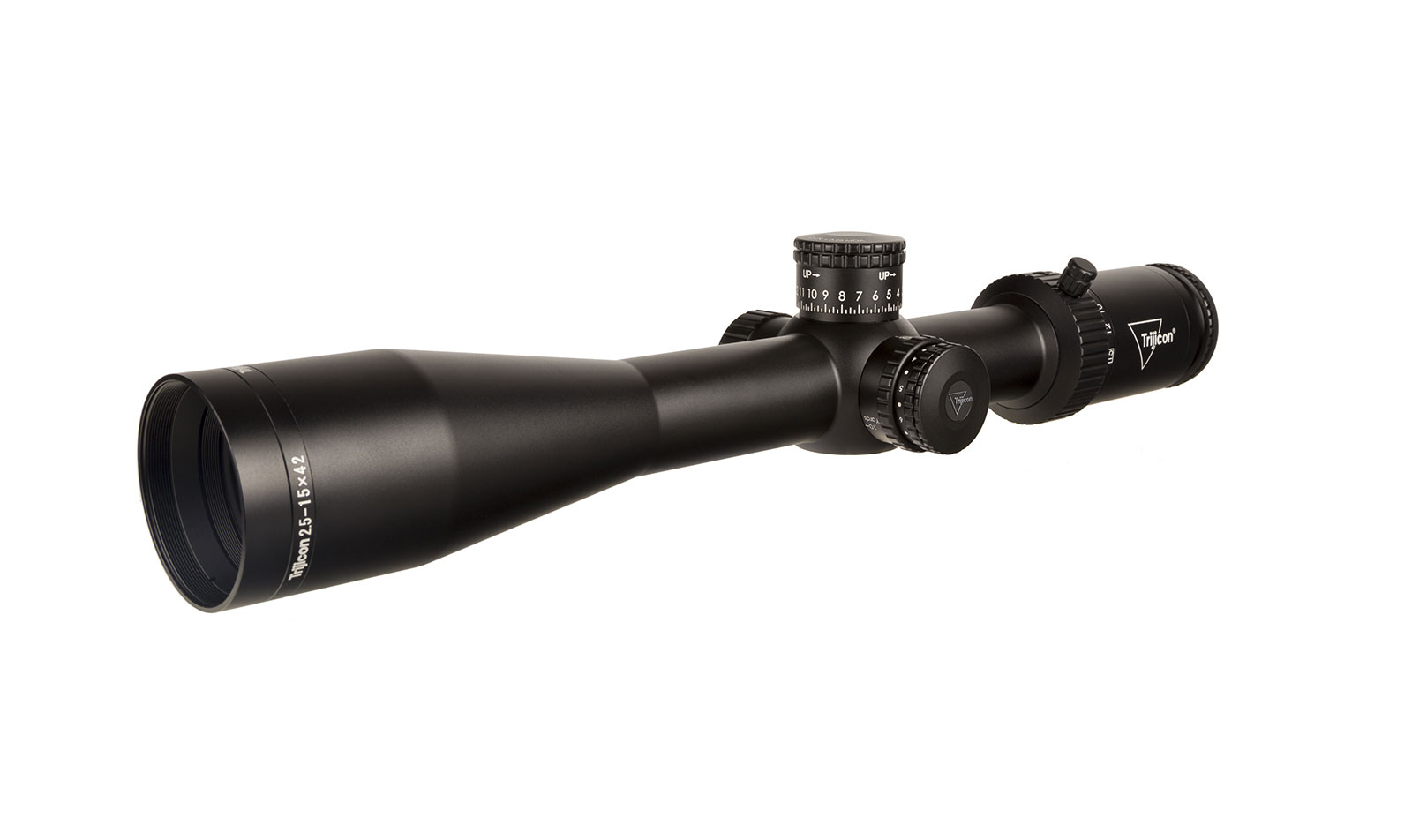

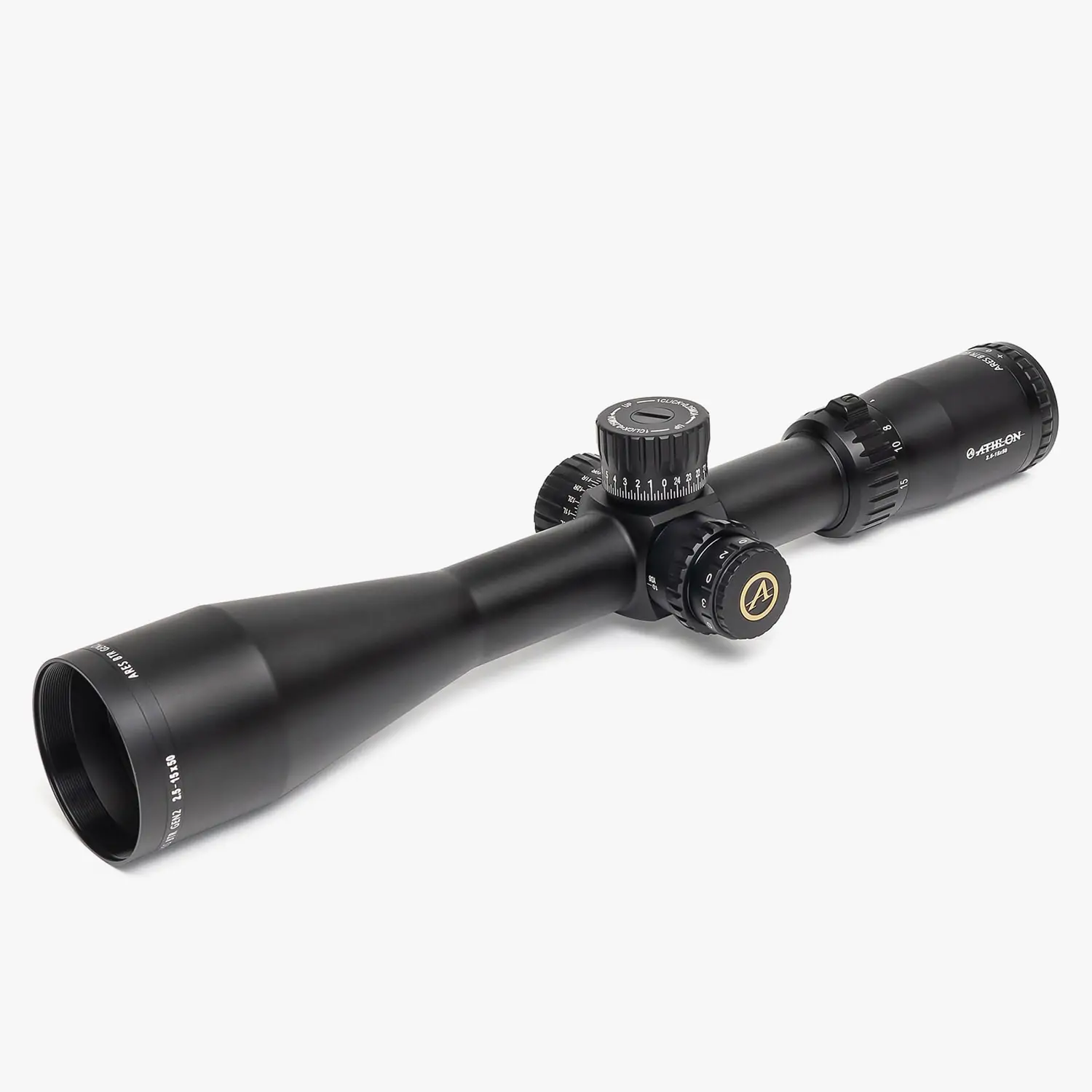
The Athlon Ares BTR Gen2 2.5-15×50 arrives with a level of mechanical refinement that immediately separates it from budget-tier optics. The 34mm main tube feels substantial without crossing into excessive weight territory – at 28.2 ounces, it sits in a reasonable middle ground for a scope of this magnification range and objective size. The anodizing is even and clean, and the turrets have a machined feel that suggests deliberate engineering rather than cost-cutting compromises. The oversized magnification ring operates smoothly with no play or binding, and the fast-focus eyepiece locks firmly once adjusted. For a scope hovering around the $500-600 street price, the Athlon Ares BTR Gen2 2.5-15×50 doesn’t feel like it’s pretending to be something it isn’t – it’s clearly positioned as a workhorse optic built for repeatable use rather than a showpiece.
The included scope caps are functional but unremarkable, and the throw lever socket comes pre-installed for those who want rapid magnification changes. The parallax adjustment dial on the left side of the turret housing operates with appropriate resistance – not too stiff, not loose enough to shift accidentally. One minor gripe: the turret caps are friction-fit rather than threaded, which works fine but won’t inspire confidence if you’re crawling through dense brush. The scope ships with a sunshade that threads cleanly onto the objective bell, though at 2.5x on the low end, you’re unlikely to need it often. Overall, the Athlon Ares BTR Gen2 2.5-15×50 presents as a scope that was designed with input from actual shooters rather than a marketing department.
Optical Performance in Variable Conditions
Glass clarity in the Athlon Ares BTR Gen2 2.5-15×50 is competitive within its price bracket but won’t be mistaken for alpha-tier European glass. At dawn and dusk – the critical periods for most hunting scenarios – the 50mm objective provides adequate light transmission, though you’ll notice a slight loss of contrast compared to scopes costing twice as much. The image remains usable in the final 15 minutes of legal shooting light, but edge-to-edge sharpness degrades noticeably beyond 12x in low light. Color rendition is neutral without the warm cast some lower-end optics exhibit, which helps with target identification in shadowed timber or overcast conditions. The fully multi-coated lenses do their job, but this isn’t the scope you choose if squeezing every photon out of marginal light is your primary concern.
Chromatic aberration is present but controlled – you’ll see some purple fringing on high-contrast edges at maximum magnification, particularly when glassing against bright skies. The eyebox is forgiving at lower magnifications but tightens up predictably as you push toward 15x, requiring more deliberate head positioning for a full sight picture. In bright midday conditions, the scope performs admirably, delivering sharp resolution across most of the field of view. The real limitation appears in mirage-heavy environments where the image can become slightly washed out at higher magnifications. For hunters operating primarily in timber or moderate ranges, the optical performance is entirely adequate. For long-range precision shooters expecting to resolve small targets beyond 600 yards in variable atmospheric conditions, you’ll want to budget for better glass.
Turrets & Reticle Functionality
The exposed tactical turrets on the Athlon Ares BTR Gen2 2.5-15×50 use a 0.1 mil adjustment system with audible and tactile clicks that are distinct enough to count without looking. Each rotation provides 10 mils of adjustment with a zero-stop feature that requires a simple set-screw procedure during initial setup. The turrets tracked accurately during box tests at 100 yards, returning to zero consistently across multiple cycles. The clicks have a slightly mushy feel compared to higher-end options but remain functional and repeatable. The turret height is moderate – tall enough to grip with gloves but not so prominent that they’re prone to accidental bumps. Windage adjustments mirror the elevation turret in feel and precision, though most users will dial elevation and hold wind with the reticle.
The APLR3 FFP reticle in the second focal plane variant uses a Christmas-tree style with hash marks at 0.2 mil intervals along the vertical stadia and simplified wind holds on the horizontal. The reticle is etched and illuminated with 11 brightness settings, including several suitable for night vision compatibility. At 2.5x, the reticle is visible but fine – adequate for close-range work but not ideal if you need rapid target acquisition in thick cover. At 15x, the reticle subtensions become highly usable for precise holdovers and ranging, though the line thickness occupies about 0.05 mils, which is acceptable for most field applications. The illumination daylight settings are bright enough for use in full sun, and the battery compartment is accessible without removing the scope from the rifle. One limitation: the reticle’s complexity can clutter the view when glassing at middle magnifications if you’re simply trying to identify game rather than range and dial.
Real-World Use: Field Testing Results
Mounted on a 6.5 Creedmoor precision rifle, the Athlon Ares BTR Gen2 2.5-15×50 proved capable at ranges from 100 to 700 yards across multiple shooting sessions in varying weather. Tracking remained consistent through several hundred rounds, with no shift in zero despite the rifle being transported in a truck bed over rough terrain. The scope held zero through temperature swings from 28 degrees to 75 degrees Fahrenheit, and the turrets showed no evidence of creep or backlash. At 400 yards, first-round hits on 8-inch steel were routine when dialing elevation, and the reticle’s hash marks allowed for accurate holdovers when speed was prioritized over precision. The magnification range proved versatile – 2.5x was adequate for locating targets in open country, while 12-15x provided sufficient resolution for precise shot placement at extended ranges.
During a late-season mule deer hunt in broken terrain, the scope’s weight and length became noticeable during steep climbs, though not prohibitively so. The low-light performance was tested during evening glassing sessions, where the scope remained functional but not exceptional compared to a hunting partner’s Leupold VX-5HD 3-15×44. The parallax adjustment required attention beyond 300 yards to maintain sharp focus, which is standard for any scope but worth noting for shooters accustomed to fixed-parallax hunting optics. The scope survived being knocked against rocks and brush without losing zero, and the turrets never moved unintentionally despite the friction-fit caps. For a shooter prioritizing mechanical reliability and dialing capability over ultimate optical refinement, the Athlon Ares BTR Gen2 2.5-15×50 delivers functional performance that aligns well with its price point.
How It Compares to Direct Competitors
| Optic | Weight | Price | Glass Quality | Turret Feel | Best Use Case |
|---|---|---|---|---|---|
| Athlon Ares BTR Gen2 2.5-15×50 | 28.2 oz | ~$550 | Good | Functional | Budget precision/hunting hybrid |
| Vortex Viper PST Gen II 3-15×44 | 27.7 oz | ~$650 | Similar | Crisper | Tactical/competition |
| Leupold VX-5HD 3-15×44 | 20.7 oz | ~$900 | Superior | Excellent | Backcountry hunting |
| Bushnell Match Pro 3-15×50 | 29.8 oz | ~$500 | Comparable | Adequate | Range/competition |
Against the Vortex Viper PST Gen II 3-15×44, the Athlon offers a slightly wider field of view at the low end due to its 2.5x starting magnification, but the Vortex edges ahead in turret precision and overall fit-and-finish. The Vortex warranty is more comprehensive, though Athlon’s lifetime warranty is transferable and has a solid reputation for customer service. Optically, the two are closely matched in daylight, with the Vortex showing marginally better contrast in low light. The Athlon’s 50mm objective provides a theoretical advantage in light gathering, but in practical field use, the difference is negligible compared to the Vortex’s 44mm.
The Leupold VX-5HD 3-15×44 operates in a different class despite the overlapping magnification range. The Leupold’s glass is noticeably clearer with better color fidelity and low-light performance, and its 20.7-ounce weight makes it a superior choice for mountain hunting where every ounce matters. However, the Leupold lacks exposed tactical turrets, positioning it as a pure hunting optic rather than a precision hybrid. The Athlon wins on price and dialing capability but can’t match the Leupold’s optical refinement or weight savings. The Bushnell Match Pro 3-15×50 competes directly on price and features, with similar glass quality and a comparable reticle design. The Bushnell’s turrets feel slightly more positive, but the Athlon’s magnification range starting at 2.5x provides more versatility for close-range work. Both are solid choices for shooters prioritizing value and mechanical features over premium optics.
Common Mistakes When Using This Scope
Many shooters mount the Athlon Ares BTR Gen2 2.5-15×50 too far forward, attempting to maximize eye relief and inadvertently creating a restricted eyebox at higher magnifications. The scope performs best when mounted so that your eye naturally aligns with the ocular lens at a comfortable cheek weld – typically around 3.5 to 4 inches of eye relief. Rushing this setup leads to frustration when trying to acquire a sight picture quickly at 12x or above. Another common error is failing to properly set the zero-stop during initial setup. The procedure requires loosening set screws after zeroing, adjusting the turret position, and retightening – skipping this step means you lose the mechanical reference point that makes the turret system useful in the field.
Shooters accustomed to second focal plane hunting scopes sometimes struggle with the first focal plane APLR3 reticle, forgetting that the subtensions remain constant regardless of magnification. This means holdovers calculated at 15x are equally valid at 6x, but the reticle appears much finer at lower power. New users occasionally over-tighten the parallax knob, which can create binding or difficulty in adjustment – the knob only needs to be snug enough to eliminate parallax shimmer, not cranked down hard. Finally, some users neglect to check turret tracking after the first range session. While the Athlon has proven reliable in testing, any scope – regardless of price – should be verified for accurate tracking and return-to-zero before being trusted in a hunting scenario. Taking 30 minutes to shoot a tracking box and confirm zero stability will prevent disappointment when it matters most.