
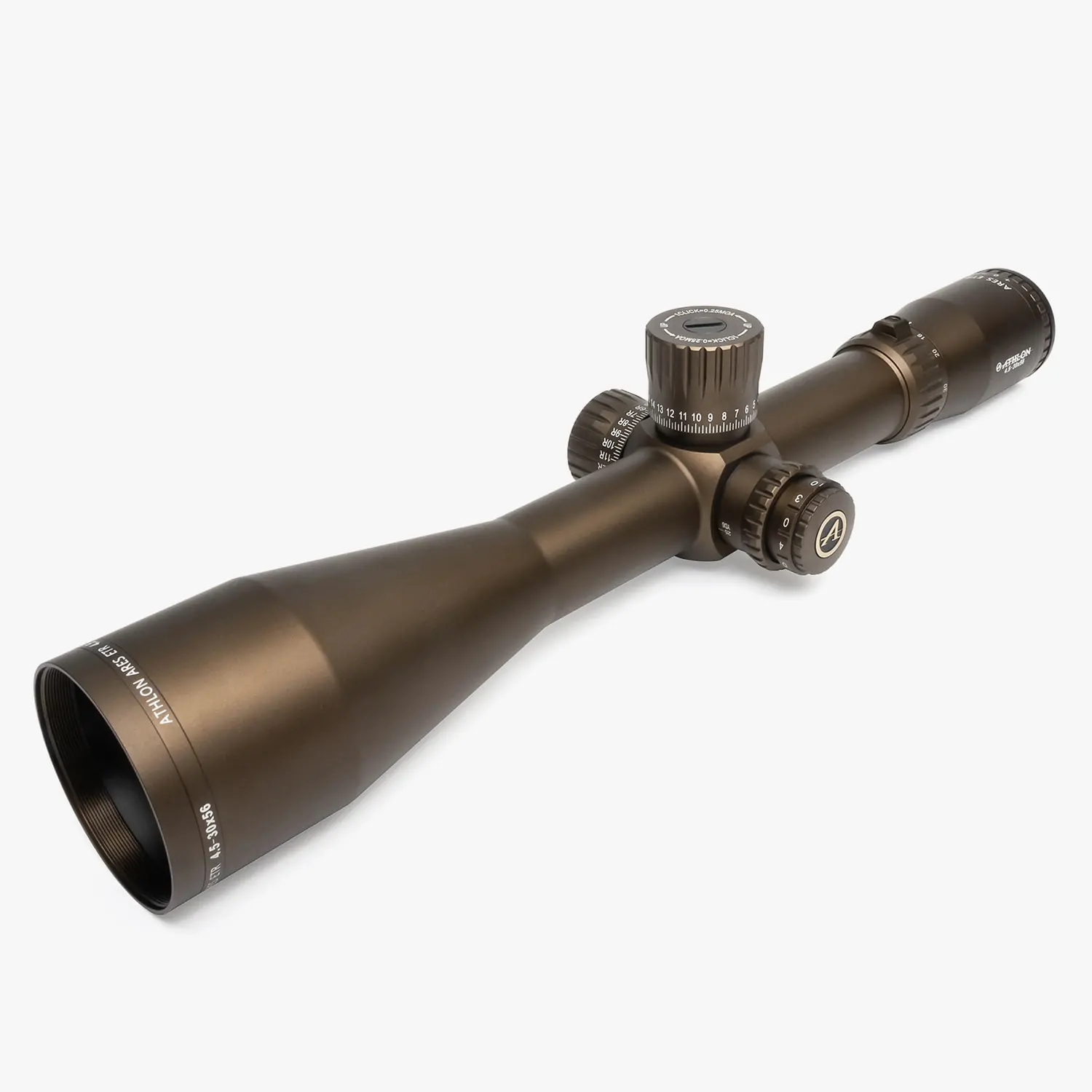
I’ve spent the last eight months putting the Athlon Ares ETR 4.5-30×56 mm through its paces – from freezing morning hunts in Colorado to sweltering afternoons at PRS club matches. This scope sits in an interesting market position: it’s priced around $1,400-$1,600, yet delivers optical and mechanical performance that makes you wonder why anyone pays three grand for similar features. The 34mm main tube, first focal plane reticle, and 56mm objective suggest Athlon built this for serious long-range work, not casual plinking.
That said, this isn’t a flawless optic that magically replaces everything costing twice as much. It’s heavy at 36 ounces, the illumination system is merely adequate, and you’re dealing with a company that doesn’t have the decades-long reputation of European manufacturers. But if you’re a precision shooter working within a budget – or someone who’d rather spend the savings on ammunition and barrel life – this scope deserves your attention. Here’s what I’ve learned after several hundred rounds and countless hours behind the glass.
Optical Performance: Clarity That Rivals Pricier Glass
The glass quality in the Ares ETR genuinely surprised me. Edge-to-edge clarity remains sharp through about 85% of the image at maximum magnification, with only the outermost periphery showing minor distortion. At 15-20x – where I spend most of my time shooting – the image is crisp enough that I’ve successfully identified .224 caliber bullet holes at 600 yards on white target backers. Color rendition leans slightly warm, which I actually prefer for picking out brown game against varied terrain. The extra-low dispersion glass does its job controlling chromatic aberration, though you’ll notice some purple fringing on high-contrast edges at 30x if you’re looking for it.
Low-light performance is where that 56mm objective earns its keep. During legal shooting light at dawn and dusk, I’ve compared this scope directly against my hunting partner’s Leupold Mark 5HD (a $2,200 optic), and the Athlon held its own. You get maybe 5-10 minutes less usable light than true alpha-tier glass, but we’re talking about the difference between shooting at 6:47 PM versus 6:52 PM. For most hunters and shooters, that’s a non-issue. The generous eye box at lower magnifications makes quick target acquisition easy, though it tightens up considerably past 25x – you’ll be doing the “scope dance” if you’re not positioned perfectly.
Turrets & Reticle: Tracking Accuracy Under Fire
The turrets on this scope have become one of my favorite features. Each click delivers a satisfying, audible “tick” with distinct tactile feedback – you can count clicks without looking, even with gloves on. I’ve run a tall target tracking test three separate times over six months, and the scope has returned to zero within 0.1 mil every single time. Dialing for distance has become second nature: 10 mils of elevation adjustment across multiple sessions showed zero discrepancy from the ballistic solver’s predictions. The turrets are capped but tool-less, using a simple pull-up design that’s quick to operate but secure enough that I’ve never had one shift unintentionally.
The APLR3 FFP reticle (first focal plane, for those new to this) is well-designed for both competition and field use. The Christmas tree-style wind holds are aggressive enough to see clearly at lower magnifications, but not so busy that they obscure targets at distance. I’m using the mil version, and the subtensions have proven accurate for ranging when needed. The illumination system works – barely. It’s got 11 settings, but even on the brightest, it’s washed out in direct sunlight. Honestly, I rarely turn it on; the reticle is visible enough as a black outline against most backgrounds. The parallax adjustment on the left side dial is smooth and ranges from 25 yards to infinity, with accurate yardage markings that I’ve verified with a laser rangefinder.
Real-World Use: From PRS Matches to Hunt Country
I’ve used the Ares ETR in three local PRS-style matches, and it’s proven entirely capable for this application. The magnification range lets you spot your own impacts on steel from 300 to 1,200 yards, and the tracking reliability means you’re not second-guessing your dope between stages. The scope’s weight is actually a benefit here – it helps balance a heavy barrel rifle and doesn’t shift during recoil. One match was in driving rain, and while I wouldn’t call this scope “waterproof deluxe,” no moisture penetrated the internals, and the lens coatings shed water adequately. I did notice the turrets got slightly stiffer in near-freezing temperatures, though they still functioned without issue.
For hunting, this scope is admittedly more specialized. It’s fantastic for western spot-and-stalk or long-range predator calling where you’re setting up on a tripod or bipod with time to dial. I took a pronghorn at 487 yards this fall, and the process was straightforward: range, dial, settle, squeeze. Where it struggles is quick-acquisition hunting in timber or brush. At 4.5x on the low end, it’s usable but not ideal for snap shots under 100 yards, and the scope’s weight makes for a front-heavy rifle on long hikes. If you’re primarily a whitetail hunter in the woods, there are better options. But for mountain hunting, prairie shooting, or any scenario where you’re glassing and shooting at distance, it’s excellent.
How It Compares: Beating Scopes Twice the Price
Here’s how the Ares ETR stacks up against direct competitors:
| Feature | Athlon Ares ETR | Vortex Razor HD Gen II | Nightforce ATACR 5-25x | Bushnell XRS3 |
|---|---|---|---|---|
| Price | ~$1,500 | ~$2,500 | ~$3,200 | ~$1,800 |
| Weight | 36 oz | 48 oz | 38 oz | 34.5 oz |
| Glass Quality | Very Good | Excellent | Excellent | Very Good |
| Turret Feel | Excellent | Excellent | Excellent | Good |
| Illumination | Adequate | Excellent | Very Good | Good |
| Warranty | Lifetime | Lifetime (VIP) | Lifetime | Lifetime |
The value proposition becomes clear when you run the numbers. The Athlon delivers roughly 85-90% of the Nightforce’s performance at less than half the price. Where you notice the difference is in the finest details: the Nightforce has slightly better glass coatings, more robust illumination, and a proven track record with military and law enforcement. But for a civilian shooter who’s dialing for prairie dogs or competing in club matches, those differences rarely matter in practical terms.
Against the Vortex Razor Gen II – a scope I’ve used extensively – the Athlon actually wins on weight and price while delivering comparable tracking performance. The Razor has better illumination and slightly superior low-light glass, but it’s also 12 ounces heavier and a thousand dollars more expensive. The Bushnell XRS3 is probably the closest competitor in both price and performance, and honestly, choosing between them comes down to personal preference on reticle design and which turret feel you prefer. I’d give the Bushnell a slight edge on overall refinement, but the Athlon edges ahead on value.
So who should actually buy the Athlon Ares ETR in 2026? This scope makes the most sense for precision shooters who’ve outgrown entry-level optics but aren’t ready to drop three grand on glass. If you’re shooting PRS club matches, working on long-range fundamentals, or hunting in open country where shots regularly extend past 300 yards, this scope will serve you well without requiring a second mortgage. It’s also ideal for shooters building multiple rifles – you could outfit two guns with Ares ETRs for the price of one top-tier optic.
Who should look elsewhere? If you’re hunting primarily in thick cover or need a lightweight mountain rifle, this scope’s weight and magnification range aren’t ideal. Competitive shooters at the national level might want the absolute best glass and illumination that money can buy. And if you’re the type who needs the prestige of a brand name or worries about resale value, established manufacturers still carry more cache. But for the practical shooter who values performance over pedigree, the Ares ETR represents one of the better value propositions in long-range optics today. I’ve trusted it with my own hunting tags and competition scores – that’s worth more than any marketing copy.