
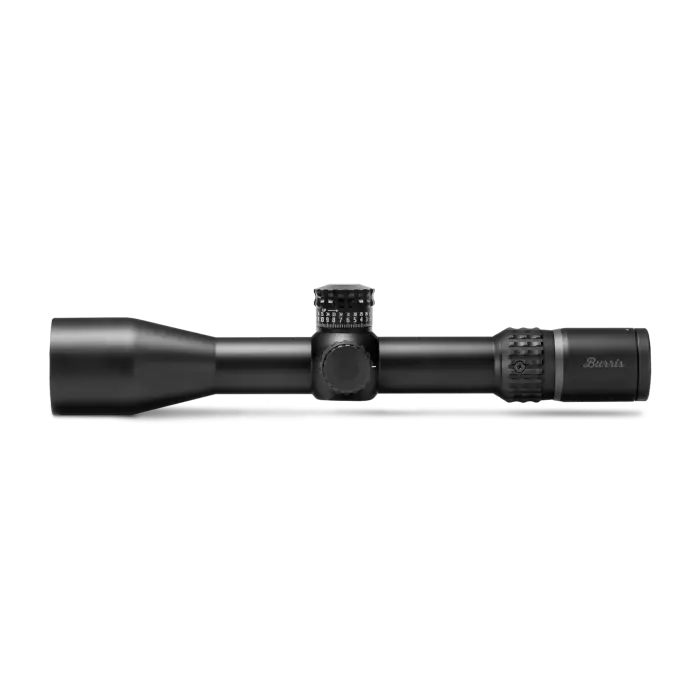
The Burris XTR II 3-15×50 arrives with a purposeful, no-nonsense appearance that immediately signals its tactical heritage. The 34mm main tube feels substantial in hand, and the overall construction conveys a sense of durability without crossing into excessive bulk. At 32 ounces, the XTR II 3-15×50 sits in a reasonable weight class for a scope of this magnification range and objective size, though it’s noticeably heavier than some hunting-focused alternatives. The matte black finish resists glare effectively, and the scope’s external features – turrets, parallax dial, and magnification ring – all operate with satisfying mechanical precision right out of the box.
Closer inspection reveals a well-executed design with attention to practical details. The turrets are capped and feature clear, tactile clicks that inspire confidence in tracking adjustments. The parallax adjustment dial on the left side of the saddle operates smoothly across its range, marked from 50 yards to infinity. The magnification ring requires moderate effort to rotate, which prevents accidental adjustment but may feel slightly stiff during rapid transitions. The ocular focus locks securely once set, and the fast-focus eyepiece design accommodates quick diopter adjustments. Overall build quality feels solid, though the scope doesn’t quite match the refined machining and finish you’d find on European glass at significantly higher price points.
Optical Performance in the Field
In varied lighting conditions, the Burris XTR II 3-15×50 delivers respectable optical performance that punches above its price point, though it falls short of premium competitors. Edge-to-edge clarity is good at lower magnifications, with noticeable softening appearing in the outer 15-20% of the image circle when pushed to 15x. Center sharpness remains usable across the magnification range, providing sufficient resolution for target identification and shot placement at distances appropriate to this scope’s intended use. Color rendition leans slightly cool but remains natural enough for effective game spotting and terrain reading.
Low-light performance represents one of the scope’s stronger attributes, with the 50mm objective gathering adequate light for shooting through extended twilight periods. During field testing at dawn and dusk, the XTR II maintained usable brightness roughly 15-20 minutes longer than comparable scopes with smaller objectives in the same price bracket. However, when directly compared to premium optics like the Zeiss V4 or Nightforce SHV, the Burris shows its limitations – chromatic aberration becomes visible in high-contrast situations, particularly around dark branches against bright sky. The scope performs best in overcast or moderate lighting where its strengths shine and its optical compromises remain less apparent.
Turrets & Reticle Functionality
The Burris XTR II 3-15×50 features exposed tactical turrets with 10 mils of adjustment per revolution, marked in 0.1 mil increments. Each click delivers a distinct, audible feedback that you can both hear and feel, making adjustments confident even when wearing gloves or operating in awkward shooting positions. The turrets track reliably – multiple box tests confirmed repeatable return to zero with minimal deviation. The elevation turret includes a zero-stop feature that requires a simple setup process involving loosening three small screws, which holds securely once configured. Turret height is moderate, allowing for good finger purchase without creating excessive bulk that might snag on gear.
The G2B Mil-Dot reticle in the first focal plane maintains consistent subtension relationships across the magnification range, which proves essential for holdover calculations and range estimation. The reticle features a relatively fine center crosshair with mil-spaced dots extending outward, providing clean aiming points without excessive clutter. At lower magnifications, the reticle becomes quite fine – potentially difficult to see against dark backgrounds or in heavy timber. At maximum magnification, the reticle thickness feels appropriate for precision work without obscuring small targets. The illumination system offers multiple brightness settings controlled by a dial on the left side, though the illuminated dot is somewhat large and may cover small targets at longer ranges when activated.
Real-World Use: Field Testing Results
Extended field testing with the Burris XTR II 3-15×50 across multiple shooting disciplines revealed a scope that performs competently within its design parameters. Mounted on a precision rifle platform for long-range shooting sessions, the scope delivered consistent results at distances from 100 to 800 yards. Tracking proved reliable through several hundred rounds of adjustment-intensive shooting, with the turrets maintaining their zero and returning accurately after dialing for elevation. The 3-15x magnification range provided adequate flexibility for both closer shots and extended-range engagements, though shooters working regularly beyond 600 yards might prefer higher top-end magnification.
In hunting applications, the XTR II showed both strengths and limitations. The scope’s weight and tactical appearance make it better suited to precision rifle builds than lightweight mountain rifles where every ounce matters. The 3x low end provides sufficient field of view for shots inside 100 yards, though the first focal plane reticle becomes quite fine at this magnification. During several dawn and dusk hunting sessions, the 50mm objective delivered on its light-gathering promise, extending shooting hours meaningfully. The parallax adjustment proved essential in the field – leaving it improperly set created noticeable image blur and accuracy concerns. Overall, the scope excels in applications where precision and repeatability matter more than minimal weight or rapid target acquisition at close range.
How It Compares to Competitors
When positioned against direct competitors in the $600-800 price range, the Burris XTR II 3-15×50 presents a compelling but imperfect value proposition. The scope competes primarily with offerings like the Athlon Ares BTR 2.5-15×50, Vortex Viper PST Gen II 3-15×44, and the lower-end Nightforce SHV 3-10×42. Against the Athlon, the Burris offers slightly better mechanical reliability and more positive turret clicks, though the Ares delivers comparable glass quality at a lower price point. The Vortex Viper PST Gen II provides superior optical clarity and a more refined reticle design, but the Burris counters with a more robust zero-stop mechanism and arguably better low-light performance thanks to its larger objective.
| Feature | Burris XTR II 3-15×50 | Athlon Ares BTR 2.5-15×50 | Vortex Viper PST Gen II 3-15×44 | Nightforce SHV 3-10×42 |
|---|---|---|---|---|
| Price | ~$700 | ~$550 | ~$750 | ~$950 |
| Weight | 32 oz | 28 oz | 27.7 oz | 29.5 oz |
| Glass Quality | Good | Good | Very Good | Excellent |
| Turret Feel | Very Good | Good | Very Good | Excellent |
| Low Light | Very Good | Good | Good | Very Good |
The real competition comes from stepping up to the Nightforce SHV, which costs roughly $250 more but delivers noticeably superior glass and bombproof reliability. The SHV’s lower magnification range may limit long-range applications, but its optical and mechanical excellence justify the premium for serious shooters. The Burris occupies a middle ground – better than budget options but not quite matching premium alternatives. It’s ideal for shooters who need tactical features and reliable performance without stretching to Nightforce or Zeiss pricing, particularly those prioritizing low-light capability and a generous magnification range.
Common Mistakes When Using This Scope
The most frequent error shooters make with the Burris XTR II 3-15×50 involves neglecting the parallax adjustment, which proves more critical with this scope than many realize. The parallax dial requires careful attention at each shooting distance – leaving it set incorrectly creates image blur and point-of-impact shifts that shooters often misattribute to ammunition or rifle issues. Many users set the parallax once and forget it, then struggle with accuracy at varying ranges. The scope’s parallax becomes particularly noticeable at magnifications above 10x, and shooters must develop the habit of checking and adjusting this setting as distances change.
Another common mistake involves improper zero-stop setup or failure to verify turret tracking before relying on the scope in critical situations. Some shooters assume the zero-stop is correctly configured from the factory or after mounting, only to discover field issues when dialing elevation. The zero-stop mechanism requires deliberate setup following the manufacturer’s instructions, and skipping verification through box tests or tracking drills can lead to disappointment. Additionally, shooters sometimes mount this relatively heavy scope on lightweight rifles where the weight distribution creates handling problems, or they expect optical performance matching scopes costing twice as much. Understanding the XTR II’s realistic capabilities – solid mid-tier performance with excellent mechanical features – prevents unrealistic expectations and helps shooters maximize what the scope does well rather than focusing on where premium optics pull ahead.