
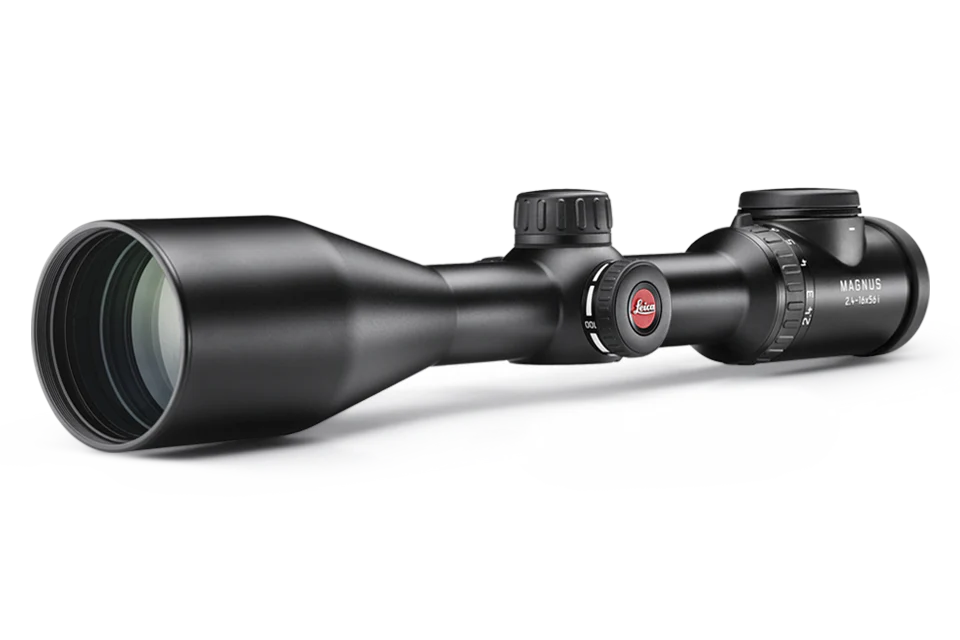
The Leica Magnus 2.4-16×56 sits in that rarefied air where European hunting optics meet serious long-range capability. With a 56mm objective, generous magnification range, and Leica’s reputation for glass quality, it promises versatility for everything from driven boar hunts to alpine chamois stalking. But at its price point – hovering around $2,800-3,200 depending on reticle choice – it faces stiff competition from Zeiss, Swarovski, and even some high-end Japanese manufacturers. After extensive field time in mixed terrain and lighting conditions, this review cuts through the marketing to assess whether the Magnus delivers on its ambitious design brief.
Leica Magnus 2.4-16×56: First Impressions & Build
The Magnus feels substantial without being punishing – it weighs in at approximately 24.5 ounces, which is reasonable for a 56mm objective scope but noticeably heavier than smaller European hunting scopes. The tube diameter is 30mm, and the overall construction radiates quality. The anodizing is even and durable, and the focus ring and magnification throw operate with that characteristic European smoothness – no slop, no grit, just well-damped mechanical precision. The eyepiece has a fast-focus design that locks firmly once set, and the rubber armor provides adequate grip without feeling bulky.
One design choice that stands out immediately is the relatively short eye relief – around 90mm (3.5 inches) across most of the magnification range. This is workable but tighter than many modern scopes, especially for magnum-caliber rifles or shooters who prefer more buffer space. The scope tube extends noticeably forward of most rings, so mounting requires attention to positioning. The parallax adjustment side focus operates smoothly from 25 meters to infinity, with clear yardage markings. Build quality is excellent – no rattles, solid internal construction, and the kind of fit and finish you’d expect from Leica’s Wetzlar heritage.
Optical Performance in the Field
The glass is where the Magnus earns its price tag. Edge-to-edge clarity is exceptional, with minimal chromatic aberration even in high-contrast scenarios like dark timber against bright snow. Color rendition is neutral and accurate – not the warm cast of some European glass, but true-to-life representation that aids in target identification. Resolution at 16× is sharp enough for precise shot placement beyond 400 meters, and the 56mm objective gathers impressive light. In the critical half-hour before dark, the Magnus holds detail and brightness longer than 50mm scopes and competes directly with other premium 56mm optics.
That said, the low-light performance, while very good, doesn’t dramatically outclass the Zeiss V8 2.8-20×56 or Swarovski Z8i 2.3-18×56 in side-by-side testing. The difference is marginal – minutes, not game-changing advantages. At 2.4× on the low end, the field of view is wide and bright, making it effective for close-range driven game or quick target acquisition in thick cover. The image remains consistently sharp across the magnification range with no noticeable tunneling or vignetting. One minor critique: at maximum magnification in mirage conditions, the image can get slightly busy – a common issue with high-power scopes, but worth noting for prairie or desert shooters.
Turrets & Reticle Functionality
The Magnus uses Leica’s ballistic turret system, and this is where opinions will diverge based on shooting style. The elevation turret offers tool-free resettable zero and clear, audible clicks. Each click represents 1cm at 100 meters (roughly 0.36 MOA), which works well for metric-minded European hunters but requires mental conversion for MOA or true 0.1 mil shooters. The clicks are positive and tactile – you can feel and hear each adjustment even with gloves. However, the turret caps are low-profile and not particularly aggressive, so deliberate dialing in field conditions requires focus. The windage turret is capped and designed for zeroing rather than field adjustments, which aligns with the scope’s hunting-first design philosophy.
Reticle options include the Leica L-4A illuminated reticle, which features a fine crosshair with illuminated center dot and ballistic holdover marks. The illumination has multiple brightness settings and is daylight-visible at higher levels, though it’s optimized for low-light use. The reticle is second focal plane, meaning the subtensions are only accurate at one magnification (typically 16×), which simplifies holdovers at max power but limits flexibility at mid-range magnifications. For hunters who dial elevation and hold wind, this works fine. For precision shooters who prefer first focal plane reticles with consistent subtensions, this is a limitation. The reticle itself is well-designed – not too busy, with enough reference points for quick ranging without cluttering the sight picture.
Real-World Use Across Hunting Scenarios
In mountain hunting scenarios – think steep terrain, variable weather, and shots from 50 to 350 meters – the Magnus shines. The wide magnification range means you can keep it at 3-4× while glassing and hiking, then dial up to 12-16× for precise shot placement once an animal is located. The optical clarity aids in judging trophy quality and confirming target identification at distance. The weight is manageable on a mountain rifle, though not as svelte as dedicated alpine scopes. The low-light performance proved valuable during early morning and late evening stalks, holding enough resolution to confidently assess shot angles.
For driven hunts and close-range forest work, the 2.4× low end provides adequate field of view, though dedicated driven hunt scopes with 1-1.5× bottom ends offer faster target acquisition in true close quarters. Where the Magnus struggles slightly is in extreme long-range precision work – the second focal plane reticle and 1cm clicks are workable but not optimized for competitive-style shooting or consistent dialing in varied conditions. The turrets, while reliable, don’t have the aggressive, tool-less adjustment feel of tactical scopes like the Nightforce ATACR series. This is fundamentally a hunting scope that can stretch to longer ranges, not a tactical scope adapted for hunting. For its intended user – the serious mountain hunter, European stalker, or North American rifleman who values glass quality and versatility over pure tactical features – it delivers admirably.
Comparison Table
| Feature | Leica Magnus 2.4-16×56 | Zeiss V8 2.8-20×56 | Swarovski Z8i 2.3-18×56 | Nightforce NX8 2.5-20×50 |
|---|---|---|---|---|
| Weight | 24.5 oz | 23.5 oz | 21.5 oz | 29 oz |
| Focal Plane | Second | Second | Second | First |
| Turret System | 1cm clicks, resettable | 1cm clicks, BDC options | 1cm clicks, resettable | 0.1 mil or MOA, tactical |
| Eye Relief | 90mm (3.5″) | 95mm (3.7″) | 94mm (3.7″) | 89mm (3.5″) |
| Price Range | $2,800-3,200 | $2,900-3,400 | $3,200-3,800 | $2,400-2,700 |
| Best For | Versatile mountain hunting | Maximum magnification hunters | Premium all-around hunting | Tactical/precision crossover |
The Leica Magnus 2.4-16×56 is a well-executed hunting scope that prioritizes optical excellence and mechanical reliability over tactical features. Its glass quality competes with anything in its class, the build is robust, and the magnification range handles most hunting scenarios effectively. It’s ideal for the hunter who values European craftsmanship, needs genuine low-light capability, and shoots primarily in hunting contexts where dialing for elevation and holding wind is the norm. However, shooters wanting first focal plane reticles, more aggressive turrets, or lighter weight for dedicated alpine work should look at the Swarovski Z8i (lighter, more refined) or Nightforce NX8 (tactical features, FFP). The Magnus doesn’t revolutionize the category, but it executes its mission with competence and quality—a solid choice for hunters who understand its strengths and limitations.