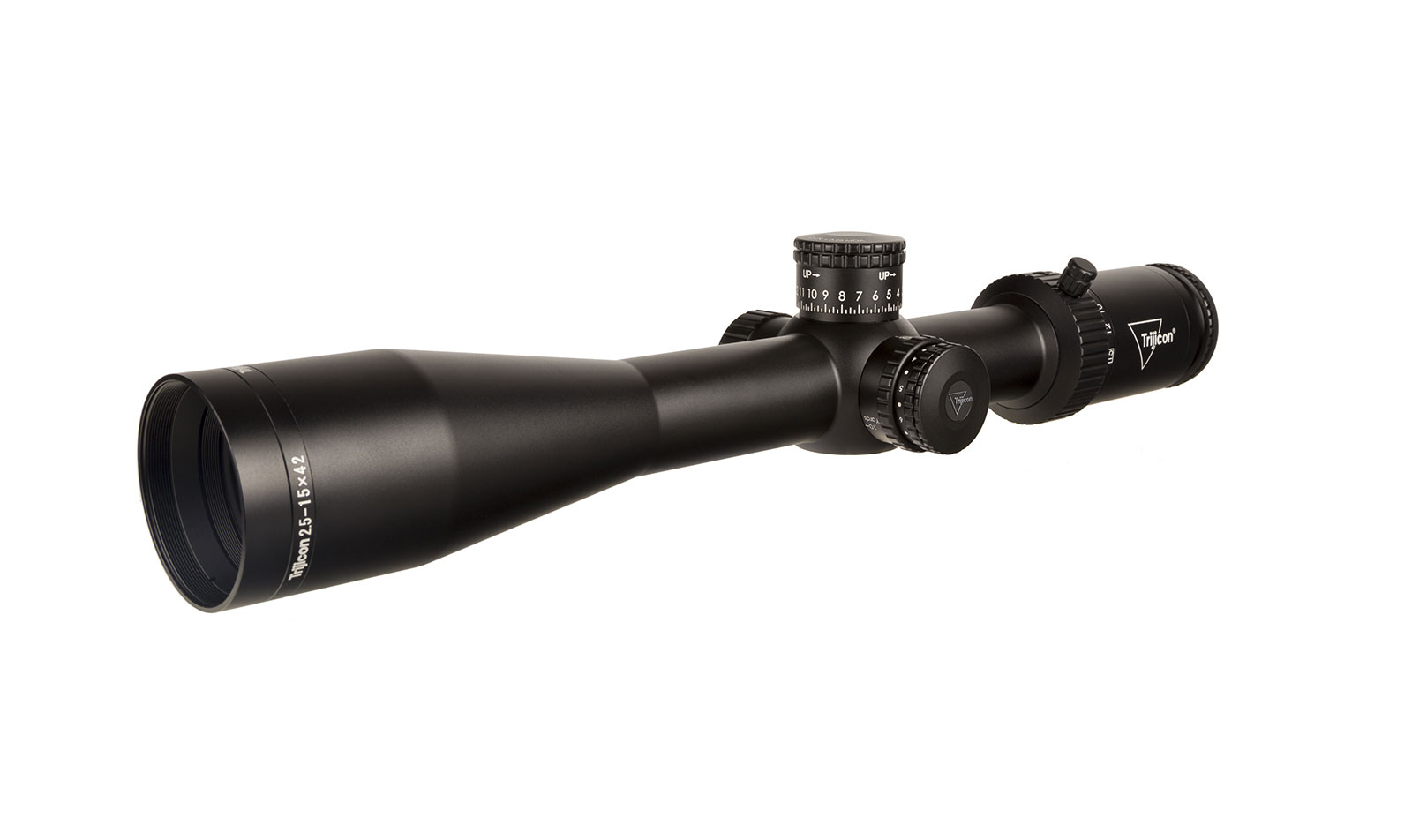

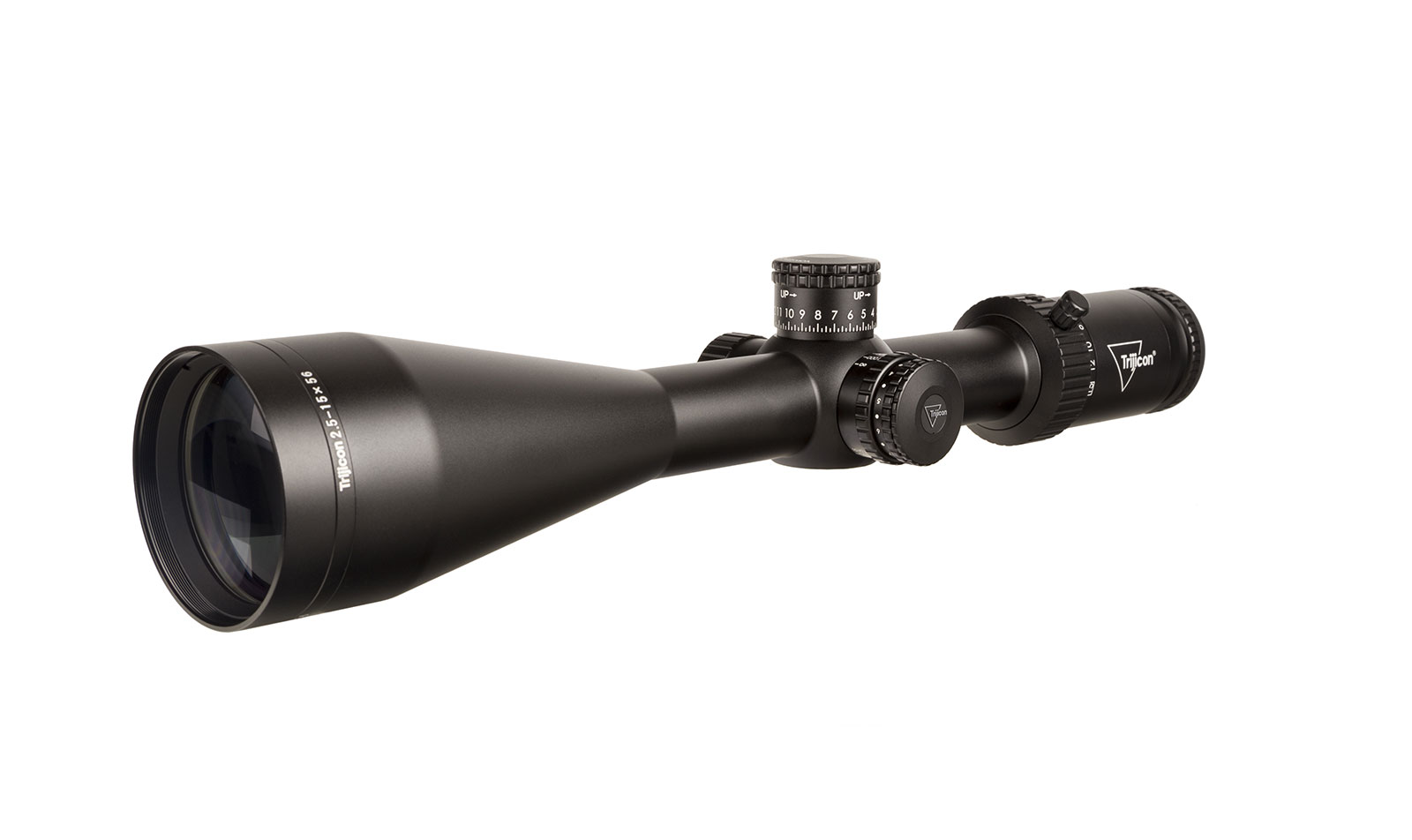
The Trijicon Credo HX 2.5-15×56 arrives with the unmistakable heft and finish you’d expect from a scope pushing the $1,300 mark. At 28.4 ounces, it’s not a lightweight, but the weight feels purposeful rather than excessive – this is a hunting optic built to take abuse without apology. The 34mm main tube is machined from a single piece of aircraft-grade aluminum, and the anodizing shows no weak points or tool marks. Everything from the eyepiece to the objective bell speaks to deliberate engineering rather than cost-cutting. The Trijicon Credo HX 2.5-15×56 wears a matte black finish that resists glare without feeling fragile, and the turret caps snap on with reassuring tension.
Handling the scope reveals thoughtful details. The magnification ring turns with smooth, consistent resistance – no slop, no binding – and the parallax adjustment on the left side of the saddle operates with tactile precision from 50 yards to infinity. The throw lever is included and installs without tools, a small but welcome touch. Eye relief sits around 3.7 inches across the magnification range, which is comfortable but not exceptionally forgiving if you’re shooting from awkward positions. The 56mm objective is large enough to gather serious light without making the scope unwieldy on most hunting rifles, though you’ll need medium to high rings depending on your barrel contour and bolt handle clearance.
Optical Performance in the Field
Glass quality is where the Credo HX justifies its price point. Trijicon uses fully multi-coated lenses with their proprietary BAK4 prisms, and the result is genuinely impressive clarity from center to edge. At 15x, the image remains sharp across roughly 85% of the field of view before you start noticing any softness at the periphery. Color rendition is neutral – not overly warm like some European glass, not cold like budget Japanese optics – which makes target identification instinctive. Chromatic aberration is well-controlled; you’ll see minimal fringing even when glassing dark timber against bright sky, a common torture test for mid-tier scopes.
Low-light performance is the 56mm objective’s reason for existing, and it delivers. During evening hunts in heavy cover, the Credo HX extends usable shooting light by 15-20 minutes compared to a 44mm scope of similar quality. At 6x to 10x magnification, the exit pupil is large enough to make the most of that twilight advantage. Push it to 15x in dim conditions and things get predictably darker, but the glass quality keeps details visible longer than you’d expect. The scope doesn’t quite match alpha-tier European glass in absolute resolution, but it’s close enough that most shooters won’t notice the difference in practical hunting scenarios.
Turrets & Reticle Functionality
The Credo HX ships with exposed tactical-style turrets that use 0.1 Mil adjustments – no MOA option on this model. Each click is distinct and audible, with a mechanical firmness that inspires confidence. The elevation turret offers 27 Mils of total travel with a zero-stop function that’s user-adjustable without tools. Resetting the turret to zero after bore-sighting requires loosening a small set screw, rotating the turret, and retightening – straightforward but not as quick as some toolless designs. Windage adjustment is capped, which makes sense for a hunting scope where you’re more likely to dial elevation than hold wind.
Tracking accuracy proved reliable through box tests and field confirmation at distance. Dialing 10 Mils up and back returned to zero consistently across multiple sessions, and impacts matched the reticle adjustments at 400 and 600 yards. The reticle options include the Trijicon BDC Hunter and several MOA and Mil-based designs. The illuminated center dot is daylight-bright at higher settings and dim enough for night use without washing out the image. Reticle thickness is appropriate for the magnification range – visible at 2.5x for close shots, fine enough at 15x for precise holdovers. The first focal plane design means the reticle scales with magnification, which is essential if you’re using holdovers at varying distances.
Real-World Use Across Conditions
Mounted on a 6.5 Creedmoor bolt gun for a mountain mule deer hunt, the Credo HX proved its versatility. The 2.5x low end handles timber shots and quick target acquisition without the tunnel vision you get from higher-magnification scopes. At 300 yards across a canyon, 10x provided plenty of detail for shot placement without needing to crank to max power. The generous eye box at mid magnifications made shooting from improvised positions easier, though getting a full sight picture at 15x required more precise head placement. Weight distribution is slightly front-heavy due to the 56mm objective, but not enough to throw off balance on a standard hunting rifle.
Weather resistance was tested across rain, snow, and temperature swings from 20°F to 65°F. The scope never fogged internally, and the lenses shed water reasonably well, though they’re not hydrophobic enough to completely eliminate the need for lens wiping in heavy rain. Turrets remained responsive in cold conditions without stiffening, and the magnification ring didn’t bind even after a day of sleet and mud exposure. The scope took several bumps and drops onto rock and hard ground without losing zero or showing mechanical issues. For a hunting optic that might see rough pack-outs and horseback transport, the Credo HX inspires confidence in its ability to maintain zero and function when it matters.
How It Compares to Rivals
| Feature | Trijicon Credo HX 2.5-15×56 | Nightforce SHV 3-10×42 | Athlon Ares ETR 3-18×50 | Vortex Razor HD LHT 3-15×42 |
|---|---|---|---|---|
| Weight | 28.4 oz | 21.6 oz | 28.9 oz | 21.3 oz |
| Tube Diameter | 34mm | 30mm | 34mm | 30mm |
| Low Mag | 2.5x | 3x | 3x | 3x |
| Price | ~$1,300 | ~$1,150 | ~$850 | ~$1,300 |
| Glass Quality | Excellent | Very Good | Good | Excellent |
| Turrets | Exposed, 0.1 Mil | Capped | Exposed, 0.1 Mil | Exposed, 0.1 Mil |
The Nightforce SHV 3-10×42 costs slightly less and saves nearly seven ounces, making it more appealing for mountain rifles where weight matters. However, you give up low-light performance, magnification range, and the 34mm tube’s extra adjustment range. Glass quality slightly favors the Trijicon, though Nightforce’s legendary durability remains unmatched.
The Athlon Ares ETR 3-18×50 undercuts the Credo HX by $450 and offers more top-end magnification, but the glass doesn’t compete in clarity or color fidelity. Turret feel is mushier, and the overall build quality feels a tier below. If budget is the primary concern, Athlon delivers solid value, but you’ll notice the compromises. The Vortex Razor HD LHT 3-15×42 matches the Trijicon’s price and glass quality while saving seven ounces, but the smaller objective limits low-light capability. For western hunting where weight and twilight performance both matter, the choice depends on which compromise you’re willing to accept.
Common Mistakes When Using This Scope
The most frequent error is mounting the Credo HX with rings that are too low. The 56mm objective requires sufficient clearance, and shooters often underestimate this, resulting in the bell contacting the barrel during recoil or when adjusting parallax. Medium or high rings are necessary for most hunting rifles, and verifying clearance before heading to the range saves frustration. Another mistake is failing to properly set the zero-stop after bore-sighting. The adjustment process is straightforward, but skipping it means losing one of the scope’s most useful features for dialing elevation in the field.
Many users also overlook the importance of setting proper eye relief and diopter focus before shooting. The Credo HX’s eyepiece should be adjusted until the reticle appears sharp without any strain, and this needs to happen before mounting the scope on the rifle. Rushing this step leads to eye fatigue and inconsistent cheek weld. Finally, some shooters assume the 56mm objective means they can effectively use 15x magnification in low light, but physics limits exit pupil size regardless of objective diameter. At maximum magnification in twilight, the image darkens significantly – staying between 6x and 10x in dim conditions makes better use of the scope’s light-gathering capability and maintains a usable sight picture.