
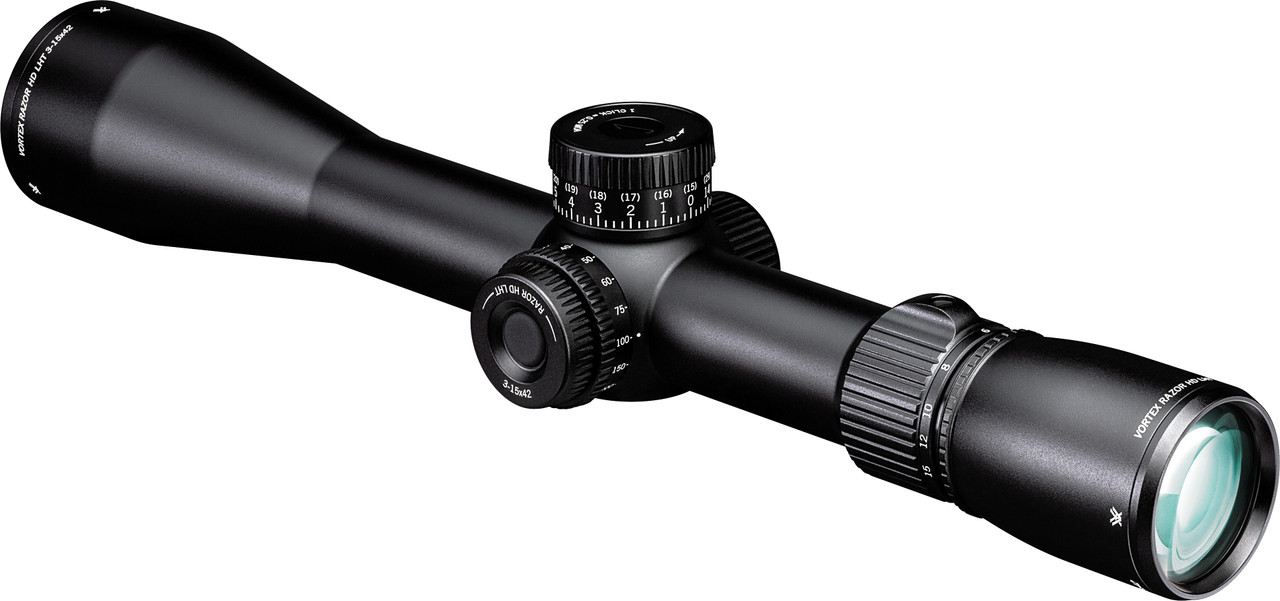
The Vortex Razor LHT 3-15×42 arrives with a purpose-driven design philosophy immediately apparent in your hands – this is a scope engineered for weight savings without abandoning the Razor line’s reputation for durability. At 21.6 ounces, the Vortex Razor LHT 3-15×42 undercuts most competitors in its class by several ounces, which matters considerably during long mountain hunts or when building a lightweight rifle system. The 30mm main tube features a matte finish that resists glare effectively, and the overall construction feels solid despite the reduced mass. Vortex achieved this through a combination of materials and design choices that prioritize functional strength over overbuilt heft.
The scope’s dimensions are well-proportioned for hunting rifles, with an eye relief ranging from 3.7 to 3.9 inches across the magnification range – adequate but not generous. The fast-focus eyepiece locks securely once adjusted, and the magnification ring turns with smooth, consistent resistance. The locking turrets sit low on the tube, contributing to the streamlined profile. My initial concern centered on whether the weight reduction compromised the mechanical integrity that defines the Razor brand, but after several months of field use including some rough pack-outs and weather exposure, the scope has maintained zero without issues. The included lens covers are functional but basic, and the sunshade threads on cleanly without cross-threading.
Optical Performance in Field Conditions
Glass quality in the Vortex Razor LHT 3-15×42 delivers performance that punches above its weight class, though it doesn’t quite match the absolute clarity of alpha-tier European glass. In good light conditions, edge-to-edge sharpness is excellent through about 12x, with minor softening appearing in the outer 10-15% of the image at full magnification. Color rendition leans neutral with good contrast, making it easier to pick out animals against complex backgrounds in timber or brushy terrain. The XR Plus lens coatings perform well in variable light, minimizing glare when glassing into shadows or across snow.
Low-light performance is where this scope earns its place on a hunting rifle. During the last 30 minutes of legal shooting light, the 42mm objective gathers enough light to maintain a usable sight picture at 8-10x magnification, which covers most realistic hunting scenarios. I’ve successfully identified and taken shots on game during late evening hunts when my hunting partner’s comparable scope had already become too dim for confident target identification. The eyebox tightens noticeably above 12x, requiring more precise head positioning, which can be frustrating when shooting from awkward field positions. Chromatic aberration is well-controlled but not completely eliminated – you’ll notice some purple fringing when glassing high-contrast edges like dark timber against bright sky, though it rarely interferes with practical use.
Turrets & Reticle Functionality
The capped turrets on the Vortex Razor LHT 3-15×42 provide 0.25 MOA adjustments with clear, tactile clicks that you can both feel and hear even with gloves. The turrets lock securely after zeroing, preventing accidental adjustment during transport or brush contact. When you need to dial for longer shots, removing the caps reveals clearly marked adjustments with 15 MOA per revolution and 65 MOA total elevation travel. The clicks are positive enough to count reliably without looking, though they lack the mechanical precision and refinement of higher-end European designs. I’ve verified tracking accuracy multiple times using box tests and tall target exercises – the scope consistently tracks true to its advertised values without drift.
The HSR-5i reticle in the second focal plane offers a practical hunting design with a fine crosshair that doesn’t obscure small targets, even at maximum magnification. The illuminated center dot provides 11 brightness settings, with the middle settings being ideal for low-light use without creating excessive glare. The reticle subtensions are calibrated at 15x, which means your holdover references only work accurately at full magnification – this is standard for second focal plane designs but requires discipline when dialing down for closer shots. The Christmas tree-style wind holds and elevation marks are spaced appropriately for hunting applications out to 500-600 yards, though precision shooters accustomed to finer reticle divisions may find them limiting for extreme-range work. Battery life has been excellent, and the illumination system shuts off automatically when you rotate below the lowest setting, preventing battery drain.
Real-World Use Across Hunting Scenarios
The Vortex Razor LHT 3-15×42 excels in mountain hunting environments where every ounce matters and shots can range from timber distances to open-country opportunities. During a Colorado elk hunt, I carried this scope on a lightweight 7mm rifle through steep terrain for five days, and the weight savings compared to my usual setup was immediately noticeable during long climbs and glassing sessions. The 3x bottom end provides enough field of view for quick target acquisition in thick cover, while the 15x top end delivers sufficient magnification for confident shots at 400-plus yards across canyons. The scope’s balance point works well with shorter, lightweight rifle builds without creating a front-heavy feel.
For eastern whitetail hunting from stands or blinds, this scope performs admirably in the low-light conditions that define morning and evening sits. I’ve taken several deer during the final minutes of shooting light when the combination of adequate objective size and quality coatings maintained a bright, clear image. The illuminated reticle center dot is particularly useful when transitioning from glassing to shooting quickly as light fades. However, the tighter eyebox at higher magnifications can be problematic when shooting from awkward positions or makeshift rests common in real hunting situations. Western spot-and-stalk hunters will appreciate the scope’s durability during rough handling, though the capped turrets mean you need to plan ahead if you anticipate needing elevation adjustments in the field. This isn’t a scope for dialing frequently during a stalk – it’s better suited to setting your zero and using holdovers within reasonable ranges.
How It Compares to Direct Competitors
| Feature | Vortex Razor LHT 3-15×42 | Leupold VX-5HD 3-15×44 | Nightforce SHV 3-10×42 |
|---|---|---|---|
| Weight | 21.6 oz | 23.1 oz | 20.8 oz |
| Price | $1,299 | $1,099 | $1,095 |
| Glass Quality | Very Good | Very Good | Excellent |
| Turrets | Capped, 0.25 MOA | Capped, 0.25 MOA | Exposed, 0.25 MOA |
| Reticle Type | SFP Illuminated | SFP Illuminated | SFP Non-Illum |
| Max Elevation | 65 MOA | 70 MOA | 60 MOA |
| Eye Relief | 3.7-3.9″ | 3.7-4.4″ | 3.5-3.9″ |
The Leupold VX-5HD 3-15×44 offers comparable optical performance at a lower price point with slightly better eye relief, making it a strong value proposition if you can accept the minor weight penalty. The Leupold’s turrets feel slightly more refined, and the overall package represents excellent value for hunters who prioritize proven reliability. The Nightforce SHV 3-10×42 sacrifices some magnification range but delivers superior glass quality and legendary mechanical reliability at a similar weight and price. For hunters who rarely shoot beyond 400 yards and value bombproof construction, the Nightforce deserves serious consideration despite the lower top-end magnification.
The Vortex Razor LHT 3-15×42 distinguishes itself primarily through its combination of weight savings and magnification range – you’re getting 15x capability in a package that weighs less than most 3-10x scopes with similar glass quality. The trade-off comes in the form of a less generous eyebox and turrets that, while functional, don’t match the tactile quality of dedicated tactical scopes. If you’re building a lightweight mountain rifle and need versatile magnification for varied shot distances, the Razor LHT makes excellent sense. Hunters who prioritize maximum optical quality over weight savings will find better glass in the Nightforce, while budget-conscious buyers get 90% of the performance from the Leupold at $200 less.
Common Mistakes When Using the Razor LHT
The most frequent error I observe with the Vortex Razor LHT 3-15×42 involves shooters cranking the magnification to maximum and then struggling with the compressed eyebox during field shots. This scope performs optimally between 8-12x for most hunting applications – that range provides excellent clarity, maintains a forgiving eyebox, and delivers more than enough magnification for ethical shot placement at typical hunting distances. Keeping the scope at 15x except when specifically needed for long-range identification or shooting will improve your real-world hit probability significantly. The tighter eyebox at full magnification isn’t a defect, it’s a characteristic of the optical design, and working within those parameters rather than fighting them leads to better outcomes.
Another common issue stems from treating the capped turrets as set-and-forget without periodically verifying zero, particularly after rough handling or temperature extremes. While the scope tracks reliably, any mechanical system benefits from confirmation, especially before critical hunts. I check zero after travel and at the beginning of each season, which takes 10 minutes and eliminates doubt in the field. Shooters also frequently miscalculate holdovers because they forget the HSR-5i reticle is second focal plane and only accurate at 15x magnification. If you’re holding for wind or elevation at 10x or 12x, your subtensions are off, and your holds won’t match the reticle markings. Either dial to 15x for precise holdovers or establish your zero at a practical hunting distance and keep shots within point-blank range at lower magnifications. Understanding these limitations and working within them transforms the Razor LHT from a scope with quirks into a reliable, lightweight hunting tool.