
First Impressions & Build Quality
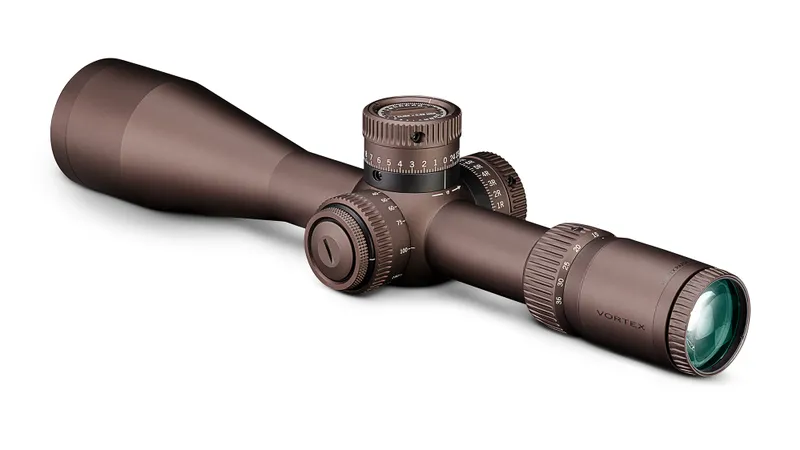
The Vortex Razor HD Gen III 6-36×56 arrives in a foam-lined hard case with all the accessories you’d expect at this price point – throw lever, lens cloth, and a detailed manual. First handling reveals a scope that means business: 48.5 ounces of machined aluminum that feels dense and purposeful rather than bulky. The 34mm main tube provides ample internal adjustment range, and the scope’s overall length of 15.3 inches fits comfortably on most precision rifle platforms without excessive overhang. The turret housing and magnification ring show precise machining with no play or wobble, and the anodizing is evenly applied with a matte finish that resists glare.
What stands out immediately is the attention to detail in the mechanical components. The locking turrets have a substantial feel with clear, tactile clicks that you can both hear and feel through gloves. The parallax adjustment knob on the left side turns smoothly through its entire range with well-defined resistance. The magnification ring requires deliberate effort to turn – which some shooters appreciate for preventing accidental adjustments, though it may feel stiff to those used to lighter scopes. The eyepiece diopter locks securely once set. At this weight and price point, you’re getting a scope built for hard use rather than mountain hunting, and the construction reflects that priority.
Optical Performance in Field Conditions
The glass quality in the Vortex Razor HD Gen III 6-36×56 delivers the clarity you’d expect from a premium optic, though it doesn’t quite reach the absolute pinnacle occupied by European alpha glass. Edge-to-edge sharpness is excellent through the mid-magnification range, with only minor softening at the periphery when pushed to 36x. The 56mm objective gathers sufficient light for shooting into late dusk, though it doesn’t provide a dramatic advantage over quality 50mm scopes in the final minutes of legal shooting light. Color rendition is neutral without the warm cast some Japanese glass exhibits, making target identification straightforward in varied lighting.
Where this scope earns its keep is in challenging conditions. Light transmission remains consistent across the magnification range without the noticeable dimming some variable scopes exhibit at higher powers. In mirage conditions common during summer prairie shooting, the image holds together well at 24-30x before heat waves become problematic – pushing to 36x in mirage is rarely productive with any scope. The scope’s resolution allows you to distinguish bullet holes on targets at 600 yards on 20-24x magnification under good conditions. In overcast or dawn scenarios, the glass performs admirably, though shooters coming from Kahles or Schmidt & Bender will notice the difference in contrast and three-dimensional image quality.
Turrets & Reticle Functionality
The turrets on this scope represent one of its strongest features. Each click delivers exactly 0.1 mil of adjustment with zero mushiness or uncertain feedback. The locking mechanism is simple and reliable – pull up to unlock, push down to lock – with enough resistance that accidental unlocking is unlikely in field use. The turret caps are generous in diameter, providing good purchase even with cold or gloved hands. Tracking tests across multiple range sessions confirmed reliable return to zero and accurate adjustment increments. The zero stop is user-adjustable and works as advertised, though the initial setup requires careful attention to the instructions.
The EBR-7C reticle in the first focal plane provides a practical balance of precision and usability. The center floating dot is fine enough for precise aiming without disappearing at lower magnifications, and the Christmas tree pattern below offers quick holdovers for wind and elevation without excessive clutter. At 6x, the reticle remains visible against most backgrounds, though the finest lines can fade against busy terrain. At maximum magnification, the reticle scales appropriately for long-range work without becoming distractingly thick. The illumination offers 11 brightness levels with several usable settings for daylight shooting. One minor complaint: the illumination dial is small and can be fiddly with gloves, and it doesn’t have an off position between each brightness setting, which means you cycle through all levels to turn it off.
Real-World Use Across Shooting Disciplines
For precision rifle shooting and PRS-style competition, the Vortex Razor HD Gen III 6-36×56 is entirely at home. The magnification range covers everything from close-range movers at 6x to reading wind at distance on 30x. The scope’s weight and size are standard for this discipline, and the generous eye box makes it forgiving when shooting from awkward positions. The reticle design supports fast target transitions and the turrets inspire confidence for dialing elevation across multiple stages. Several shooters I know run this scope in monthly matches and report zero tracking issues after thousands of rounds and countless adjustments.
For hunting applications, the scope’s suitability depends entirely on your hunting style. If you’re shooting from a blind, vehicle, or established position where weight isn’t a concern, the optical quality and adjustment range make it capable for everything from predator control to long-range western hunting. The 6x low end provides adequate field of view for closer shots. However, at over three pounds, this isn’t a scope for mountain hunting or situations requiring extended hiking with your rifle. The 56mm objective also sits high on most actions, often requiring higher rings that can affect cheek weld. Hunters who spend more time glassing than shooting might find the scope’s bulk a liability compared to lighter alternatives.
How It Compares to Direct Competitors
| Feature | Vortex Razor HD Gen III 6-36×56 | Nightforce ATACR 7-35×56 | Kahles K525i 5-25×56 | ZCO ZC527 5-27×56 |
|---|---|---|---|---|
| Weight | 48.5 oz | 48 oz | 31.4 oz | 32 oz |
| Price | $2,700-$2,900 | $3,300-$3,500 | $2,800-$3,000 | $3,400-$3,600 |
| Glass Quality | Excellent | Excellent | Outstanding | Outstanding |
| Turret Feel | Excellent | Excellent | Very Good | Excellent |
| Max Magnification | 36x | 35x | 25x | 27x |
| Eye Box | Very Good | Good | Excellent | Excellent |
Against the Nightforce ATACR 7-35×56, the Vortex offers similar performance at a lower price point. The Nightforce has a slight edge in glass clarity and proven durability in extreme conditions, but the Vortex turrets feel equally precise and the reticle options are more modern. The Nightforce’s reputation is unassailable, but you’re paying for that brand confidence. For shooters who need absolute reliability and have budget flexibility, the Nightforce makes sense. For those seeking maximum capability per dollar, the Vortex competes directly.
The Kahles K525i and Zero Compromise ZC527 represent a different philosophy – lighter weight, shorter magnification range, and in both cases, superior glass quality. The Kahles is noticeably lighter and offers the best eye box in this comparison, making it more versatile for hunting and tactical use where speed matters. The ZCO delivers glass quality that surpasses everything here, with an image that simply looks more three-dimensional and resolved. However, both sacrifice maximum magnification compared to the Vortex. If you’re primarily shooting beyond 1,000 yards and need that extra magnification for wind reading, the Vortex’s 36x becomes relevant. For most shooting under 1,200 yards, 25-27x is sufficient, making the weight savings of the Kahles or optical superiority of the ZCO worth considering despite their higher prices.
Common Mistakes When Using This Scope
The most frequent error with this scope is mounting it in rings that are too low, especially on rifles with standard-height actions. The 56mm objective requires medium to high rings on most platforms, and shooters often discover after mounting that their cheek weld is uncomfortable or that the objective bell contacts the barrel. Before purchasing rings, check the manufacturer’s ring height recommendations for your specific action and rail height. Related to this, some shooters fail to properly level the scope during installation, which becomes increasingly problematic at longer ranges where even a degree or two of cant creates significant horizontal error.
Another common mistake involves the parallax adjustment. This scope requires careful parallax correction, especially at higher magnifications and closer ranges. Shooters sometimes assume that setting the parallax knob to the estimated target distance is sufficient, but proper technique requires adjusting while looking through the scope until the reticle no longer shifts against the target when you move your eye position. At 36x, even slight parallax error can cause missed shots. Additionally, some users never explore the full magnification range and default to maximum power, when often 20-24x provides a better balance of image stability, field of view, and resolution for most practical shooting. The scope’s capability at 36x is there when you need it, but that doesn’t mean you should live there for every shot.