
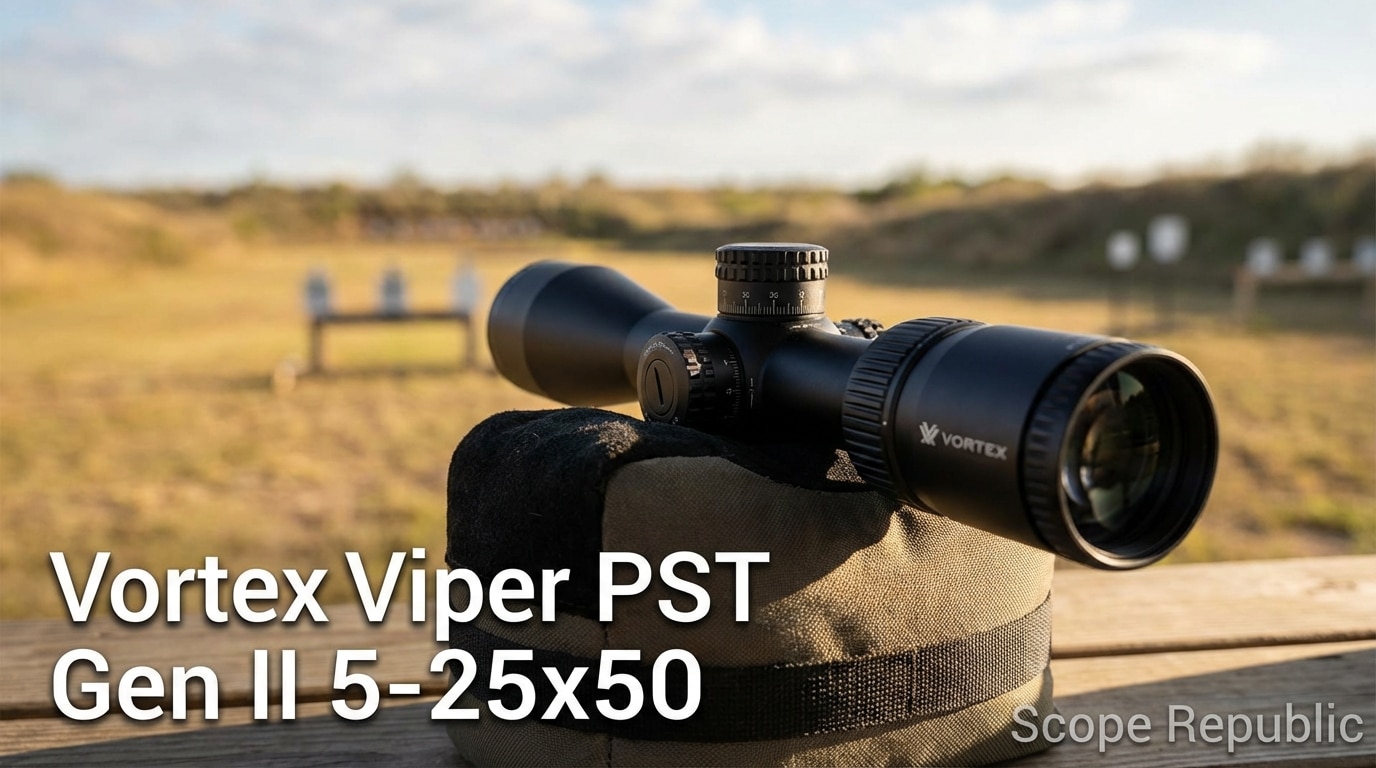
The Vortex Viper PST Gen II 5-25×50 sits in that challenging middle ground – too expensive to be a budget scope, yet priced well below the alpha-tier optics. After several months of field use across range sessions, prairie dog hunts, and long-range steel work, this scope has proven itself as a solid workhorse rather than a standout performer. It’s a scope that delivers where it counts for most shooters, though it won’t make you forget what truly premium glass looks like. For those seeking reliable tracking and decent optics without the four-figure price tag, the PST Gen II deserves serious consideration, but it’s not without compromises.
Vortex Viper PST Gen II: First Impressions & Build
The PST Gen II arrives with a substantial heft – 31 ounces isn’t light, but it’s reasonable for a 50mm objective in this magnification range. The scope tube feels solidly machined, with a matte finish that resists glare without being overly delicate. The turrets are capped on the windage side, with an exposed elevation turret featuring a zero-stop mechanism. Build quality feels appropriate for the price point – nothing rattles, the magnification ring turns smoothly with good resistance, and the parallax adjustment operates without slop. The eyepiece diopter locks securely once set.
What stands out immediately is the practical design philosophy. This isn’t trying to be an elegant European hunting scope or a bombproof tactical brick. The PST Gen II feels like a tool built by people who actually shoot – the turret height is reasonable, the throw lever attachment point is well-positioned, and the power ring has enough grip without being overly aggressive. The 30mm tube provides adequate internal adjustment range (roughly 65 MOA total elevation travel), and the scope comes with quality lens covers. At around $900-1100 depending on reticle choice, the initial impression is of competent engineering rather than corner-cutting.
Optical Performance in Field Conditions
Glass clarity is where the PST Gen II shows its price point most clearly. In good light, the image is sharp across most of the magnification range, with acceptable edge-to-edge clarity at lower powers. Center resolution is good enough for precision work out to 800-1000 yards on standard IPSC-sized targets. However, push into dawn or dusk conditions, and the limitations become apparent. The glass doesn’t gather light like scopes costing twice as much – that last 20 minutes of shooting light shows noticeably less contrast and color fidelity compared to higher-tier optics.
Chromatic aberration is present but not offensive. You’ll see some color fringing on high-contrast edges at maximum magnification, particularly in bright backlit conditions, but it’s rarely intrusive during actual shooting. The eyebox tightens considerably above 20x, requiring more precise head position – not ideal for hunting scenarios where you need to get on target quickly. Parallax adjustment is effective but requires attention; leaving it set incorrectly at higher magnifications creates noticeable image shift. For range work and deliberate long-range shooting, the glass performs adequately. For low-light hunting or mountain work where that last bit of usable light matters, you’ll wish you’d spent more.
Turrets & Reticle: Tracking and Usability
The exposed elevation turret is where the PST Gen II genuinely impresses. Clicks are tactile and audible without being mushy – 0.1 Mil adjustments feel distinct, and the turret provides consistent feedback throughout its rotation. Over multiple tracking tests (box tests and tall-target ladder tests), the scope has returned to zero reliably and tracked accurately. The zero-stop works as advertised, though the initial setup requires following the instructions carefully. Turret caps are secure without being difficult to remove, and the turret markings are clear and readable in various lighting conditions.
I tested the EBR-2C MOA reticle, which offers a practical balance between precision holdovers and a relatively uncluttered sight picture. The reticle is in the first focal plane, so holdovers remain accurate across the magnification range – essential for field shooting where you might not have time to dial. The reticle illumination has 11 brightness settings, with the middle settings being genuinely useful for low-light work without washing out the center. The Christmas-tree style lower portion provides wind holds without excessive clutter. For PRS-style shooting or hunting where you need quick wind corrections, it’s functional. If you prefer cleaner reticles for traditional hunting, the busier lower half might feel intrusive, though you can simply ignore it at lower magnifications.
Real-World Use: From Range to Rugged Terrain
On the range, the PST Gen II performs its job without drama. Dialing elevation for various distances is straightforward, and the scope handles the repetitive adjustments of long-range practice without issue. During a prairie dog hunt in Wyoming, the scope spent two days bouncing around in a truck and being set up on various improvised positions. It held zero throughout, and the magnification range proved useful – lower powers for scanning, cranking up to 20-25x for precise shots on small targets at 400+ yards. The weight became noticeable during a day of hiking with the rifle, though it’s not egregious for a scope in this class.
Where the scope shows limitations is in versatility across extreme conditions. During an early-morning antelope hunt, the glass simply didn’t provide enough brightness and contrast in that critical pre-sunrise period when animals are most active. Compared to a friend’s Leupold Mark 5HD, the difference in usable light was obvious. The scope excels in its intended role – deliberate, precision shooting where you have time to set up and conditions are reasonable. It’s less ideal for fast-moving hunting scenarios, true low-light work, or situations where every ounce matters. For shooters focused on long-range target work, steel competitions, or hunting in good conditions with a stable platform, the PST Gen II delivers solid performance at a reasonable price.
Competitive Comparison
| Scope | Price | Weight | Glass Quality | Tracking | Best For |
|---|---|---|---|---|---|
| Vortex Viper PST Gen II 5-25×50 | ~$1,000 | 31 oz | Good | Excellent | Range work, PRS on budget, general long-range |
| Athlon Ares ETR 4.5-30×56 | ~$1,300 | 35 oz | Good-Very Good | Excellent | Competitors wanting more magnification, slightly better glass |
| Burris XTR III 5.5-30×56 | ~$1,400 | 34 oz | Very Good | Excellent | Those prioritizing glass over price, more magnification |
| Leupold Mark 5HD 5-25×56 | ~$2,000 | 30 oz | Excellent | Excellent | Hunters needing low-light performance, lighter weight at larger objective |
The PST Gen II competes directly with the Athlon Ares ETR and Burris XTR III. The Athlon offers slightly better glass and more magnification for about $300 more, while weighing a bit more. The Burris XTR III has noticeably better optical quality and is worth considering if glass performance matters more than saving $400. The Leupold Mark 5HD costs nearly double but provides genuinely superior low-light performance and weighs the same despite a larger objective – if your budget allows and you hunt in challenging light, it’s a meaningful upgrade.
Who This Scope Is For – And Who Should Look Elsewhere
The Vortex Viper PST Gen II 5-25×50 is ideal for shooters who prioritize mechanical reliability and tracking accuracy over ultimate optical quality. If you’re building a precision rifle for range work, competing in local PRS matches on a budget, or need a dependable scope for long-range hunting in good conditions, this scope delivers solid value. The excellent warranty support from Vortex adds peace of mind, and the tracking performance legitimately competes with scopes costing significantly more. Shooters who dial frequently and need consistent returns to zero will appreciate what this scope offers.
Look elsewhere if low-light hunting is your primary use case – the glass simply doesn’t compete with higher-tier optics when light fades. Mountain hunters counting ounces should consider lighter options, and those who’ve experienced truly premium glass may find the optical compromises frustrating. If you rarely shoot beyond 600 yards, you’re paying for magnification and features you don’t need; a simpler 3-15x or 4-16x scope might serve you better. The PST Gen II is a competent tool that does several things well without excelling at any particular one. It’s honest performance at a fair price, which makes it easy to recommend for the right shooter, but it’s not a scope that will exceed its design parameters.
After extensive field use, the Vortex Viper PST Gen II 5-25×50 earns respect as a reliable performer within its limitations. The tracking is genuinely excellent, the build quality inspires confidence, and the price point makes precision shooting accessible without sacrificing mechanical reliability. However, the optical performance reveals its mid-tier positioning when conditions become challenging. This is a scope for shooters who understand the trade-offs and prioritize features that matter for their specific use – if that’s reliable adjustments and functional glass for range and fair-weather field work, the PST Gen II delivers. If you need the last bit of optical performance or regularly shoot in marginal light, budget another $500-1000 for a meaningful upgrade. It’s a solid choice, not an exceptional one, and sometimes that’s exactly what you need.