
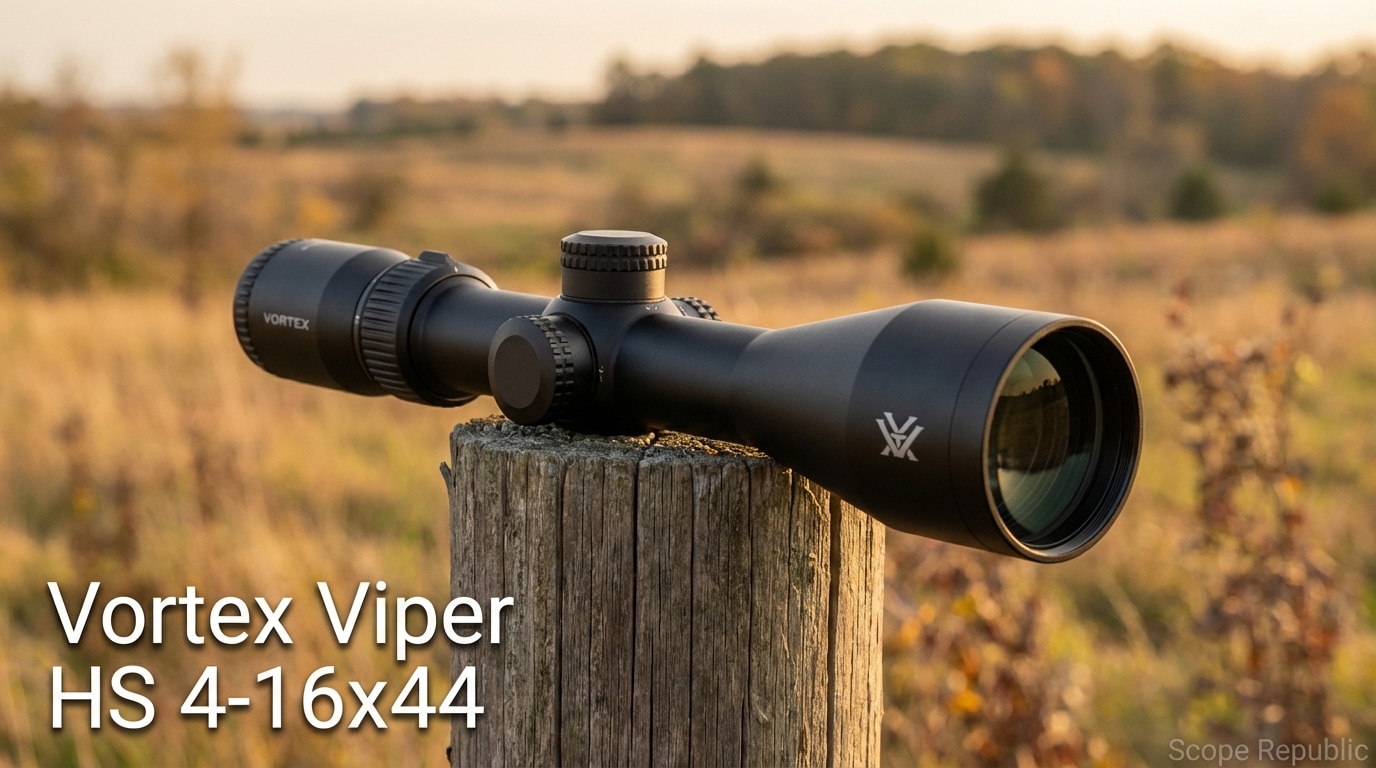
The Vortex Viper HS 4-16×44 sits in an interesting middle ground – it’s more than an entry-level scope but doesn’t carry the premium price tag of high-end European glass. I’ve spent considerable time with this optic across different environments, from whitetail stands in low light to prairie dog towns where I needed reliable tracking at distance. This review comes from actual field use, not just range impressions, and I’ll be straightforward about where it excels and where you might find it lacking. If you’re considering this scope, you’re probably weighing practical performance against cost, and that’s exactly the lens I’ll use here.
First Impressions & Build Quality Overview
Right out of the box, the Viper HS feels substantial without being burdensome. At 16.9 ounces, it’s lighter than many scopes in its magnification range, which matters when you’re carrying a rifle up a mountain or through thick timber. The tube is a standard 1-inch diameter with a 44mm objective – a sensible combination that keeps the scope low-profile without sacrificing too much light-gathering capability. The finish is matte black with good texture on the power ring and parallax adjustment, though I’d stop short of calling it exceptional. It looks professional, not flashy.
The construction is solid, with no rattles or play in any of the adjustments. Vortex builds these in the Philippines, and while that might concern some shooters who equate price with country of origin, the reality is that the manufacturing quality here is consistent. The scope is fully sealed and nitrogen-purged, and I’ve had it out in rain and temperature swings without any fogging issues. The fast-focus eyepiece locks firmly once adjusted, and the magnification ring has appropriate resistance – not too stiff, not loose enough to shift on its own during recoil.
Optical Performance: Clarity and Low Light
The optical performance is where you start to see what your money buys – and what it doesn’t. In good light conditions, the Viper HS delivers sharp, clear images with accurate color rendition. Edge-to-edge clarity is good through about 80% of the field of view, with some expected softening at the periphery, particularly at higher magnifications. This is a second focal plane (SFP) scope with fully multi-coated lenses, and the image quality is entirely adequate for hunting situations where you’re focused on a target rather than scanning landscapes. I’ve made positive identifications on deer at 400+ yards without issue.
Low light performance is respectable but not remarkable. During the last 20 minutes of legal shooting light, I could still distinguish details well enough for ethical shot placement on game, but side-by-side with premium glass, you’d notice the difference. The 44mm objective is a compromise – it keeps the scope compact but doesn’t gather as much light as a 50mm would. For most hunting scenarios, it’s sufficient, but if you’re regularly shooting in deep shadow or heavy timber at dawn and dusk, you might find yourself wishing for more light transmission. The glass won’t wow you, but it won’t let you down in typical field conditions either.
Turrets & Reticle Options Explained
The turrets on the Viper HS are target-style with exposed adjustments, offering 1/4 MOA clicks that are both audible and tactile. Each click is distinct without being overly loud – you can count them reliably even with gloves on. The elevation turret has a zero-stop feature that’s reasonably easy to set, though it requires a bit of fiddling with shims the first time. Windage is capped, which makes sense for a hunting scope where you’ll zero and mostly leave it alone. Total adjustment range is 60 MOA elevation and 60 MOA windage, which is adequate for most hunting applications out to reasonable distances.
Reticle options include the Dead-Hold BDC and a simple duplex, among others. I’ve used the Dead-Hold BDC extensively, and it’s practical for hunters who want holdover references without doing math in the field. The reticle is in the second focal plane, so the holdover subtensions are only accurate at maximum magnification (16x in this case), which you need to remember. The reticle is etched glass and illuminated on some models, with daylight-bright settings that actually work in full sun. For dialing elevation, the turrets track reliably – I’ve done box tests and tall target tests without finding any issues with repeatability or linearity.
Real-World Use: Hunting and Range Testing
I’ve used this scope primarily on a .308 Winchester for whitetail hunting and steel shooting out to 600 yards. The eye box is forgiving enough for quick target acquisition from field positions, though it tightens up noticeably above 12x magnification. The 4x magnification on the low end is genuinely useful for closer shots in brush, and I’ve comfortably taken deer inside 75 yards without feeling like I was looking through a tunnel. The parallax adjustment, which focuses from 50 yards to infinity, is smooth and has clear yardage markings that are reasonably accurate.
During extended range sessions, the scope held zero through several hundred rounds of .308 without any shifts. Tracking has been consistent – when I dial 3 MOA up, the impact moves 3 MOA. Return to zero after dialing for distance has been reliable over multiple sessions. The scope has handled recoil from the .308 without issue, and I’ve also mounted it briefly on a 7mm Rem Mag without problems. Weight distribution is good enough that it doesn’t make a rifle feel front-heavy. For a hunting rifle that might see occasional longer shots, this scope does what it’s supposed to do without drama.
How It Compares to Similar Riflescopes
The Viper HS competes in a crowded field around the $500-600 street price point. It’s worth looking at how it stacks up against direct competitors:
| Feature | Vortex Viper HS 4-16×44 | Athlon Midas TAC 4-16×44 | Leupold VX-3HD 4.5-14×40 | Burris Veracity 4-20×50 |
|---|---|---|---|---|
| Price (approx.) | $550 | $400 | $650 | $600 |
| Weight | 16.9 oz | 22.4 oz | 12.9 oz | 25.1 oz |
| Focal Plane | SFP | FFP | SFP | FFP |
| Turret Style | Exposed, 1/4 MOA | Exposed, 0.1 mil | Capped, 1/4 MOA | Exposed, 1/4 MOA |
| Glass Quality | Good | Good | Better | Good |
| Warranty | VIP Unlimited | Lifetime | Limited Lifetime | Forever |
Against the Athlon Midas TAC, the Viper HS is noticeably lighter and has a slightly better reputation for customer service, though the Athlon offers first focal plane at a lower price if that matters to you. The Leupold VX-3HD has noticeably better glass and is even lighter, but you give up exposed turrets and pay more – it’s built for a different user who prioritizes weight and optical quality over dialing. The Burris Veracity offers more magnification range and FFP, but it’s significantly heavier and the turrets don’t feel as precise.
The Viper HS makes sense if you want a balance of features: decent glass, reliable turrets, reasonable weight, and Vortex’s no-questions-asked warranty. It’s not the lightest, doesn’t have the best glass, and isn’t the cheapest, but it’s a solid all-arounder. If you know you need first focal plane or premium European glass, look elsewhere and spend more. If you’re primarily a hunter who wants the option to dial occasionally, this scope fits the bill.
Common Mistakes When Using the Viper HS
The biggest mistake I see with this scope is shooters forgetting it’s second focal plane and trying to use the BDC holdovers at magnifications other than 16x. The reticle subtensions only correspond to the advertised values at maximum power. If you’re at 8x and using the holdover marks, you’ll miss. Either dial your elevation or make sure you’re cranked to 16x before using the BDC. This isn’t unique to the Viper HS, but it’s a common source of frustration with any SFP scope.
Another issue is improper parallax adjustment. The side focus knob needs to be set correctly for your target distance, especially beyond 200 yards and at higher magnifications. I’ve watched shooters blame the scope for perceived accuracy issues when they simply hadn’t adjusted parallax. Take the time to focus the image properly – when done correctly, there should be no shift in reticle position when you move your eye around behind the scope. Also, don’t over-tighten the ring screws. The tube is aluminum and can be damaged by excessive torque. Use a torque wrench and follow the manufacturer’s specifications – usually around 18-20 inch-pounds for most quality rings.
The Vortex Viper HS 4-16×44 is a practical scope for hunters and recreational shooters who need reliable performance without emptying their wallet. It won’t impress optical snobs, and it’s not the tool for serious long-range competition, but it does the job for the vast majority of hunting situations and casual precision shooting. The warranty backs it up, the turrets work as advertised, and the weight is manageable for a carry rifle. If you’re putting together a do-everything hunting rifle that might take deer at 300 yards or shoot steel for fun on weekends, this scope deserves consideration. Just understand what you’re getting – solid middle-of-the-road performance, not premium features. For many shooters, that’s exactly what makes sense.