
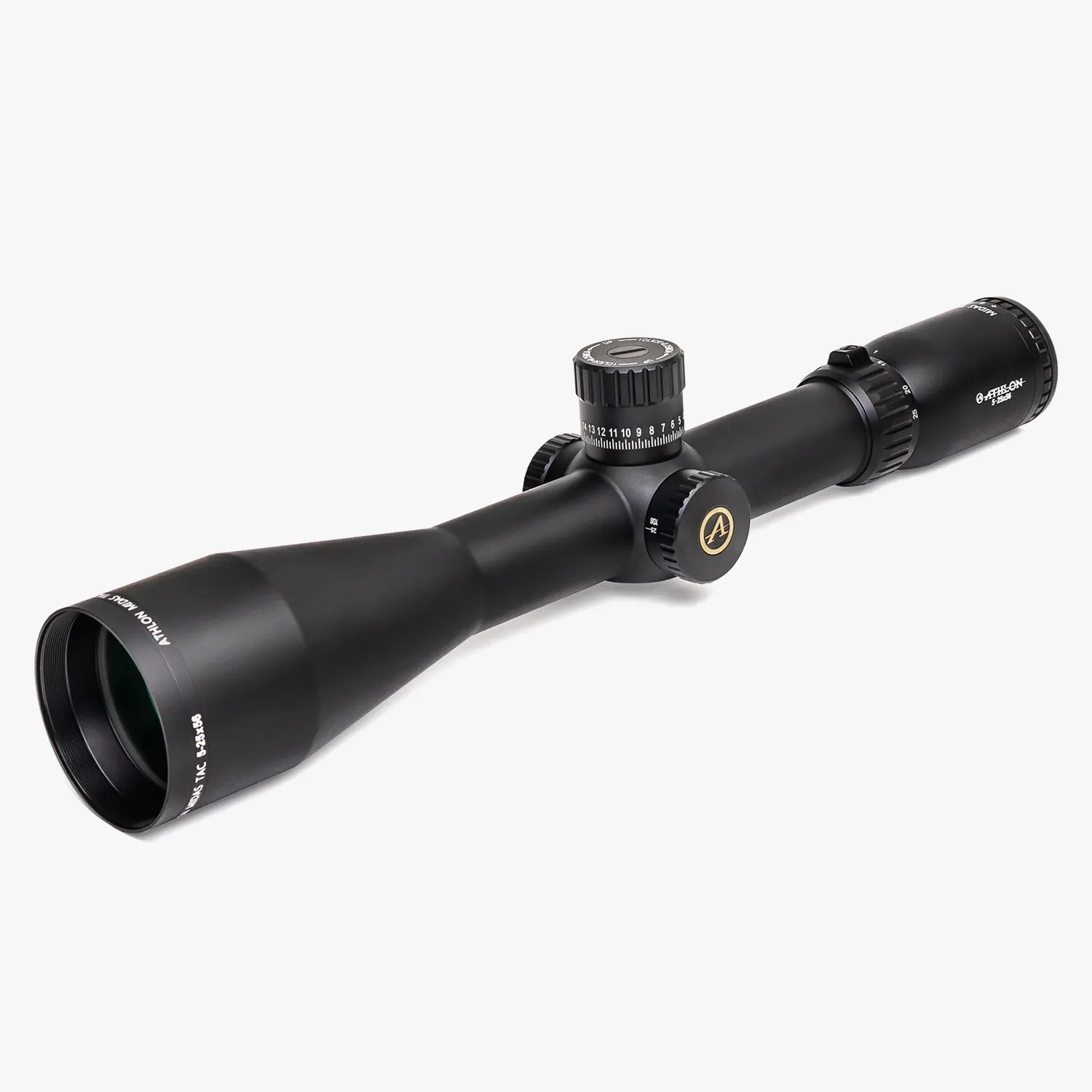
The Athlon Midas TAC 5-25×56 arrives with a solid, workmanlike presence that immediately signals its tactical and precision rifle heritage. At 31.5 inches long and weighing in at 32 ounces, this isn’t a lightweight hunting scope – it’s built for stability on heavy rifles and precision platforms. The tube is a true 34mm design, offering ample internal adjustment range (80 MOA elevation, 50 MOA windage), and the scope ships with a sunshade, throw lever, and lens covers. The anodizing is even and durable, though not quite as refined as premium European glass. The Athlon Midas TAC 5-25×56 features a side focus parallax adjustment that runs from 25 yards to infinity, and the magnification ring turns smoothly with positive detents at key magnification points.
Build quality reflects Athlon’s mid-tier positioning. The scope feels robust in hand, with no play in the turrets or magnification ring, and the eyepiece locks firmly after diopter adjustment. However, the finish and machining tolerances don’t quite match Japanese or German competitors in this price range. The scope is nitrogen-purged and O-ring sealed, and it has survived rain, snow, and temperature swings without fogging. The 56mm objective provides excellent light-gathering potential, though it does require medium to high rings on most rifles. For the price point (typically around $700-$800), the physical construction is competitive, though you can feel where Athlon saved costs compared to scopes twice the price.
Optical Performance in Field Conditions
Glass clarity in the Athlon Midas TAC 5-25×56 is respectable but not exceptional. Edge-to-edge sharpness is good at lower magnifications, with noticeable softening starting around 18x and becoming more pronounced at full 25x power. Center resolution remains usable throughout the magnification range, but chromatic aberration appears as purple fringing on high-contrast edges, particularly in bright conditions and at higher magnifications. Color rendition is neutral without the warm cast of premium European glass, which some shooters prefer for target work. In direct comparison to scopes using Japanese ED glass or European HD systems, the Athlon shows its limitations – but it’s entirely adequate for precision rifle work inside 800 yards.
Low-light performance is where the large 56mm objective should shine, and it does deliver usable twilight capability. At 25x magnification, the exit pupil is only 2.24mm, which limits true low-light advantage, but dialing back to 12-15x provides a brighter image that extends shooting time by 15-20 minutes compared to smaller objectives. The lens coatings are effective at reducing glare, though not quite as transmission-efficient as premium multi-coatings. In practical hunting scenarios at dawn and dusk, the scope performs adequately for target identification and shot placement on deer-sized game out to 400 yards. For serious low-light precision work, scopes with better glass quality will provide a clearer advantage, but the Athlon doesn’t embarrass itself in this category.
Turrets & Reticle Functionality Tested
The exposed tactical turrets on the Athlon Midas TAC 5-25×56 are the scope’s strongest mechanical feature. Both elevation and windage turrets offer crisp, audible clicks with 0.25 MOA adjustments that are easy to count by feel alone. The elevation turret features a zero-stop mechanism that’s simple to set and reliably returns to zero after dialing. Turret tracking has proven accurate across multiple box tests, with no measurable deviation over 40 MOA of travel. The turrets are tall enough to grip with gloves, and the numbers are clearly marked. Revolution indicators are visible and functional, though the turret caps add bulk. One minor complaint: the turrets feel slightly mushier than comparable Vortex or Bushnell Elite Tactical models, though they remain entirely functional.
The APLR2 FFP MOA reticle is a practical, uncluttered design well-suited to precision rifle competition and tactical applications. As a first focal plane reticle, it scales proportionally with magnification, maintaining accurate holdover values at any power setting. The reticle features a floating center dot with hash marks at 1 MOA intervals on the vertical stadia and 0.5 MOA marks on the horizontal, providing precise wind holds without excessive clutter. The reticle is etched and illuminated with 11 brightness settings, including several night-vision compatible lower settings. Illumination is daylight-bright enough for use in full sun, though the dot is small enough that older eyes may struggle to acquire it quickly at low magnification. The reticle design favors deliberate, calculated shooting over rapid target acquisition – it’s a precision tool, not a hunting reticle.
Real-World Use Across Shooting Scenarios
On a precision rifle platform chambered in 6.5 Creedmoor, the Athlon Midas TAC 5-25×56 performs exactly as its specifications suggest. At the range, dialing elevation for targets between 300 and 1,000 yards is straightforward, with consistent turret tracking and a reticle that makes wind calls simple. The scope excels in structured shooting environments where you have time to dial and confirm your zero. The large magnification range allows for detailed target observation at distance, and the FFP reticle remains useful at lower powers for closer shots. Eye box is forgiving at lower magnifications but becomes more critical above 20x, requiring precise head positioning for a full sight picture. The scope’s weight and bulk make it better suited to prone or supported shooting positions than field carry.
For hunting applications, the Athlon Midas TAC 5-25×56 works best in situations that mirror precision shooting – static positions with time to range, dial, and shoot. Western spot-and-stalk hunts, prairie dog shooting, or long-range predator calling are ideal scenarios. The scope is less suitable for quick-handling situations like driven hunts or thick-cover whitetail hunting, where the weight, length, and tactical reticle become liabilities. In variable weather, the scope has performed reliably, maintaining zero through recoil and temperature changes. After several hundred rounds on a 308 Winchester and extensive use on a 6.5 Creedmoor, the scope shows no mechanical issues or point-of-impact shifts. It’s a workhorse optic that prioritizes function over refinement.
How It Compares to Direct Competitors
| Feature | Athlon Midas TAC 5-25×56 | Vortex Viper PST Gen II 5-25×50 | Bushnell Elite Tactical XRS II 4.5-30×50 |
|---|---|---|---|
| Price | ~$750 | ~$1,000 | ~$1,300 |
| Weight | 32 oz | 31 oz | 38 oz |
| Glass Quality | Good | Better | Better |
| Turret Feel | Good | Excellent | Excellent |
| Reticle Options | 1 (APLR2 FFP) | 2 (EBR-2C, EBR-7C) | Multiple FFP options |
| Warranty | Lifetime | Lifetime (VIP) | Lifetime |
| Best For | Budget precision/training | Competition/serious hunting | Competition/tactical |
Against the Vortex Viper PST Gen II 5-25×50, the Athlon offers similar magnification range and turret functionality at a lower price point, but the Vortex delivers noticeably better glass clarity and a more refined overall package. The Viper PST’s turrets have a more positive feel, and the optical performance justifies the $250 price premium for shooters who prioritize image quality. The Vortex also benefits from broader dealer support and a more established reputation in competitive shooting circles.
Compared to the Bushnell Elite Tactical XRS II 4.5-30×50, the Athlon is significantly less expensive but also less refined in every measurable category. The Bushnell offers superior glass, better mechanical feel, and more reticle options, though it’s also heavier and costs nearly double. For serious competitors or tactical professionals, the Bushnell represents a clear step up. However, for shooters building a capable precision rifle system on a budget, the Athlon delivers 80% of the performance at 60% of the cost. The Athlon Midas TAC 5-25×56 sits comfortably in the entry-level precision market, offering solid performance without the premium price.
Common Mistakes When Using This Scope
The most frequent error with the Athlon Midas TAC 5-25×56 is using too much magnification. New precision shooters often crank the scope to 25x for every shot, which narrows the field of view, reduces light transmission, and makes mirage management difficult. For most practical shooting situations inside 600 yards, 12-18x provides a better balance of target resolution and situational awareness. The scope’s optical limitations become more apparent at maximum magnification, so staying in the 15-20x range for most shooting yields better results. Understanding when to dial back magnification improves both hit probability and shooter comfort.
Another common mistake is neglecting proper zero-stop setup and turret verification. While the zero-stop mechanism is reliable, it requires correct initial setup to function as intended. Shooters should verify turret tracking with a tall target or box test before relying on the scope for important shooting scenarios. Additionally, some users fail to account for the scope’s weight when selecting mounting solutions – cheap rings or bases will compromise the system’s accuracy potential. Use quality mounts (at least medium height to clear the 56mm objective) and properly torque all fasteners. Finally, expecting optical performance comparable to scopes costing twice as much leads to disappointment. The Athlon Midas TAC 5-25×56 is an excellent value proposition when understood as a functional precision tool, not a premium optic.