

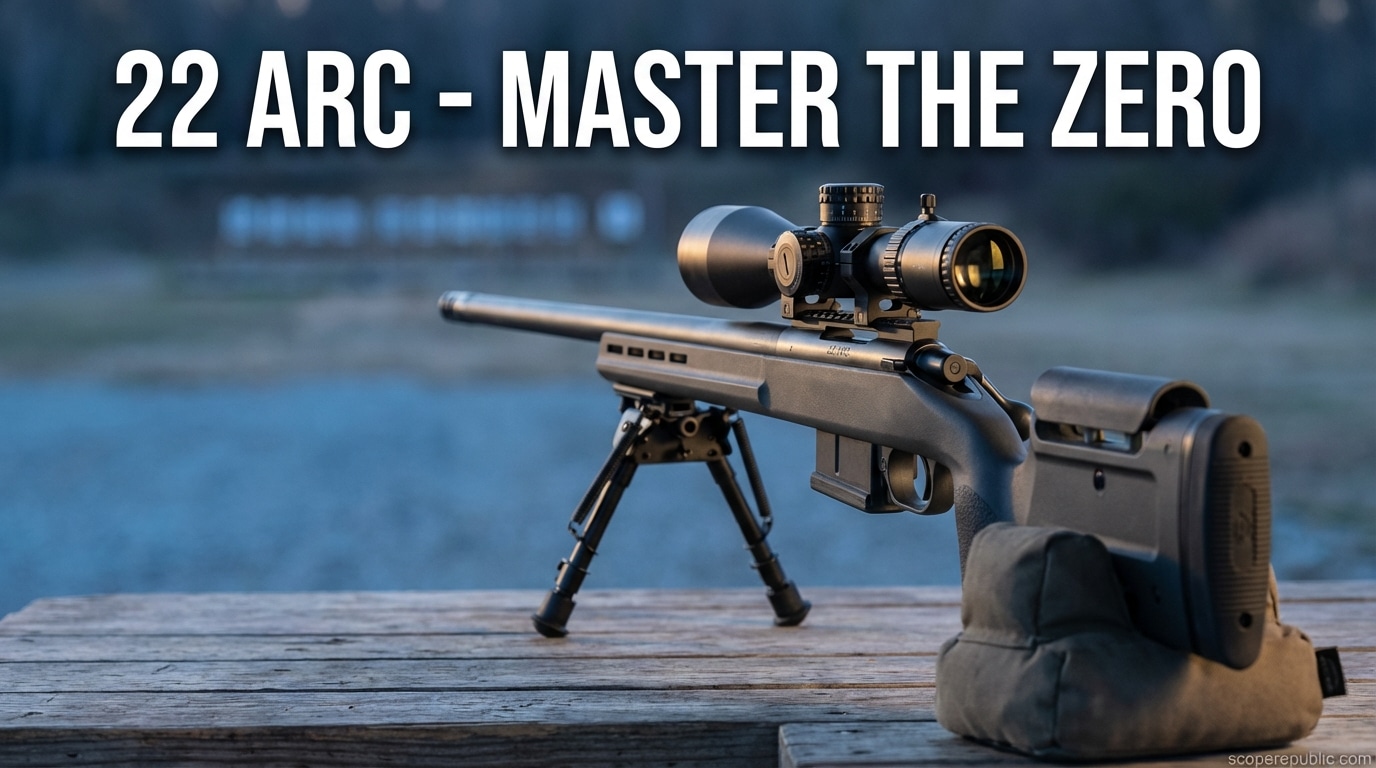
Choosing the right zero for your 22 ARC rifle is one of those decisions that looks minor on paper but has a real effect on how your rifle performs in the field. Zero at 100 yards and you’re adding unnecessary hold-over on every shot beyond 300. Zero too far out and your near-distance shots require hold-under that’s easy to misjudge.
For 22 ARC – particularly in bolt-gun form with handloads pushing 3,100+ fps – a 500-yard zero is a strong choice that keeps the bullet within a usable vertical band across a wide range of hunting and precision distances. This guide walks you through why 500 yards makes sense, how to practically get there, and what to do once you’re there.
Why 500 Yards? Understanding the Zero Logic
A zero distance isn’t just where your scope and bore axis converge. It’s also the anchor point for your entire ballistic solution. The further out your zero, the more your bullet has “caught up” its arc before you freeze the reference point – which affects the maximum height above line-of-sight during the bullet’s mid-range rise.
Here’s what a 500-yard zero looks like for bolt-run 22 ARC (80gr ELD-X, ~3,100 fps):
| Distance | Approximate Height Relative to Line of Sight |
|---|---|
| 100 yards | +5.5″ above line of sight |
| 200 yards | +7.5″ above line of sight |
| 300 yards | +5.0″ above line of sight |
| 400 yards | -1.5″ below line of sight |
| 500 yards | 0″ (zero) |
| 600 yards | -10″ below line of sight |
| 700 yards | -27″ below line of sight |
The key insight: at a 500-yard zero, the bullet stays within roughly ±8 inches of your line of sight all the way from muzzle to 400 yards. That’s a workable “point and shoot” zone for ethical hunting shots on deer-sized targets (vital zone diameter is typically 10–12 inches) without needing to hold over or under significantly at close to mid-range.
At 600 yards you’re 10 inches low and 700 yards 27 inches low – both manageable with a DOPE-based hold.
For comparison, a 100-yard zero with the same load leaves you 28 inches low at 500 yards. You’d have to know and apply your drop from scratch at every distance beyond about 250 yards. The 500-yard zero pre-loads the mid-range arc and keeps you in a flat shooting band across a wider practical range.
What You’ll Need
Before you head to the range, make sure you have:
- Your rifle with the scope fully mounted (rings torqued, scope leveled)
- A bipod or solid front rest plus a rear bag
- A boresighter (laser or collimator) – optional but speeds up the process
- A target with a 1-inch grid at 100 yards and a 6-inch grid at longer ranges
- A ballistic app loaded with your load data (Hornady 4DOF, Applied Ballistics, or similar)
- A spotting scope or high-quality binoculars for calling your own shots
- A shooting log / data book
- At minimum, access to a 100-yard range; ideally 300–500 yards for final confirmation
Step 1: Start at 25 Yards (Bore Sight)
Don’t start at 100 yards cold. Getting a rough mechanical zero at 25 yards saves you significant ammo and frustration.
Remove the bolt and look through the bore at a target 25 yards downrange. Center the target in the bore. Without moving the rifle, adjust your scope so the reticle also centers on the same target. This puts you roughly in the ballpark before you fire a single round.
If you have a laser boresighter, use it – it’s faster and you don’t need to remove the bolt.
Step 2: Confirm at 100 Yards
Set up a target at 100 yards. Fire a 3-shot group aiming at the same point each time. Don’t adjust between shots – you want to see where the group is landing relative to your point of aim.
Using your known 500-yard zero ballistic data, your 100-yard impact point should be approximately 5–5.5 inches above your aiming point for a 500-yard zero. This is the “high at 100” value pre-calculated for your load.
If you’re landing significantly below that – say, only 2 inches high at 100 yards – your scope needs to come up. If you’re hitting 8 inches high, dial down.
Use this formula to calculate your required 100-yard correction:
- Determine how many inches high you need to be at 100 yards (from your ballistic app)
- Measure where your group actually landed
- Calculate the difference in MOA or MRAD (1 MOA ≈ 1 inch at 100 yards, 1 MRAD ≈ 3.6 inches at 100 yards)
- Dial the appropriate correction on your elevation turret
Re-confirm with a 3-shot group. You’re looking for a group landing 5–5.5 inches above your point of aim. Once you’re there, you’re in the ballpark for a 500-yard confirmation.
Step 3: Confirm at 300 Yards
Moving to 300 yards first (rather than jumping straight to 500) lets you verify your ballistic model is working before committing to the longer distance.
Based on the table above, at 300 yards you should be approximately 5 inches above your aiming point. Fire a 3-shot group. If your impact is within an inch or two of that predicted value, your ballistic data and your 100-yard setup are both tracking correctly.
If you’re significantly off – say, hitting at the point of aim at 300 yards instead of 5 inches above – stop and troubleshoot before going further. Common causes: wrong BC entered in your app, muzzle velocity estimate off, scope is tracking inconsistently (test by dialing up 10 MOA and back down, confirm point of impact returns to zero).
Step 4: Dial and Confirm at 500 Yards
At 500 yards, your impact should be exactly at your point of aim. This is the zero confirmation shot.
Set up a target with a clear aiming point. Fire a 3-shot group. Adjust as needed to put the group on your point of aim. Once you’re printing a 3-shot group at or very near your aiming point at 500 yards, you have your zero.
Set your zero stop here (if your scope has one). A zero stop physically prevents the elevation turret from going below your zero position, making it fast and reliable to return to zero after dialing up for a long shot.
Record everything in your data book:
- Date
- Load (bullet weight, brand, powder, primer, COAL)
- Conditions (temperature, elevation above sea level, humidity)
- Scope settings at zero
- Observed group size
Step 5: Build Your DOPE Card
A zero is only useful if you know what to do beyond it. Once you’re zeroed at 500 yards, you need correction data for every distance you might shoot.
Run your load through a ballistic calculator using your actual field-verified muzzle velocity (chronograph data is far more accurate than manufacturer specs). Input your scope height above bore (measure physically with calipers – don’t guess), your zero distance, and environmental conditions.
Sample DOPE card: 22 ARC bolt, 80gr ELD-X, 3,100 fps, 500-yard zero (MOA / MRAD from zero):
| Distance | Dial from Zero (MOA) | Dial from Zero (MRAD) | 10 mph Wind (MOA) | 10 mph Wind (MRAD) |
|---|---|---|---|---|
| 100 yards | -5.3 MOA | -1.5 MRAD | 0.5 MOA | 0.1 MRAD |
| 200 yards | -7.2 MOA | -2.1 MRAD | 1.0 MOA | 0.3 MRAD |
| 300 yards | -4.8 MOA | -1.4 MRAD | 1.8 MOA | 0.5 MRAD |
| 400 yards | -1.4 MOA | -0.4 MRAD | 2.7 MOA | 0.8 MRAD |
| 500 yards | 0 | 0 | 3.7 MOA | 1.1 MRAD |
| 600 yards | +1.9 MOA | +0.6 MRAD | 5.0 MOA | 1.5 MRAD |
| 700 yards | +5.2 MOA | +1.5 MRAD | 6.6 MOA | 1.9 MRAD |
| 800 yards | +9.4 MOA | +2.7 MRAD | 8.5 MOA | 2.5 MRAD |
These values are approximate. Generate your own from actual chronograph data and your specific scope height.
Print this card, laminate it, and attach it to your stock or scope with a data card holder. In the field, you’ll reference it under pressure – you can’t be doing mental math when an elk is at 350 yards and moving.
When a 100-Yard Zero Makes More Sense
The 500-yard zero isn’t universal. There are valid reasons to zero at 100 yards instead:
- Factory 22 ARC in an AR-15 with a 450-yard effective ceiling. A 200-yard zero keeps the mid-range arc tight and gives you a simple -8 to -10 inch hold at 400 yards. Easier to work with when the platform itself limits your effective range.
- Shooting ranges where 500 yards isn’t available. A confirmed 100-yard zero with a well-maintained DOPE card works just as well – it just adds a step in the field.
- Hunting situations with unpredictable close-range shots. If you hunt in timber where shots inside 100 yards are common, a 500-yard zero puts you 5.5 inches high at 100 yards. That’s manageable but worth knowing about when a buck appears at 50 yards.
Checking and Maintaining Your Zero
Your zero will drift over time from recoil, temperature changes, and transport. Here’s when to check it:
- After any significant temperature swing (more than 40°F from when you last confirmed zero)
- After transporting the rifle in a vehicle, especially off-road
- At the start of every hunting season – shoot a 3-shot group at 100 yards, confirm you’re 5–5.5 inches high
- Any time a scope ring or base has been touched
- After any hard impact (dropped rifle, rough handling)
A quick 100-yard check takes three shots and five minutes. Don’t skip it.
The Bottom Line
A 500-yard zero for bolt-run 22 ARC gives you a flat, practical shooting band from muzzle to 400 yards and a clean, logical reference point for all longer-range DOPE. Getting there requires a systematic approach – start close, walk out, verify against your ballistic model, and confirm on paper at distance.
The zero is the foundation. Everything else in long-range shooting – dialing drops, reading wind, making field corrections – builds on top of it. Get this right and the 22 ARC‘s long-range potential becomes accessible and repeatable.