
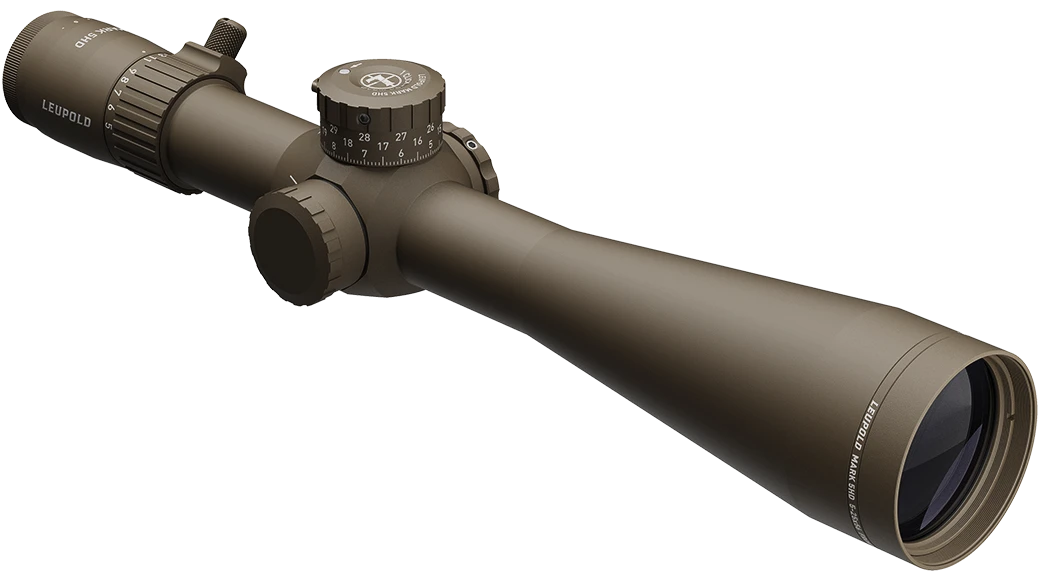
After spending extensive time behind the Leupold Mark 5HD 5-25×56 mm across multiple seasons and shooting scenarios, I can confidently say this optic represents what American manufacturing does well – though it’s not without its quirks. The Mark 5HD sits in that interesting space where serious hunters and tactical shooters overlap, offering features both groups need without fully committing to either camp. With a street price hovering around $2,400-$2,800 depending on reticle choice, this isn’t an impulse purchase, so understanding what you’re actually getting matters more than marketing promises.
The 5-25x magnification range paired with a 56mm objective lens provides genuine versatility, whether you’re glassing for elk at dawn or dialing precision shots at distance. Leupold offers this scope in both first focal plane (FFP) and second focal plane (SFP) configurations, with reticle options ranging from simple hunting designs to more complex tactical grids like the Tremor3 and H59. The 35mm main tube is becoming the standard in this class, providing more internal adjustment range than traditional 30mm tubes without the bulk of a 34mm design.
Optical Performance: Edge-to-Edge Clarity
The glass quality in the Mark 5HD genuinely impresses, particularly in low-light conditions where Leupold’s Twilight Max Light Management System earns its keep. I’ve compared it directly against European glass during late evening hunts, and while premium Zeiss or Swarovski optics still hold a slight edge in absolute clarity, the Mark 5HD stays competitive until the final minutes of legal shooting light. The edge-to-edge sharpness remains consistent across the magnification range, with minimal distortion in the outer 15% of the image – something I’ve found matters more when scanning for game than when focused on a single target.
Color rendition leans slightly warm, which I actually prefer for hunting applications as it makes animals stand out against vegetation more naturally. The 56mm objective does gather substantial light, though it’s worth noting you won’t see dramatic differences between this and a quality 50mm scope until lighting conditions deteriorate significantly. At maximum magnification (25x), image quality remains usable but does show some minor chromatic aberration around high-contrast edges – this is physics at work, not a fault of Leupold, and it’s present in competing scopes at this magnification level as well.
Turrets & Reticle: Tracking You Can Trust
The turret system is where Leupold made deliberate choices that won’t please everyone. The low-profile M5C3 turrets provide tactile, audible clicks with a satisfying mechanical feel – each 0.1 mil adjustment locks in with reassuring precision. I’ve tracked these turrets through box tests multiple times, and they consistently return to zero, even after significant recoil from magnum cartridges. The zero-stop feature works as advertised, though the initial setup requires removing the turret cap and following the manual carefully – not difficult, but definitely a task you want to do at home rather than in the field.
However, the elevation turret only provides 20 mils of total adjustment in the FFP version I tested, which feels limiting compared to competitors offering 25-30 mils in this price range. For most hunting applications out to 600-800 yards, this proves adequate, but long-range precision shooters working beyond 1,000 yards might find themselves mounting the scope in specialized rings to gain additional elevation. The parallax adjustment dial operates smoothly with clear yardage markings, though I’ve found the side focus requires more rotation than some competing designs – not a dealbreaker, but noticeable when transitioning between targets at varying distances quickly.
Real-World Use: Field-Tested Performance
I’ve mounted this scope on everything from a lightweight 6.5 Creedmoor hunting rifle to a heavier 300 Winchester Magnum precision rig, and the 30-ounce weight hits a reasonable middle ground. On a true lightweight mountain rifle under 7 pounds, the Mark 5HD does shift the balance point forward noticeably – if you’re building an ultralight backcountry setup, you might consider the smaller Mark 5HD 3.6-18x44mm instead. On a 10-12 pound precision rifle, the scope feels perfectly proportioned and doesn’t create any handling issues.
The eyebox at higher magnifications (20-25x) requires more precise head positioning than I’d prefer, particularly when shooting from awkward field positions. At hunting magnifications (6-12x), eye relief remains forgiving with about 3.6-3.8 inches of comfortable positioning. The illumination system offers multiple brightness levels that work well in varying conditions, though the brightest settings drain the CR2032 battery faster than expected—I now carry a spare as standard practice. One genuine advantage: the scope has endured temperature swings from single digits to over 90 degrees Fahrenheit, multiple rainstorms, and considerable dust exposure without fogging or losing zero.
How It Compares to Other Premium Optics
The Mark 5HD competes directly with several established options, each with distinct characteristics:
| Optic | Price | Weight | Elevation Travel | Glass Quality | Best For |
|---|---|---|---|---|---|
| Leupold Mark 5HD 5-25×56 | $2,400-$2,800 | 30 oz | 20 mils | Excellent | All-around hunting/precision |
| Nightforce ATACR 5-25×56 | $3,000-$3,400 | 38 oz | 30 mils | Excellent | Pure tactical/competition |
| Zeiss LRP S3 4-25×50 | $2,600-$3,000 | 31 oz | 29 mils | Outstanding | Precision shooting priority |
| Athlon Cronus BTR 4.5-29×56 | $1,400-$1,600 | 35 oz | 27 mils | Very Good | Budget-conscious buyers |
The Nightforce ATACR delivers more adjustment range and arguably tougher construction, but at the cost of eight additional ounces and $500-600 more. For pure tactical applications or competition shooting where the rifle stays in a case between uses, that trade makes sense. The Zeiss LRP S3 offers slightly better glass and more elevation travel with similar weight, though you’re paying a premium and losing Leupold’s legendary customer service and lifetime warranty. The Athlon Cronus provides remarkable value with competitive features at nearly half the Mark 5HD’s price, but the glass quality and mechanical refinement don’t quite match – though for many shooters, that difference won’t justify the additional cost.
Where the Mark 5HD distinguishes itself is the combination of Leupold’s warranty, American manufacturing, and that intangible reliability reputation earned over decades. I’ve had exactly zero mechanical failures with this scope across hundreds of rounds and rough handling. The warranty isn’t just lifetime – it’s transferable and doesn’t require proof of purchase, which maintains resale value better than many competitors. For hunters who need precision capability but can’t justify a dedicated long-range scope and separate hunting optic, the Mark 5HD genuinely bridges both applications better than most alternatives.
The Leupold Mark 5HD 5-25×56 mm isn’t perfect – the limited elevation travel frustrates long-range precision work, the eyebox could be more forgiving at maximum magnification, and the price positions it above budget-friendly options that perform admirably. But after extensive field use, I understand why this scope maintains its reputation. The glass quality delivers when light fades and shots matter most, the turrets track reliably after heavy recoil, and the overall package balances hunting practicality with precision capability better than most competitors. If you’re a hunter who occasionally stretches distance or a precision shooter who actually hunts with their rifle, the Mark 5HD makes sense. Pure competition shooters should probably look at the Nightforce ATACR for more adjustment range, while dedicated mountain hunters might prefer the lighter 3.6-18x44mm model. For everyone else in that broad middle ground, the Mark 5HD represents a solid investment that will likely outlast several rifles – and that’s ultimately what justifies its premium price.